Mali’s crisis: a warning for Ghana’s security strategy
The coordinated jihadist attacks that struck multiple cities in Mali on April 25, 2026, serve as a stark reminder that security challenges in the Sahel are not confined to local borders. For Ghana and its neighbors, this escalation underscores the urgent need to reassess strategies that rely too heavily on external military partnerships without addressing underlying vulnerabilities.
The fall of Kidal: a turning point in Mali’s security crisis
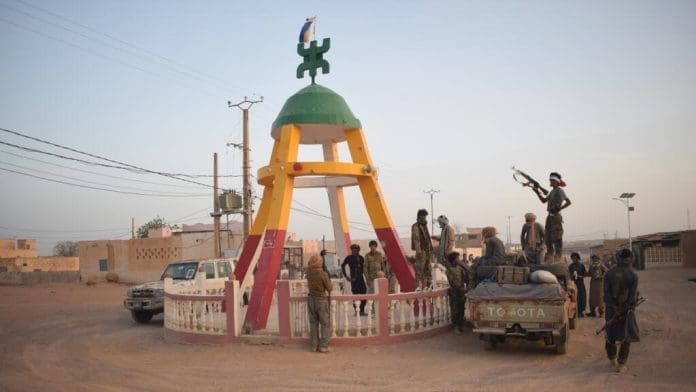
Among the most alarming developments was the sudden collapse of Kidal, a strategic city long touted by Mali’s military leadership and its Russian-backed Africa Corps as a symbol of regained control. Reports indicate that Russian-linked forces withdrew after minimal engagement, leaving Malian troops exposed. This retreat not only exposed operational weaknesses but also shattered the narrative of military progress that had been central to the partnership’s legitimacy.
The offensive, attributed to fighters linked to JNIM and the Azawad Liberation Front (FLA), targeted key locations including Bamako, Kati, Gao, Kidal, Mopti, Bourem, and Sévaré. A Russian Mi-8 helicopter was destroyed near Wabaria, while checkpoints north of the capital were overrun. The death of Mali’s Defence Minister, General Sadio Camara, and injuries to senior military figures highlighted a severe intelligence failure within both Malian forces and their Russian partners.
Russia’s response: propaganda over substance
Moscow’s reaction followed a familiar pattern. The Africa Corps claimed to have killed 1,000–1,200 insurgents and destroyed 100 vehicles, while framing the assault as a thwarted coup orchestrated by external actors. By shifting blame to alleged Western and Ukrainian involvement, Russia diverted attention from its own strategic missteps. This tactic mirrors its approach in Syria and Ukraine, where setbacks are recast as geopolitical conspiracies rather than military failures.
The intelligence lapse was particularly damning. A senior Malian official revealed that Russian forces had been warned of the impending attack three days prior but took no preventive action. The insurgents’ ability to neutralize a Russian helicopter suggests they had anticipated and prepared for aerial responses—a level of counterintelligence awareness conspicuously absent in Moscow’s and Bamako’s calculations.
Why Ghana must act now
The risks posed by Mali’s crisis are not hypothetical. Jihadist groups operating in Mali have already expanded their reach into Burkina Faso and threaten to infiltrate northern Ghana through porous borders. The Sahel’s instability fuels the spread of illicit arms, transnational crime, and economic disruption, creating conditions that erode regional resilience.
A critical flaw in Mali’s approach—and one Ghana must avoid—is the overreliance on a single external partner focused narrowly on military solutions. While Russia’s involvement brought weapons and mercenaries, it failed to address the root causes of insecurity: weak governance, economic stagnation, and the lack of community trust. A strategy that suppresses violence without tackling its foundations only displaces the problem, often to neighboring countries.
The limits of military partnerships
Russia’s engagement in Mali, like its operations elsewhere, prioritizes short-term military gains over sustainable security. With its resources stretched thin by the war in Ukraine, Moscow’s ability to sustain commitments in Africa is increasingly uncertain. For Ghana, this highlights the dangers of relying on an overstretched partner whose priorities may shift unpredictably.
Military containment alone cannot resolve the Sahel’s crisis. Without investment in infrastructure, economic development, and governance, extremist groups will continue to exploit grievances to fuel recruitment. Ghana must recognize that security begins at home but is only sustainable when paired with regional cooperation and long-term resilience-building.
Regional cooperation as a necessity, not an option
Despite political tensions, ECOWAS remains the cornerstone of West African security. However, the Alliance of Sahel States—comprising Mali, Burkina Faso, and Niger—has proven ineffective in coordinating a collective response. For now, it exists more in rhetoric than in action. Ghana and its neighbors must prioritize rebuilding regional mechanisms that ensure seamless intelligence sharing, joint operations, and border security.
Key priorities include:
- Enhanced intelligence collaboration: Establishing joint cells that integrate military, police, and border agencies to monitor high-risk corridors, particularly between Ghana and Burkina Faso.
- Leveraging international partnerships: Collaborating with organizations like the EU, US, UK, and China to access technical expertise in surveillance, cybersecurity, and strategic analysis—while ensuring transparency and accountability.
- Investing in local resilience: Redirecting resources toward economic development, education, and infrastructure to reduce the appeal of extremist narratives.
A call for self-reliance in security
The lesson from Mali is unequivocal: security cannot be outsourced. External support can bolster national efforts, but it cannot replace them. A military-first approach that captures territory without building governance, economic stability, or community trust will inevitably lead to reversals. Ghana’s security does not begin at its borders but is shaped by the choices made in Bamako, Ouagadougou, and Niamey.
The Sahel is not a buffer zone but a conduit for instability. What transpires there does not stay there. The challenge for Ghana and West Africa is to act decisively—learning from Mali’s mistakes, adapting quickly, and fostering unity. The time to strengthen regional security is not after the next attack, but before it.