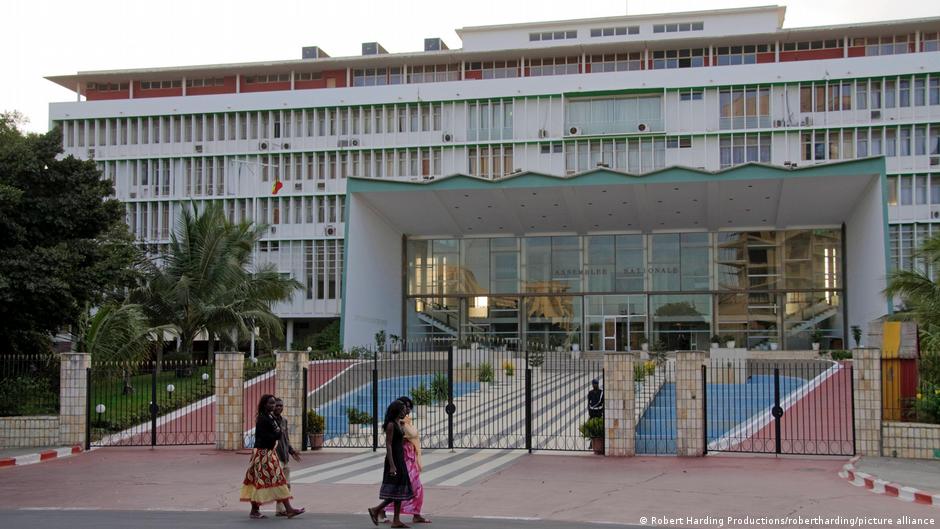
Sénégal’s constitutional revision law clears parliament in heated vote
The National Assembly has approved the constitutional revision bill with 129 votes in favor, following a contentious session marked by opposition boycotts and procedural disputes. The government’s proposed amendments were all rejected by the ruling majority.
Justice Minister Moussa Sarr represented the executive branch during the vote, defending the government’s four amendments, which sought to address what officials claimed were imbalances favoring the legislature over the presidency.
Opposition protests procedural violations
Opposition lawmakers walked out of the session after accusing National Assembly President Ousmane Sonko of violating parliamentary rules. They condemned the constitutional revision as an act of « treachery » and staged a demonstration to highlight what they described as authoritarian tendencies in the legislative process.
Aïssata Tall Sall, leader of the opposition parliamentary group, declared the protest a success, stating that it exposed the alleged dictatorship within the Assembly to the world. « Our objective was clear: to show the world that what is happening here is not democracy, but forgery. They deployed gendarmes to remove a deputy who was simply exercising his right to speak. Mission accomplished », she asserted.
Clash over institutional balance
The government’s rejected amendments aimed to curb what officials argued were excessive powers granted to the legislature, including expanded motions of no-confidence and restricted presidential dissolution powers. Minister Sarr warned that the revisions could disrupt the traditional institutional balance and undermine the country’s constitutional framework.
« This revision touches on fundamental constitutional matters and disrupts the delicate balance of our system. Allowing ten motions of no-confidence per legislature while limiting presidential dissolution to just once per term fundamentally alters our institutional equilibrium. »
Disagreements within the ruling coalition
Tensions also surfaced between President Bassirou Diomaye Faye and Assembly President Ousmane Sonko over key provisions, particularly the requirement for asset declarations at the start and end of a mandate. Sonko criticized the president for selectively adopting elements of the revision that suited his agenda while discarding others that had been agreed upon through political dialogue.
« The Constitution does not belong to Bassirou Diomaye Faye alone. He cannot unilaterally decide which commitments to honor and which to discard. We have fought together for over a decade—on what grounds does he claim the right to cherry-pick provisions? »
Sonko has urged the president to promulgate the law, while President Faye has indicated his intention to submit the text to a referendum. The proposed reforms have already sparked protests from opposition groups and civil society near the National Assembly.
Comments are closed, but trackbacks and pingbacks are open.