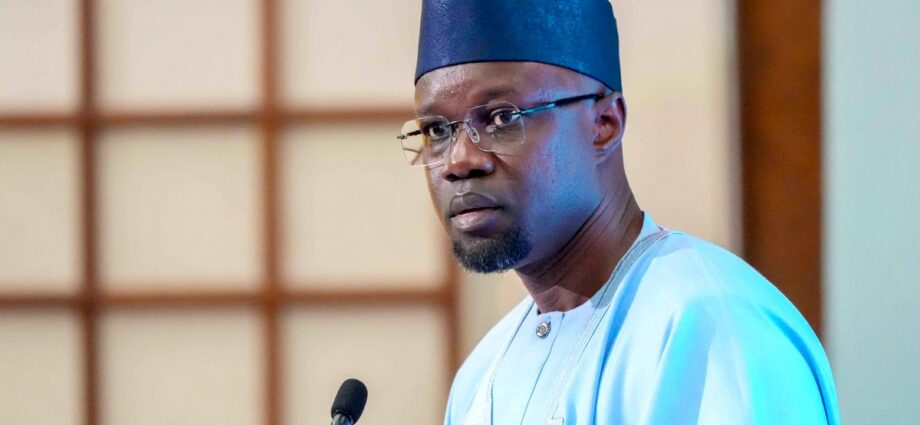
Senegal’s Debt Strategy Under Sonko: A Turning Point in Public Financing
Senegal’s public debt strategy took a decisive turn under former Prime Minister Ousmane Sonko, who between 2024 and 2026 steered the country away from conventional debt restructuring in favor of innovative financing solutions. Speaking at a press briefing, Sonko dismantled claims of indecision, asserting that neither he nor key financial leaders in his administration ever endorsed debt restructuring as a viable path forward.
« Abdourahmane Sarr, Cheikh Diba, and I stood united against restructuring—none of us supported it, » Sonko declared, naming the former economy minister and current finance minister as witnesses to his administration’s firm stance. His remarks suggest a coordinated effort to realign Senegal’s debt strategy, with President Bassirou Diomaye Faye later adopting the same position after reviewing the proposals.
Sonko’s defense underscores a broader shift in Senegal’s financial policy, one that prioritized alternative funding mechanisms over traditional debt renegotiations—a move he frames as a strategic breakthrough for the country’s economic resilience.
An Alternative Funding Mechanism Takes Shape
Facing criticism over perceived inaction, Sonko emphasized the proactive steps his administration took to mobilize financial resources. He dismissed notions of government inertia, pointing to internal discussions documented in official records that explored restructuring but ultimately rejected it as the primary solution.
« There was never stagnation—only strategic exploration, » he stated, while outlining plans for a debt guarantee fund targeting between 1.8 to 2 trillion CFA francs. This fund was designed not only to stabilize Senegal’s fiscal position but also to reduce reliance on debt restructuring by leveraging partnerships with international financial institutions.
Collaborations with key institutions such as the African Development Bank (AfDB), the West African Development Bank (BOAD), the Islamic Development Bank (IsDB), and JPMorgan were central to this plan. The goal? To secure financing without resorting to the high-stakes gamble of debt restructuring—a process Sonko argues could have placed Senegal at a disadvantage in international financial markets.
UAE Partnership Delivers $2 Billion Boost
Sonko revealed that Senegal secured a landmark agreement with the United Arab Emirates, following two high-level visits to Abu Dhabi. The deal, valued at nearly $2 billion, combines favorable financing terms with targeted investments in local infrastructure, including the development of a business hub on the former French military site in Mermoz.
According to Sonko, the first tranche of $1 billion was earmarked for release in February 2026, with $900 million allocated to financial operations and $100 million designated for the Mermoz project. While Sonko claims documentation exists to support these figures, the full verification of amounts, terms, and disbursements remains pending.
« The resources are real, the agreements are signed, and the momentum is undeniable, » he asserted, framing the UAE partnership as a testament to Senegal’s growing appeal as an investment destination.
Why Restructuring Wasn’t the Answer
Sonko’s rejection of the G20 Common Framework for debt treatment reflects a broader critique of external financial interventions that he believes would have placed Senegal at a disadvantage. « We refused to be Guinea Pigs in a new system, » he stated, arguing that Senegal’s challenges were solvable through liquidity management and targeted financial support rather than systemic debt overhauls.
He cited remarks attributed to the International Monetary Fund (IMF) Managing Director, who reportedly acknowledged Senegal’s strong fundamentals as justification for exploring alternative financing routes. Sonko’s position suggests a belief that Senegal could achieve economic recovery without sacrificing sovereignty or subjecting itself to the uncertainties of debt restructuring.
Unanswered Questions and the Path Forward
While Sonko’s claims paint a picture of decisive financial leadership, key questions linger. Were the financing agreements formalized? Have the promised funds from the UAE been disbursed in full? And could the proposed mechanisms have sustained Senegal’s long-term fiscal health?
The absence of public documentation and third-party verification leaves room for scrutiny. However, Sonko’s narrative frames his tenure as a pivotal moment in Senegal’s economic history—one defined by bold choices and a refusal to conform to conventional financial constraints.
For now, the full impact of his strategy remains to be seen. But one thing is clear: Senegal’s approach to public debt has entered uncharted territory, with Sonko’s tenure marking a turning point in the nation’s pursuit of financial independence.
Comments are closed, but trackbacks and pingbacks are open.