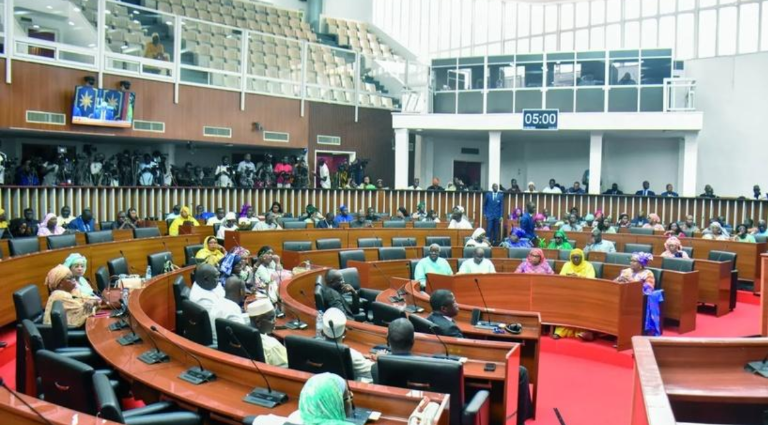
Rejection of 2026 budget bill sparks institutional standoff
The political rift between Senegalese President Bassirou Diomaye Faye and his former party has now escalated into a full-blown institutional crisis. On November 3, 2026, the National Assembly rejected the draft rectified finance law for 2026, delivering a sharp blow to the government. Behind the budget vote lies an escalating confrontation between the executive branch and a parliamentary majority controlled by the Pastef party led by Ousmane Sonko.
The parliamentary session saw the adoption of a preliminary motion to reject the bill, with 109 votes in favor, 20 against, and three abstentions, out of 132 participating deputies. The motion, proposed by Pastef deputy Amadou Ba, effectively blocked further discussion of the government’s budget proposal.
Parliamentary majority challenges executive authority
This rejection highlights deepening tensions between the executive and the parliamentary majority, both historically aligned but now at odds. While President Faye heads the government, former Prime Minister Sonko—now President of the National Assembly—leads the dominant party in parliament. Their once-collaborative relationship has deteriorated since Sonko’s departure from the premiership in May 2026.
The Pastef holds a strong majority in the Assembly but no longer supports the government’s agenda unconditionally. The rejection of the rectified budget bill underscores this shift, demonstrating that the executive can no longer take parliamentary backing for granted, even on economic matters.
Budget disagreements reflect broader policy disputes
Key disputes focus on fiscal credibility, debt management, and public spending priorities. The government’s revised budget projects revenue of 5,848.7 billion CFA francs—down from an initial 6,188.8 billion—while spending is estimated at 7,583.9 billion, pushing the deficit to 7.6% of GDP from an originally planned 5.4%.
Critics within the Pastef caucus argue that the government has failed to justify its fiscal adjustments, particularly cuts of 555 billion CFA francs in investment credits. The Economy and Finance Ministry, led by Cheikh Diba, maintains that all requested data—including details on energy subsidies, family security grants, and priority spending—was provided before the vote.
This clash reflects two competing visions: a government prioritizing rapid fiscal adjustment to economic realities, and a parliament asserting its oversight role in budgetary decisions.
Economic and international implications of the budget deadlock
The political impasse carries serious economic consequences. Senegal is negotiating a new financing program with the International Monetary Fund (IMF), where approval of the rectified budget bill plays a critical role. The rejection complicates these negotiations and increases uncertainty around securing essential state funding.
Domestically, delays in budget approval risk disrupting public payments to contractors, suppliers, and key sectors, potentially straining state finances further. The crisis thus transcends political posturing, directly impacting the country’s economic stability and investor confidence.
Institutional limbo raises questions about Senegal’s future
While Senegal is not formally in a cohabitation scenario, the current setup mirrors its core tensions: an executive branch operating without reliable parliamentary support. The November 3 vote raises a crucial question: how far can the conflict between two factions of the same political movement escalate before institutional functioning becomes unsustainable?
With no clear resolution in sight, the government must seek alternative paths to break the deadlock, while Pastef deputies show no signs of backing down on their demands. One thing is certain: the rejection of the 2026 rectified budget marks a turning point in Senegal’s political landscape, reshaping the balance of power between Bassirou Diomaye Faye and Ousmane Sonko within the heart of the Republic’s institutions.
Comments are closed, but trackbacks and pingbacks are open.