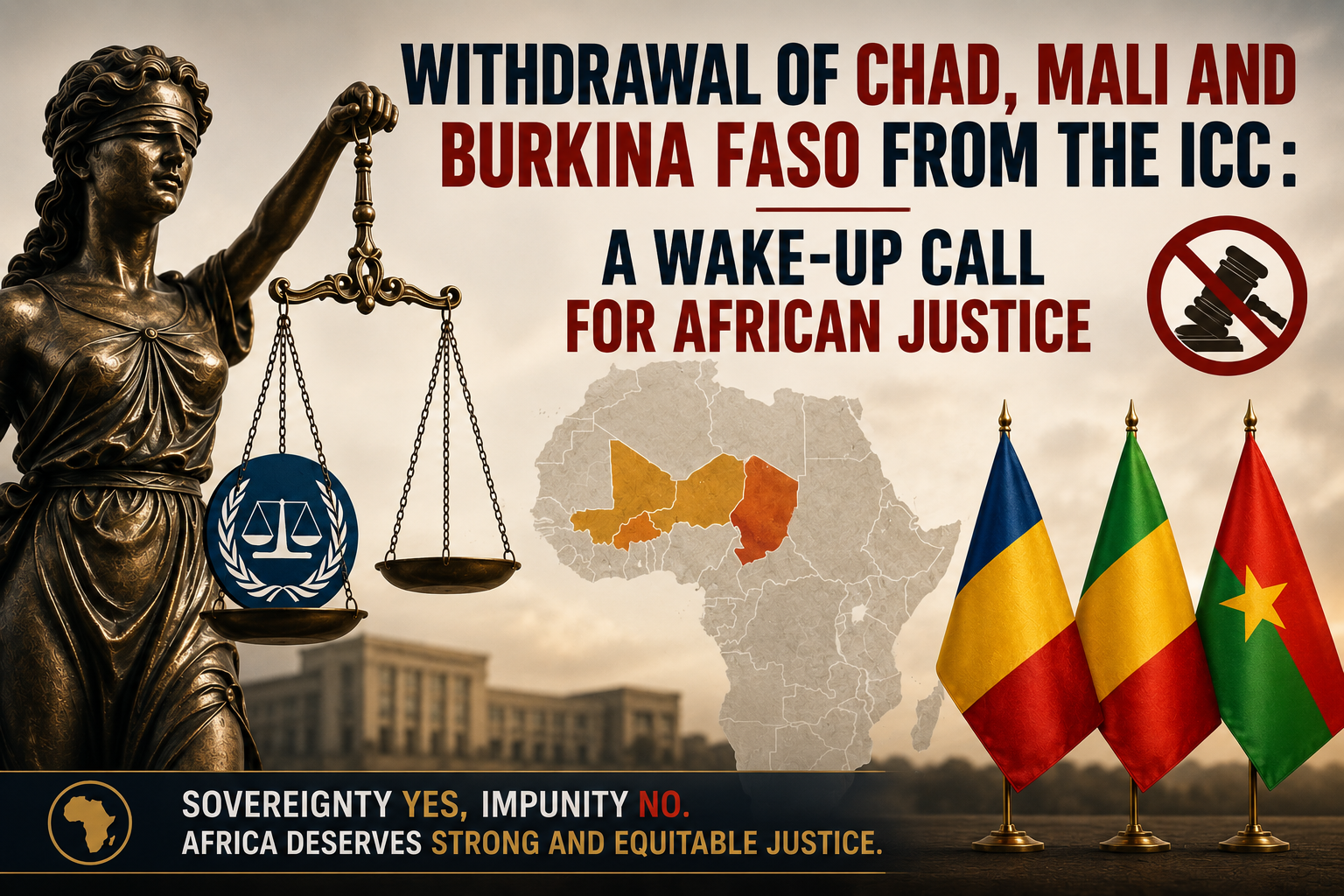
Withdrawal from the ICC signals deeper judicial challenges in the Sahel
Chad’s recent decision to withdraw from the Rome Statute of the International Criminal Court (ICC) has intensified discussions on the continent’s evolving approach to international justice. This move follows similar declarations from Mali, Burkina Faso, and Niger, all citing concerns over the Court’s perceived ineffectiveness and what they describe as an unequal application of international law.
The withdrawal of these four Sahelian nations is not merely a legal dispute with The Hague it reflects a broader crisis of trust between African governments and international judicial institutions. Yet, this development raises a critical question: what safeguards are in place when states withdraw from global justice mechanisms without first establishing robust national and regional alternatives?
Beyond criticism: the legitimacy of ICC concerns
The governments in question justify their withdrawal on the grounds of national sovereignty, arguing that the ICC’s track record particularly its focus on African cases demonstrates a lack of impartiality. While these criticisms are not without merit, they must be examined within the broader context of international justice.
The ICC has long faced scrutiny over its selective enforcement, limited resources, and perceived political influence. However, abandoning the Court does not resolve the underlying issue: the ongoing prevalence of war crimes, crimes against humanity, and grave violations of international law. These crimes persist regardless of a state’s participation in the Rome Statute.
The peril of judicial void in conflict zones
The withdrawal from the ICC is particularly alarming in regions plagued by armed conflict. Reports from human rights organisations have documented systemic abuses by both armed groups and state forces in Mali, Burkina Faso, Niger, and Chad. The potential loss of ICC jurisdiction could leave victims without recourse to justice, truth, or reparations.
While a strong national judiciary could theoretically fill this void, the reality is often different. Many Sahelian states lack independent courts, adequate investigative resources, and protections for witnesses and victims. Without these safeguards, sovereignty risks becoming a shield for impunity rather than a foundation for justice.
The legal reality of withdrawal
It is crucial to clarify that withdrawal from the ICC does not immediately absolve states of all obligations. The Rome Statute includes a one-year transition period following notification, during which the withdrawing state remains bound by its legal duties. Additionally, the ICC retains jurisdiction over crimes committed before the effective withdrawal date.
This nuance underscores that exiting the ICC is not a quick fix for accountability. It also raises a pressing question: after withdrawal, what mechanisms will ensure that alleged perpetrators of international crimes do not evade justice?
The promise and limits of African justice
Proponents of withdrawal often advocate for a continent-led judicial system, one that is more responsive to African contexts. While this vision is theoretically sound, its implementation remains unproven. A credible African justice system must meet several key criteria:
Independence from political interference, ensuring magistrates can operate without fear of retribution.
Comprehensive jurisdiction, covering all parties in conflict, including state actors.
Victim-centred procedures, guaranteeing access to justice, reparations, and witness protection.
Sustainable institutional capacity, with trained personnel, secure funding, and regional cooperation.
The Hissène Habré trial demonstrated that African-led justice is possible. However, scaling this model into a permanent, continent-wide system requires more than political rhetoric—it demands concrete action.
The political risks of judicial withdrawal
The timing of these withdrawals is particularly concerning. In several Sahelian nations, concentration of power and shrinking civic spaces raise doubts about the commitment to judicial independence. If a government withdraws from the ICC to escape accountability, it must simultaneously prove that its domestic systems are more transparent and rigorous than the international alternative.
Otherwise, sovereignty becomes a one-sided argument: a justification for rejecting external oversight, but not for ensuring justice for citizens.
The human cost of weakened justice
For families displaced by conflict, survivors of sexual violence, or communities targeted by armed groups, the debate over the ICC may feel abstract. Yet, the absence of a robust judicial mechanism leaves them vulnerable. While the ICC is not flawless its proceedings are often slow and politically constrained it serves as a critical safeguard against complete impunity.
The gradual erosion of this safety net could have devastating consequences for victims who have already endured unimaginable suffering.
A system at a crossroads
The ICC itself is facing institutional challenges, including leadership transitions and mounting international pressure. Each withdrawal further diminishes the Court’s geopolitical influence and weakens the principle of universal justice.
If states begin to view international institutions as acceptable only when they serve their interests, the very concept of shared legal norms risks collapse. Justice cannot be credible if it is applied selectively.
The path forward: building credible alternatives
The withdrawal from the ICC should not be an endpoint it must be a catalyst for stronger domestic and regional justice systems. To prove their commitment to sovereignty, Sahelian governments must:
Strengthen national courts with independent magistrates and sufficient resources.
Document crimes systematically, ensuring evidence is preserved for future prosecutions.
Protect witnesses and victims, shielding them from retaliation.
Establish regional mechanisms capable of addressing transnational crimes.
The true test of sovereignty lies not in rejecting international oversight, but in demonstrating that domestic systems can deliver justice without fear or favour. Until then, the victims of war crimes and atrocities will remain the first casualties of this judicial retreat.
The debate over the ICC should not pit African sovereignty against international justice. Instead, it must focus on a single, urgent question: how can Africa and the world ensure that no individual, regardless of power or position, is above the law?
Comments are closed, but trackbacks and pingbacks are open.