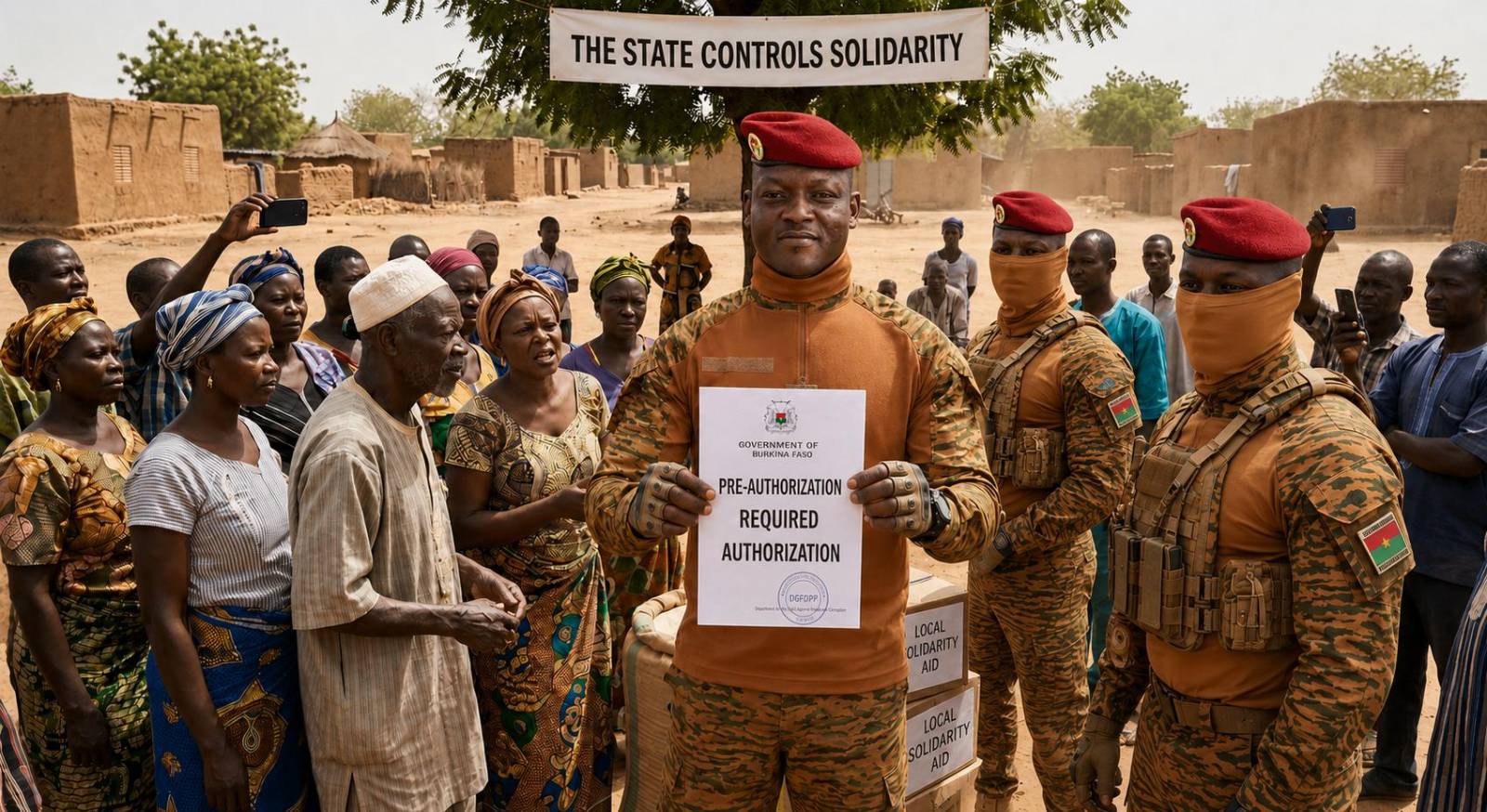
The State’s Grip on Humanitarian Aid: A New Regulatory Framework
The Ministry of Solidarity in Burkina Faso has introduced sweeping changes to charitable practices, mandating prior administrative authorization for all humanitarian initiatives. This move, framed as a safeguard against digital voyeurism and undignified public appeals, raises a critical question: can altruism itself become a regulated offense?
At first glance, efforts to curb abuses on social media may appear justified. The rapid spread of online fundraising campaigns has, at times, exploited human suffering for visibility or financial gain. However, the blanket imposition of state oversight risks conflating legitimate grassroots initiatives with potential malfeasance. By requiring pre-approval for every act of solidarity, the government effectively criminalizes spontaneous generosity, turning compassion into a bureaucratic transaction.
A Threat to Civic Autonomy and Grassroots Solidarity
Historically, Burkina Faso’s humanitarian landscape has thrived on the agility of its citizens, religious communities, and diaspora networks. These actors often respond to crises long before state institutions can mobilize. The new regulations, however, threaten to stifle this organic solidarity by subjecting it to a labyrinth of administrative procedures. The principle of individual freedom—central to civic engagement—is undermined when every charitable act demands government validation.
This shift reflects a broader trend: the state’s growing suspicion of autonomous civil society. Under the current transitional leadership, even well-intentioned initiatives are viewed through a lens of control, as if benevolence outside state purview constitutes a challenge to authority. Such a mindset fosters an environment of mistrust between citizens and institutions, eroding the social fabric that has long sustained Burkina Faso through adversity.
The Paradox of Dignity and Regulatory Overreach
The government defends its policy as a means to protect the dignity of vulnerable populations, arguing that public appeals for aid degrade human worth. Yet this perspective overlooks a harsh reality: restricting visibility does not eliminate suffering; it merely silences those in need. True dignity lies not in concealing distress but in ensuring timely assistance—whether through regulated or spontaneous channels—while upholding ethical standards and transparency.
A balanced approach, combining ethical oversight with respect for civic initiative, would better serve both humanitarian principles and public trust. Instead, the new framework risks reducing solidarity to a cold administrative process, leaving those in urgent need without recourse.
Humanitarian Crises and the Cost of Bureaucratic Delay
Burkina Faso faces escalating security and humanitarian challenges, from mass displacement to food insecurity. In such contexts, the speed of response is paramount. Yet the requirement for prior authorization creates a dangerous bottleneck. Medical emergencies, sudden population displacements, and acute food shortages cannot wait for ministerial approvals to be processed. While bureaucratic wheels turn, lives hang in the balance.
This policy also disregards the limitations of the state itself. Burkina Faso’s administrative apparatus lacks the financial, human, and logistical resources to replace the rapid, decentralized aid networks that have historically filled gaps in public services. By stifling grassroots initiatives, the government not only fails to address urgent needs but actively deepens vulnerabilities. The so-called “solidarity of the bush”—the lifeline connecting cities, villages, and the diaspora—risks unraveling under the weight of excessive regulation.
The Long-Term Consequences: A Society of Hesitant Generosity
The chilling effect of these regulations cannot be underestimated. Fear of sanctions or administrative burdens may deter individuals from offering help, transforming a culture of generosity into one of caution. A society where citizens hesitate to act out of self-preservation is a society where social cohesion frays—and where the most vulnerable are left without lifelines.
Ultimately, this policy embodies a dangerous paradox: in the name of protecting dignity and preventing abuse, it strips away the very mechanisms that sustain Burkina Faso’s resilience. A state that monopolizes compassion risks becoming an obstacle to the humanity it claims to uphold. The path forward lies not in rigid control but in collaborative governance that empowers both institutions and citizens to act in the best interests of the people.