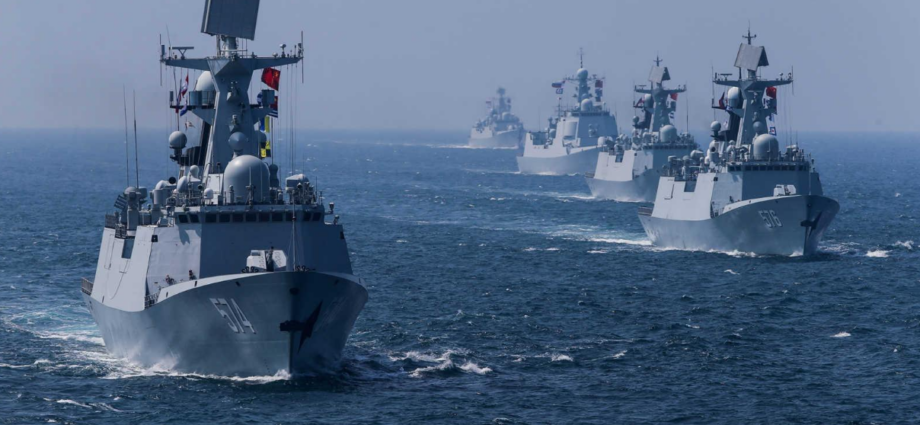
The Pacific is heating up as China stages its largest naval exercise near Taiwan in years. Over 100 vessels from the Chinese military and coast guard were deployed in early November in waters surrounding the island, according to Taiwanese security sources. The mobilization reportedly included warships and coast guard boats from the Northern, Eastern, and Southern fleets, with exercises simulating attacks on military targets and coastal cities.
China’s massive naval demonstration raises regional concerns
The operation, which unfolded without prior official announcement from Beijing, extended beyond the Taiwan Strait into a broader section of the western Pacific. Taiwanese authorities tracked approximately 70 Chinese ships near the first island chain as of November 13, signaling a sustained presence rather than a brief maneuver. Analysts point to the scale and coordination of the deployment as a potential test of China’s ability to restrict access to Taiwan in a future crisis.
Potential strategy to isolate Taiwan
Experts warn that these exercises could serve as a rehearsal for a naval blockade, cutting off Taiwan’s maritime and air routes to disrupt imports and deter foreign military intervention. Such a move would align with Beijing’s broader goal of exerting pressure without launching a full-scale amphibious assault. Reports from the Institute for the Study of War suggest the drills may mirror denial-of-access and isolation scenarios that could be activated in the event of escalation.
US nuclear detection aircraft spotted as tensions escalate
On November 15, a specialized aircraft linked to the US Air Force was detected in the Taiwan area. The WC-135R Constant Phoenix, known for its “Nuclear Sniffer” capabilities, took off from Okinawa and flew a route passing south of Taiwan toward the southwestern approaches of the Taiwan Strait. The aircraft’s primary role is to detect atmospheric traces of radioactive materials, typically used to monitor nuclear tests or radiological incidents.
Is this a routine mission or strategic surveillance?
While the timing of the flight coincides with China’s naval maneuvers, no official confirmation has been provided regarding its specific objectives. The absence of public disclosure leaves room for multiple interpretations: it could be a routine nuclear monitoring mission, part of broader intelligence-gathering efforts, or a direct response to Beijing’s military activities. The US base at Kadena in Okinawa serves as a critical hub for regional air operations, reinforcing the significance of such flights.
Global stakes of a Taiwan Strait crisis
The strategic importance of Taiwan extends far beyond its immediate geography. The island is a linchpin in global semiconductor supply chains, a fact that amplifies the risks of any conflict. A prolonged disruption in the strait could destabilize trade, trigger supply shortages, and heighten tensions between major powers. Both the US and Japan have reiterated their commitment to regional security, making Taiwan a focal point in broader geopolitical rivalries.
What’s next in the escalating standoff?
At this stage, there is no indication that a Chinese military intervention is imminent. However, the combination of large-scale naval drills, potential blockade scenarios, and heightened US surveillance paints a picture of a Pacific region increasingly shaped by strategic rivalry. Observers caution that every military movement in these waters is now under intense scrutiny, as the margin for miscalculation narrows.
One thing remains clear: the western Pacific is a powder keg of geopolitical tension. In this high-stakes environment, clarity on intentions is scarce, and every maneuver carries the weight of potential consequence.
Comments are closed, but trackbacks and pingbacks are open.