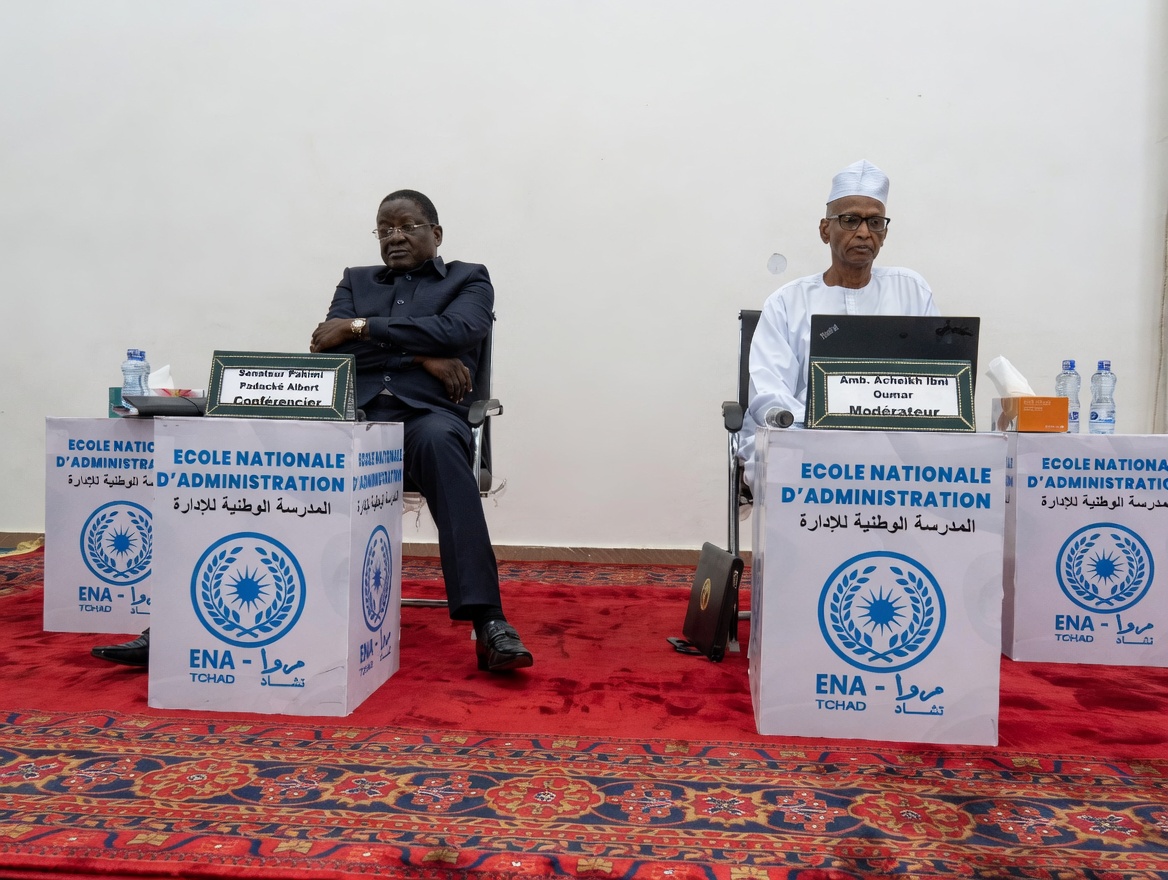
The École Nationale d’Administration (ENA) in Chad hosted a high-profile conference-debate this past Friday, May 29, featuring former Prime Minister and current Senator Albert Pahimi Padacké. Centered on the theme «Decentralization as a driver of local development: the role of provincial councils», the event drew a packed audience of students, civil servants, administrators, and political leaders.
Albert Pahimi Padacké, a seasoned politician with decades of experience in government and public administration, delivered a structured and insightful presentation that resonated deeply with participants. He opened by emphasizing the timeliness of the discussion, framing decentralization not just as a policy issue, but as a cornerstone of equitable and participatory development across Chad’s provinces.
The former Prime Minister anchored his remarks in Chad’s historical and constitutional context. He traced the roots of decentralization to the 1993 Sovereign National Conference, which laid the foundation for a unitary yet highly decentralized state. This vision was later enshrined in the 1996 Constitution and reaffirmed in the 2023 Constitution of the Fifth Republic, reflecting a national commitment to empowering local governance.
Pahimi Padacké structured his analysis around three critical dimensions:
- Political and normative foundations: Decentralization as a legal and institutional framework for development.
- Existing challenges: Why provincial councils are still struggling to fulfill their mandate.
- Pathways to progress: How to transform these councils into engines of local development.
He highlighted key constitutional principles, including the principle of subsidiarity—enshrined in Article 271—which mandates that decisions be made at the most local level possible. Recent organic laws, such as Law No. 14 of 2024 on the status of autonomous collectivities and Law No. 28 of 2024 on the distribution of competencies between the central state and local authorities, have formally transferred significant powers to provincial councils. Yet, implementation remains uneven, with critical gaps in enabling legislation and operational guidelines.
The speaker did not shy away from addressing the harsh realities on the ground. He identified systemic bottlenecks: delayed transfers of financial and human resources, weak technical and administrative capacity within provincial administrations, governance gaps, and coordination failures between decentralized state services and elected local bodies.
In closing, Pahimi Padacké outlined a roadmap for meaningful reform. He called for the immediate and full transfer of allocated resources—including oil and tax revenue shares—rapid capacity-building for elected officials and civil servants, the establishment of robust monitoring and evaluation systems, and stronger involvement of civil society and development partners. Above all, he stressed the need to uphold the principle of subsidiarity not as a slogan, but as a lived practice.
With a clear message to the next generation of administrators, he urged them to internalize these imperatives, noting that only a genuine decentralization process can ensure balanced national development and bring government closer to the people.