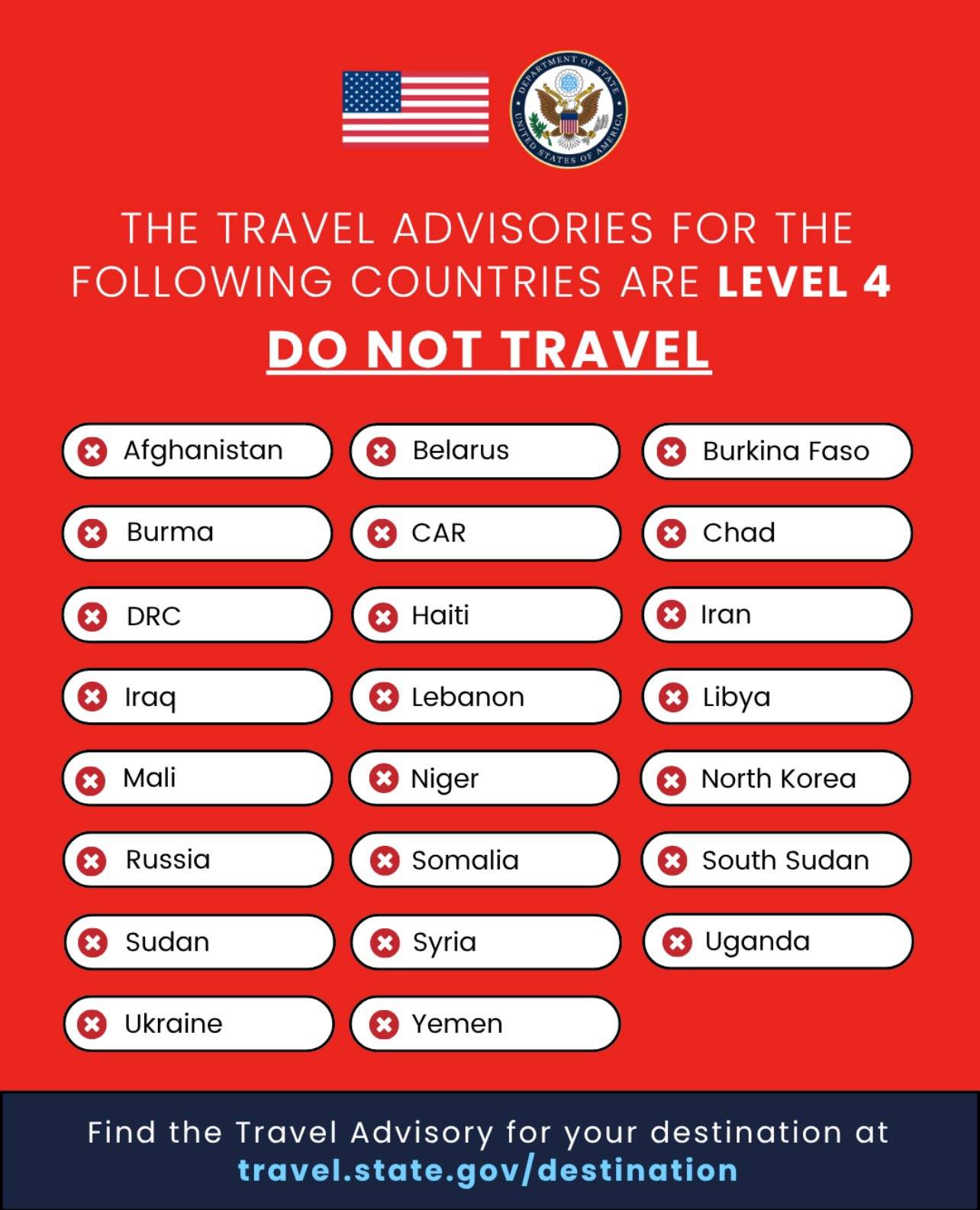
The United States Department of State has once again updated its global travel advisory, placing 23 countries under its highest risk category—Level 4, “Do not travel.” Among the nations facing this severe warning are Russia, the Democratic Republic of Congo, and Chad, but the focus remains squarely on the three Sahel nations that form the Alliance of Sahel States (AES): Burkina Faso, Mali, and Niger. Washington’s decision underscores an unprecedented deterioration in security and the relentless expansion of terrorist networks across this volatile sub-Saharan belt, now widely regarded as the epicenter of global instability.
Level 4 alert: what it means for travelers and diplomats
The U.S. government’s four-tier travel advisory system serves as a clear warning system for American citizens abroad. A Level 4 designation is not merely advisory—it is a stark prohibition. The State Department strongly urges all U.S. nationals to avoid travel to these countries entirely. More concerning, however, is the limited capacity of American diplomatic missions to provide emergency assistance, including consular or medical support, due to the withdrawal of non-essential personnel from high-risk zones.
This latest update paints a stark picture of a world where large regions are slipping beyond the control of central governments, exposing Western nationals to grave risks such as kidnapping, armed attacks, or hostage situations.
The AES under siege: Burkina Faso, Mali, and Niger in Washington’s crosshairs
The joint inclusion of Burkina Faso, Mali, and Niger in the Level 4 category reflects a deepening crisis that has gripped the region. These nations, now allied under the Alliance of Sahel States (AES), are navigating profound challenges: military-led transitions, a strategic realignment away from traditional Western partners, and a rapid erosion of state authority in borderlands and remote areas.
The roots of this instability are complex. Chronic underdevelopment and systemic poverty have created fertile ground for armed groups to recruit disenfranchised youth. Meanwhile, the withdrawal of Western military forces—often replaced by new security partnerships, including with Russia—has left a power vacuum that terrorist organizations are exploiting with alarming efficiency.
Terrorism on the march: borders no longer a barrier
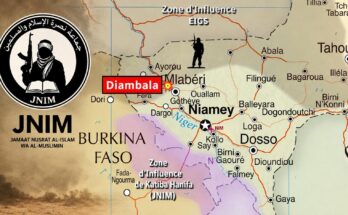
Washington’s justification for the Level 4 alert hinges on the accelerating geographic expansion of terrorist networks. Groups such as the Group for the Support of Islam and Muslims (JNIM), affiliated with Al-Qaeda, and the Islamic State in the Greater Sahara (EIGS) are no longer confined to remote desert sanctuaries. They now launch coordinated offensives and steadily extend their influence across the region.
Burkina Faso: a nation under siege
Burkina Faso bears the brunt of this asymmetric warfare. Large swaths of the country are either under militant control or encircled by blockades, cutting entire communities off from vital supplies. Daily attacks on supply convoys and military outposts have triggered massive internal displacement, leaving hundreds of thousands stranded and vulnerable.
Mali: instability spreads from north to south
In Mali, the security situation has deteriorated dramatically since the departure of the UN peacekeeping mission (MINUSMA) and the resurgence of hostilities between government forces and northern rebel factions. Terrorist groups are capitalizing on this security void, intensifying violent incursions. The threat is no longer confined to the north—it is creeping toward the south, putting even the outskirts of Bamako, once considered relatively safe, at risk.
Niger: triple-front pressure
Niger faces a dual military threat. In the west, along the “triple border” shared with Burkina Faso and Mali, and in the southeast, near Lake Chad, where Boko Haram and the Islamic State’s West Africa Province (ISWAP) remain active. Despite efforts to reorganize its armed forces, Niger continues to grapple with endemic insecurity, compounded by regional diplomatic tensions that hinder cross-border cooperation.
A global snapshot of danger: from Russia to the DRC
The U.S. advisory extends far beyond the Sahel. In Russia, the ongoing war in Ukraine, the risk of arbitrary detention, and arbitrary enforcement of local laws keep the country at Level 4. Meanwhile, eastern Democratic Republic of the Congo remains a hotspot of active conflict, with dozens of armed factions—including the M23—engaged in brutal clashes that frequently result in civilian massacres and abductions. Neighboring Chad, caught between the Sahel and the war in Sudan, faces spillover threats from terrorism, border skirmishes, and persistent civil unrest.
Economic and humanitarian fallout of a ‘red zone’ classification
The consequences of a Level 4 designation ripple far beyond tourism. For the already fragile economies of the AES, the warning acts as a deterrent to foreign investment. Multinational corporations hesitate to deploy staff due to exorbitant insurance premiums, freezing or scrapping projects in sectors like infrastructure and natural resource exploration. Non-governmental organizations also face severe constraints. Rigid security protocols restrict humanitarian access to populations in dire need of food aid, medical care, and education.
The Sahel’s security deadlock
Washington’s decision to keep the AES nations at Level 4 underscores the failure of past stabilization efforts over the past decade. Despite regime changes in Bamako, Ouagadougou, and Niamey, and realignments in foreign alliances, the ground reality remains unchanged: insecurity is worsening, and civilians are paying the highest price. Military solutions alone have proven insufficient. Without addressing governance failures, social justice, economic development, and access to basic services, the Sahel’s map of instability—drawn in red by Western chancelleries—is likely to remain unchanged for years to come.