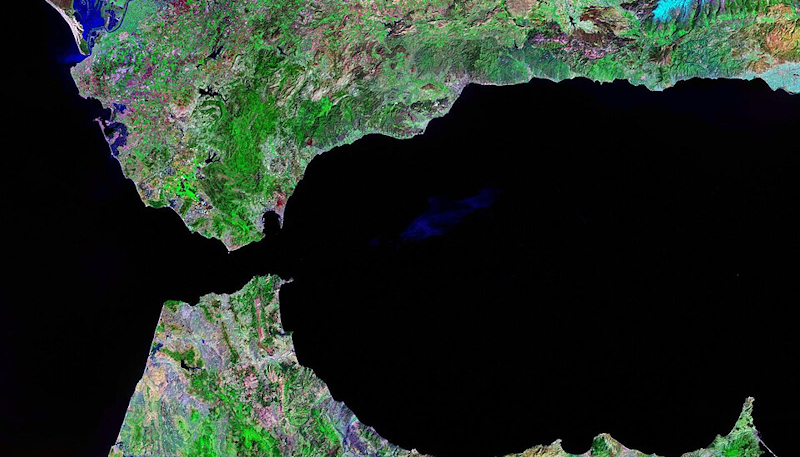
Relations between the United States and Morocco are entering a pivotal phase as Washington shifts its stance on two key North African issues: the Western Sahara and the Spanish enclaves of Ceuta and Melilla. After endorsing Morocco’s autonomy plan for Western Sahara in 2020, U.S. support now appears to extend to Rabat’s longstanding claims over Ceuta and Melilla, a development that could reshape geopolitical dynamics in the western Mediterranean.
Since late July, Washington has signaled a deeper alignment with Morocco across multiple fronts—security, economy, regional stability, and now the status of Ceuta and Melilla. This shift coincides with a recent migration crisis in Ceuta, where tens of thousands of individuals crossed into the Spanish enclave within 24 hours, straining relations between Rabat and Madrid.
The surge of migrants, which placed immense pressure on Spanish authorities and the European Union, raised questions about whether the influx was spontaneous or deliberately facilitated. While some observers suggest Morocco may have played a role in enabling the movement, analysts argue the crisis was largely organic before being politically leveraged by Rabat to underscore its territorial claims over Ceuta.
Western Sahara remains Morocco’s top diplomatic priority
The Western Sahara dispute has long been central to Morocco’s foreign policy, and Rabat is working to secure continued U.S. backing for its autonomy proposal. In 2020, the Trump administration’s recognition of Morocco’s sovereignty over Western Sahara in exchange for normalization with Israel marked a historic turning point. Now, Morocco is reinforcing this support through symbolic and strategic gestures, including naming a major highway in Western Sahara after former U.S. President Donald Trump.
According to regional analysts, Rabat’s goal is to ensure Washington maintains its backing for the autonomy plan amid ongoing international negotiations. The kingdom views U.S. support as critical to achieving a settlement that aligns with its interests in the territory.
Economic incentives fuel U.S.-Morocco cooperation
Beyond political alignment, economic interests are strengthening ties between the two nations. In late July, the U.S. ambassador to Morocco visited Laâyoune, the capital of Western Sahara, to finalize an agreement for a U.S.-funded project to establish a hydrogen and ammonia production unit. Analysts see this as part of Washington’s broader focus on investments that benefit American companies while advancing its strategic goals in the region.
The partnership between Washington and Rabat now rests on multiple pillars: political endorsement of Morocco’s positions, economic collaboration, security cooperation, and alignment on Israel-related policies. This convergence has created a mutually beneficial framework for both countries.
U.S. Congress targets the Polisario Front
A new legislative proposal in the U.S. Congress has raised concerns among supporters of the Polisario Front, the independence movement in Western Sahara. Two American lawmakers have introduced a bill to evaluate whether the group should be designated as a foreign terrorist organization, citing alleged ties to Iran. The initiative reflects Washington’s broader regional strategy to counter perceived Iranian influence in North Africa and the Middle East.
Analysts caution that there is no concrete evidence linking the Polisario Front to Iran or Hezbollah. Instead, they suggest Morocco is leveraging the current anti-Iran sentiment in Washington to reframe the Western Sahara conflict in a way that aligns with U.S. priorities. By associating the dispute with broader geopolitical rivalries, Rabat aims to secure stronger support for its claims.
Ceuta and Melilla emerge as a new flashpoint
The most significant shift in U.S. policy concerns its stance on Ceuta and Melilla, two Spanish enclaves that Morocco has long claimed as its own. Recent statements from Washington suggest a subtle but meaningful departure from its previous position, with U.S. officials reportedly questioning the enclaves’ status as indisputably Spanish territory. Such a shift could introduce a new layer of tension between the U.S. and Spain, a traditional ally of the United States and a key NATO partner.
For decades, Morocco has maintained that Ceuta and Melilla are occupied territories. While Spain insists on their Spanish sovereignty, the evolving U.S. stance could embolden Rabat’s diplomatic offensive and complicate Madrid’s strategic positioning in the region.
Madrid navigates a changing transatlantic landscape
Spain finds itself at the center of this shifting dynamic. In response to the migration crisis in Ceuta and broader regional developments, Spanish Prime Minister Pedro Sánchez visited Algeria—a key backer of the Polisario Front—to strengthen bilateral ties, particularly in the energy sector. While this move may raise eyebrows in Rabat, analysts note that it does not necessarily signal a fundamental shift in Spain’s position on Western Sahara, where Madrid continues to support Morocco’s autonomy plan.
The crisis in Ceuta, however, is driven by a different set of dynamics: the longstanding territorial dispute between Spain and Morocco. The migration surge served as a reminder of Rabat’s willingness to use pressure points to advance its claims, even as Spain seeks to diversify its regional partnerships.
Could Spain’s strategic guarantees be at risk?
The potential re-evaluation of Ceuta and Melilla’s status by the U.S. introduces uncertainty for Spain, which has historically relied on its alliances with the U.S. and NATO to safeguard its security and territorial integrity. If Washington were to adopt a more sympathetic view of Morocco’s claims, it could challenge the foundations of Spain’s strategic environment in the western Mediterranean.
While a full-blown crisis is not imminent, analysts warn that the current trajectory could lay the groundwork for future political negotiations over the enclaves’ status. The evolving U.S. position may embolden Morocco to push for a resolution that aligns with its interests, even if Spain resists such changes.
A shifting balance of power in North Africa
The evolving U.S.-Morocco partnership is reshaping the balance of power in North Africa, with Ceuta, Melilla, and Western Sahara emerging as central themes in this new geopolitical landscape. Rabat is capitalizing on the moment to consolidate its diplomatic gains, while Madrid must adapt to a less predictable transatlantic relationship. For the U.S., the focus on Morocco reflects a broader strategy to strengthen its influence in the Maghreb through strategic partnerships and economic collaboration.
The convergence of these issues—once treated as separate disputes—now places Morocco, the U.S., and Spain at the heart of a complex diplomatic chessboard, where the stakes extend far beyond the borders of North Africa.
Comments are closed, but trackbacks and pingbacks are open.