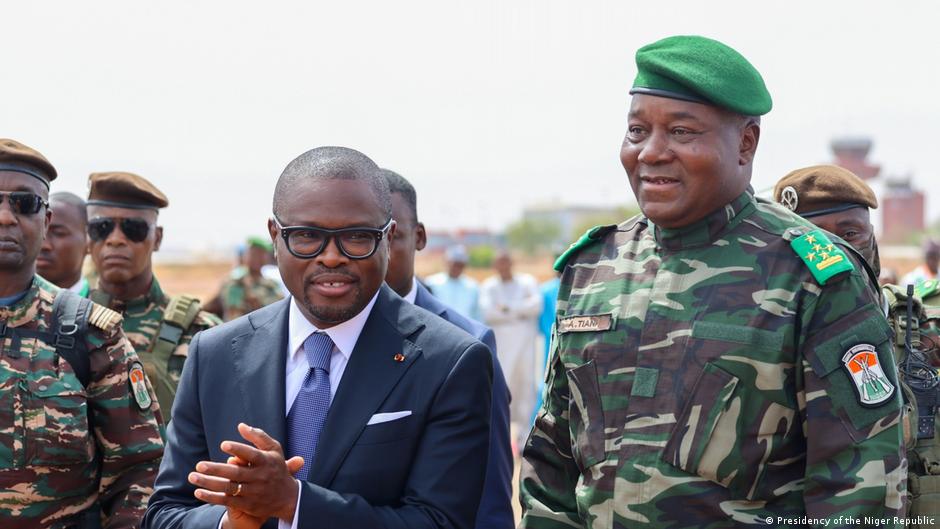
After three years of strained relations, a joint expert committee has tabled a groundbreaking proposal to lift the closure of the Benin-Niger border—a move that could reignite critical trade flows between the two West African nations. The findings, which address security protocols, transit regulations and legal frameworks, mark a pivotal step toward easing tensions that have crippled regional commerce and deepened economic hardship on both sides of the divide.
While the technical groundwork for reopening appears to be in place, Niamey has set forth three « non-negotiable » prerequisites that must first be met. These demands reflect deep-seated concerns over sovereignty, regional security and mutual trust. The stakes could not be higher: the border’s continued closure has choked off a lifeline that once supported millions of livelihoods and powered entire economies.
Niamey’s red lines for reopening
The Nigerien authorities have outlined three core conditions that must be satisfied before any formal border reopening can take place. Each reflects pressing national priorities in a post-coup environment marked by heightened distrust of external actors.
The first requirement is the formal signing of a mutual defense and non-aggression pact between Benin and Niger. This agreement would enshrine a commitment to refrain from hosting or supporting any armed groups that could destabilize the other nation—a provision seen as essential in a region grappling with violent extremism. While the concept is standard in international relations, analysts note that its explicit articulation in this context underscores lingering suspicions.
Régis Hounkpè, executive director of InterGlobe Conseils, emphasizes the pragmatic necessity of such an accord: « The principle is simple: Benin will not attack Niger, and Niger will not attack Benin. Yet, given the three-year rift, even basic assurances take on symbolic weight. The real challenge lies in implementation—ensuring these commitments translate into concrete actions rather than hollow declarations. »
The second condition demands the establishment of a joint intelligence-sharing cell to facilitate real-time information exchange on cross-border threats, including terrorism and illicit trafficking. Hounkpè praises this initiative as a vital mechanism for reinforcing regional stability: « Mutual confidence hinges on transparency. Both nations must be certain that no destabilization efforts are being orchestrated from either side. »
The final non-negotiable involves full disclosure of foreign military presence along the Beninese side of the border. This demand touches on Niger’s deep unease over external partnerships that could indirectly compromise its security. While Benin asserts its sovereign right to forge international alliances—whether with France, China, Russia or regional blocs—Niamey seeks clarity to alleviate fears of external interference.
Hounkpè frames this as a sovereignty safeguard: « Benin’s freedom to collaborate with global partners is unquestionable. However, Niamey must be reassured that such alliances are not weaponized against it. Pragmatically, no nation benefits from igniting conflicts beyond its borders. »
Economic fallout of a closed frontier
The border’s closure has exacted a devastating toll on both nations, but Niger—being landlocked—has suffered the most acute consequences. With nearly 70% of its imports traditionally transiting through Benin, the blockade has disrupted supply chains, inflated costs and strangled economic activity. The port of Cotonou, once a bustling hub for transit goods, now faces severe congestion, while overland routes through Togo or Nigeria have become prohibitively expensive.
The damage extends far beyond logistics. The Niger-Benin pipeline, a 2,000-kilometer infrastructure linking Agadem’s oil fields to the port of Sèmè-Kpodji, has seen its flows suspended, depriving Niger of critical revenue. Analysts estimate the daily loss at tens of millions of dollars—an unsustainable hemorrhage for a country already grappling with economic strain.
Benin, while less dependent on transit fees than in previous years, is not immune to the fallout. The port’s congestion has paralyzed trade, slashed customs revenues by up to 60% in some sectors and forced businesses to redirect shipments to neighboring Togo and Nigeria. This shift threatens Benin’s long-standing role as a regional trade corridor, risking its competitive edge in West Africa.
The human cost is equally stark. At border towns like Malanville and Gaya, markets have withered as trade volumes plummeted by nearly half. Vendors, transporters and small-scale traders face destitution, while families separated by the closure endure emotional and financial strain. The crisis has also fueled smuggling networks and opportunistic racketeering, further destabilizing local communities.
Why cooperation trumps confrontation
Despite political tensions rooted in last year’s coups in both countries, economic imperatives are pushing Benin and Niger toward reconciliation. The election of Beninese President Romuald Wadagni in early 2026 sparked a swift diplomatic thaw, culminating in his landmark visit to Niamey in June. The joint expert committee, established in the wake of that meeting, has since labored to bridge the divide.
Hounkpè underscores the inescapable logic of cooperation: « Leaders today must prioritize geography over ideology. They have no choice but to coexist and collaborate—whether in economics, logistics, security or counterterrorism. » He expresses cautious optimism that the two presidents will approve a phased reopening of the border, beginning with high-priority goods under heightened monitoring.
Such a move, he argues, could serve as a model for broader reconciliation within the Alliance of Sahel States (AES) and the Economic Community of West African States (ECOWAS). Just as Côte d’Ivoire and Mali recently revived trade ties amid economic pragmatism, Benin and Niger’s rapprochement may signal a shift toward regional stability driven by necessity rather than ideology.
Comments are closed, but trackbacks and pingbacks are open.