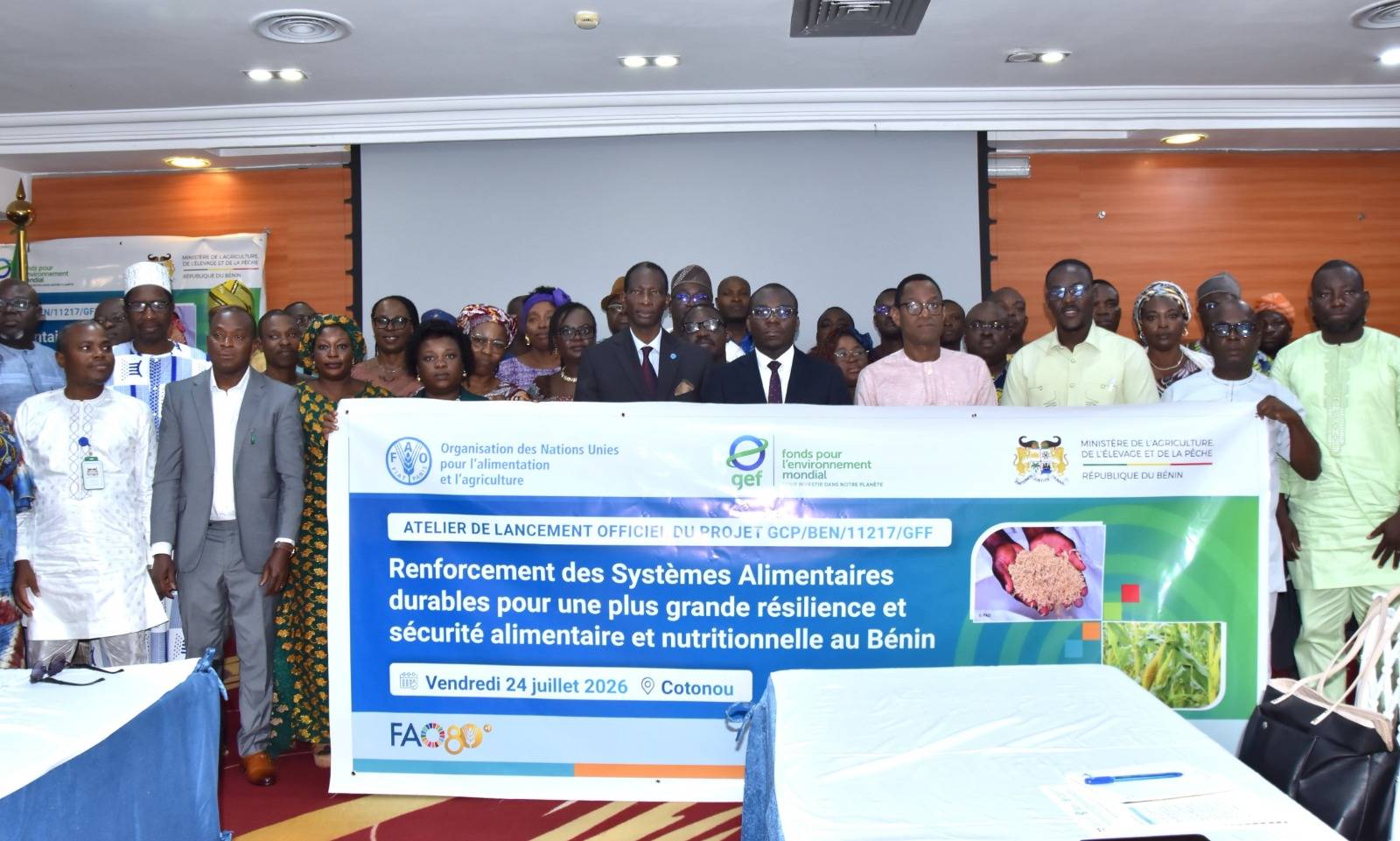
The heart of Bénin’s economy—agriculture—is under severe strain. With nearly 70% of jobs and 26% of GDP tied to the sector, the nation’s prosperity hinges on the productivity of its soil. Yet, over the past decade, widespread land degradation has crippled harvests, threatening food security and economic stability. To reverse this alarming trend, the government, with critical support from global partners, has launched the ambitious Food Systems initiative, a 20.7 million dollar program designed to restore degraded land and transform the rice and maize value chains by 2030.
soil depletion: a silent crisis eroding Benin’s future
While agriculture remains the backbone of Bénin’s economy, its growth is being strangled by a growing crisis: soil infertility. Addressing the nation’s top agricultural leaders at the launch event in Cotonou, Minister of Agriculture, Livestock and Fisheries Adin Yeton Bloukounon Goubalan delivered a stark warning: “Degraded soil leads to shrinking harvests, trapping farmers in a cycle of poverty that undermines both rural livelihoods and national food security.”
Statistics paint an even bleaker picture. A recent national survey reveals that over 5 million Béninois—nearly 40% of the population—live directly under the shadow of land degradation. Shockingly, 38% of the country’s total land area is now classified as degraded, slashing agricultural output by more than half in affected zones. This not only cuts off rural communities from vital resources like clean water and food but also deepens poverty and vulnerability across the nation.
food systems: a blueprint for agricultural transformation
The Food Systems project emerges as a bold response to this ecological and economic emergency. Developed by Bénin’s government in partnership with the Food and Agriculture Organization (FAO) and the Global Environment Facility (GEF), this initiative goes beyond mere symptomatic treatment. It aims to overhaul the entire agricultural model, from policy frameworks to production techniques and market access.
The project zeroes in on the nation’s two most critical staple crops: rice and maize—staples consumed across both rural and urban landscapes. The goal is clear: transition these value chains from low-yield, environmentally damaging systems to high-efficiency, sustainable models that deliver tangible socio-economic benefits.
investing in land restoration and farmer prosperity
The program’s financial backbone is as robust as its vision. With a total budget of 20.7 million dollars, funding is structured as a tripartite partnership: the GEF contributes 5.9 million dollars, while Bénin’s government provides a 14.8 million dollar national co-financing commitment. Over the next six years, the project will focus on five strategic communes: Karimama, Malanville, Glazoué, Kétou, and Les Aguégués.
The anticipated outcomes are transformative. By 2030, the initiative aims to:
- Restore fertility to 20,000 hectares of degraded land.
- Introduce sustainable farming practices across 114,900 hectares.
- Empower 36,000 farmers directly, with ripple effects benefiting an additional 356,000 people in surrounding communities.
collaboration and caution: the path to success
Despite the optimism surrounding the project, its architects emphasize the importance of precision and partnership. Minister Goubalan cautioned that the choice of soil restoration technologies must be meticulous, warning: “The wrong methods could do more harm than good—derailing progress before it begins.”
Echoing this sentiment, Paul-Henri Zoéwindé Bouda, FAO’s Resident Representative in Bénin, stressed that technology alone won’t suffice. “True transformation requires the full commitment of every actor—from policymakers to field-level farmers. Without collective ownership, even the most innovative solutions will fail to take root.”
toward a resilient agricultural future
By addressing the root cause of Bénin’s agricultural decline—soil degradation—the Food Systems project lays the groundwork for a more food-secure future. If targets are met by 2030, the nation could not only stabilize its rice and maize supplies but also set a replicable model for ecological transition across West Africa. The stakes are high, but the vision is clear: a Bénin where agriculture thrives, ecosystems flourish, and communities prosper.