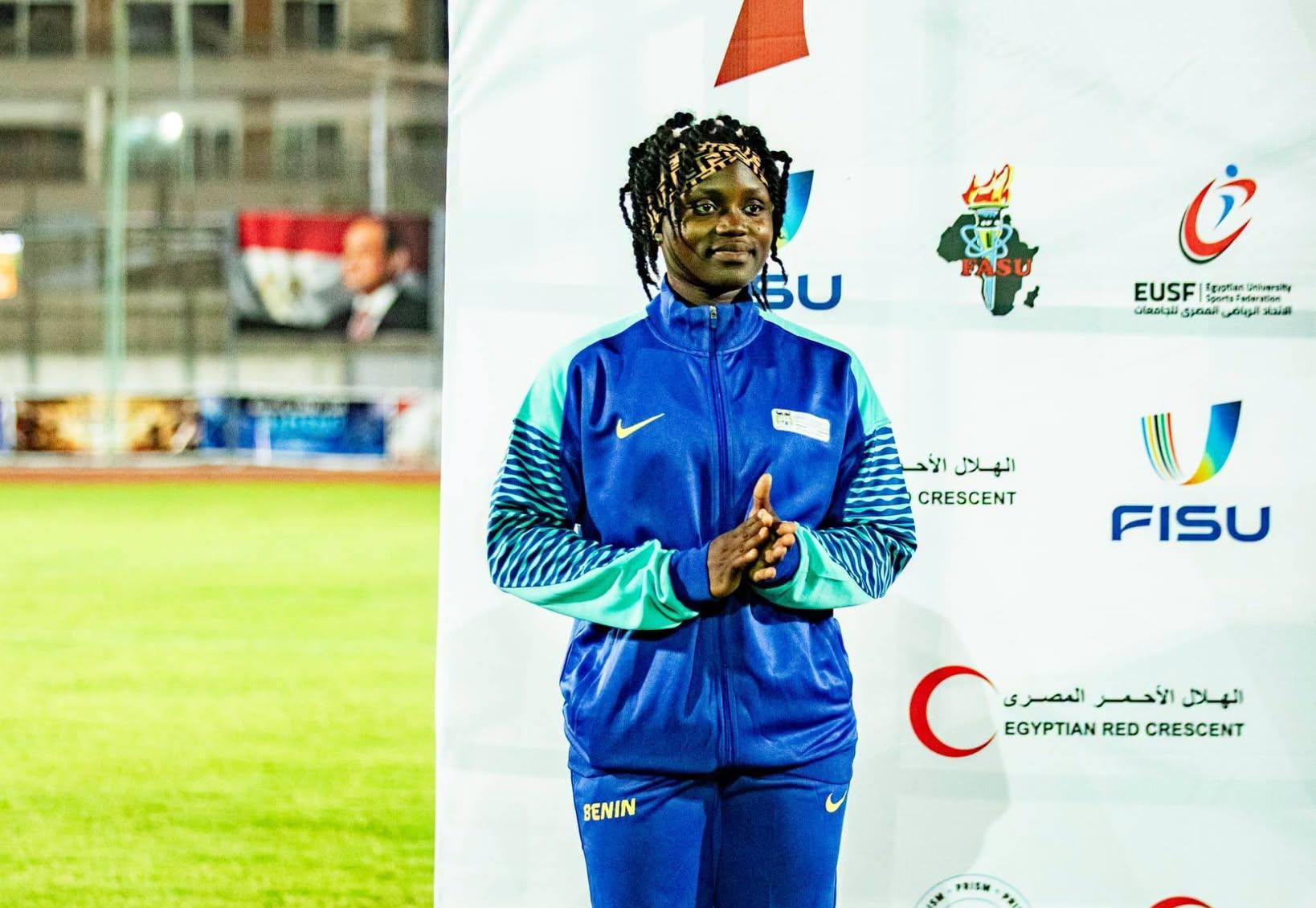
When Brigitte Tchede stepped onto the podium twice at the 12th African University Games in Cairo, she did more than add to Benin’s medal tally. Her silver in the discus and a second medal in another event have concrete consequences for a country where sport is increasingly seen as a driver of youth development and economic opportunity. The ripple effects are already being felt across Benin’s athletic community and beyond.
A double podium that puts money and attention on Benin athletics
From 8 to 16 September 2026, Cairo hosted the 12th African University Games, bringing together student-athletes from across the continent. For Benin, the stakes went beyond mere participation. The delegation sought to showcase its young talent and confirm the progress of athletes already competing internationally. Brigitte Tchede delivered on both fronts.
The Porto-Novo native secured Benin’s first two medals of the 2026 edition, claiming silver in the discus and another podium finish in a second discipline. This achievement has immediate implications: increased visibility for Benin’s university sports programs, potential funding boosts, and a morale lift for a nation eager to compete on the continental stage.
47.08 Meters: a personal best with economic and symbolic weight
The first medal came on Sunday, 13 September. Competing in the women’s discus, Tchede took second place with a throw of 47.08 meters. Beyond the silver, this mark represents a new personal record, significantly improving her previous best of 44.37 meters set in May at the African Athletics Championships in Accra, Ghana.
That 2.71-meter improvement over a few months signals not just athletic progress but also the effectiveness of targeted training and support. For Benin, such gains translate into tangible returns: better performances attract sponsors, inspire younger athletes, and strengthen the case for investment in sports infrastructure.
What this means for Benin’s sporting ecosystem
Tchede’s success is already being cited as evidence that Benin can nurture world-class talent. The double podium in Cairo highlights the importance of university competitions as a pipeline for elite athletes. For a country with a growing youth population, this is more than a feel-good story—it’s a reminder that strategic investment in sport can yield measurable results.
The economic angle is clear: medals bring recognition, which can lead to increased public and private funding. They also boost the profile of Beninese universities, potentially attracting more students and partnerships. And for local businesses, a successful athlete like Tchede becomes a marketable figure, capable of drawing attention to brands and initiatives.
From Accra to Cairo: a trajectory that builds national pride
Tchede’s recent journey illustrates a steady upward curve. Her previous record of 44.37 meters in Accra has now been eclipsed by the 47.08-meter throw in Cairo. This progression is not just personal—it reflects a broader trend of Beninese athletes closing the gap with continental leaders.
The continuity between competitions shows that consistent international exposure pays off. Each event offers experience, tougher competition, and a chance to raise personal benchmarks. For Benin, this means a growing pool of athletes who can represent the country at major global meets.
Medals before the final whistle: Benin’s early success in Cairo
With the Games concluding on 16 September, Benin already has a notable haul thanks to Tchede. Her discus silver, tied to a new personal record, and her second medal confirm her central role in the delegation.
As the competition wraps up, Benin returns from Cairo with both medals and a new individual benchmark. For Tchede, the 47.08-meter throw sets a fresh target to surpass. For Benin, these two podiums are a reminder that university sports can be a springboard for talents destined for bigger stages—and a catalyst for economic and social benefits at home.
Comments are closed, but trackbacks and pingbacks are open.