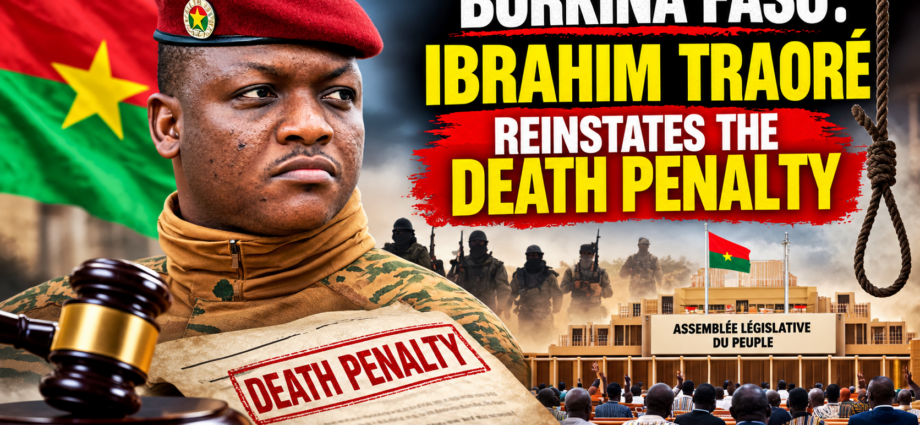
Military regime tightens legal measures to combat jihadist violence
The National Assembly of Burkina Faso has approved a sweeping penal reform that brings back the death penalty, abolished in 2018, as part of a broader crackdown on terrorism and serious crimes. The move, which passed unanimously on October 20, 2026, underscores the military-led government’s increasingly hardline approach under Captain Ibrahim Traoré.
Can extreme punishment curb jihadist attacks?
The new penal code targets terrorism, espionage, treason, and parricide with capital punishment, along with severe penalties for offenses such as importing expired or banned goods that result in death. While authorities argue that such measures are necessary to restore order in a country plagued by jihadist violence, experts question whether harsher penalties alone can address the root causes of insecurity.
Since 2015, Burkina Faso has faced relentless attacks by armed groups linked to Al-Qaeda and the Islamic State, displacing millions and eroding state control in vast rural areas. Despite the regime’s rhetoric, critics argue that executing prisoners may not deter militants who operate in lawless border regions where state authority is weak.
Justice v. deterrence: what the new law delivers
The effectiveness of the death penalty in combating terrorism remains a contentious issue. Proponents claim it sends a strong message to extremists, while opponents warn that it risks miscarriages of justice in a judicial system already strained by prolonged conflict. International observers have raised concerns about due process, particularly in cases involving national security, where fair trials are not always guaranteed.
The law also reintroduces penalties for certain press offenses, raising fears that dissenting voices could be silenced under the guise of national security. With journalists, activists, and critics already facing intimidation, the reform risks further eroding civic freedoms in a country where public debate is already heavily restricted.
Fear as a tool of governance
The return of capital punishment reflects a deeper shift in how the Burkinabè state exercises power. Under Traoré’s leadership, the government has increasingly framed security and sovereignty as justifications for limiting freedoms—from expanded military rule to the suppression of opposition voices.
While the death penalty may satisfy demands for decisive action, it does little to address the structural weaknesses crippling Burkina Faso’s security apparatus. Without strengthened intelligence networks, improved local governance, and sustainable peacebuilding, extreme penalties alone cannot restore stability to communities under attack.
Public trust eroded by punitive measures
The reform risks conflating state defense with regime protection, creating a climate where criticism is equated with treason.
Independent judiciary and media watchdogs have documented cases of forced conscriptions and disappearances of critics, intensifying concerns over human rights violations.
Civil society groups argue that a justice system that prioritizes fear over fairness will struggle to win public confidence.
What does security mean in practice for Burkinabè citizens?
The government’s primary obligation is to protect civilians from daily violence whether in markets, schools, or farmlands. Yet, in regions where state presence is minimal, military offensives and harsh penalties have failed to stem the tide of attacks. The real test of this reform’s success lies not in the severity of its sentences, but in its ability to reduce violence and restore trust in public institutions.
For Traoré, the challenge is clear: demonstrate that the death penalty and the broader legal crackdown leads to tangible improvements in security, not just political control. A strategy based solely on punishment risks deepening social fractures and alienating the very communities it aims to protect.
Beyond punishment: building a secure future
Burkina Faso stands at a crossroads. While the reinstatement of the death penalty marks a decisive break with the previous government’s approach, it raises critical questions about long-term governance. Can a state secure its people through fear, or must it also uphold justice, transparency, and the rule of law?
The coming months will reveal whether this legal overhaul strengthens Burkina Faso’s fight against terrorism or whether it deepens a cycle of repression that leaves citizens more vulnerable than before. One thing is certain: real security cannot be built on executions alone.
By Alasane OUEDRAOGO — Journalist
Comments are closed, but trackbacks and pingbacks are open.