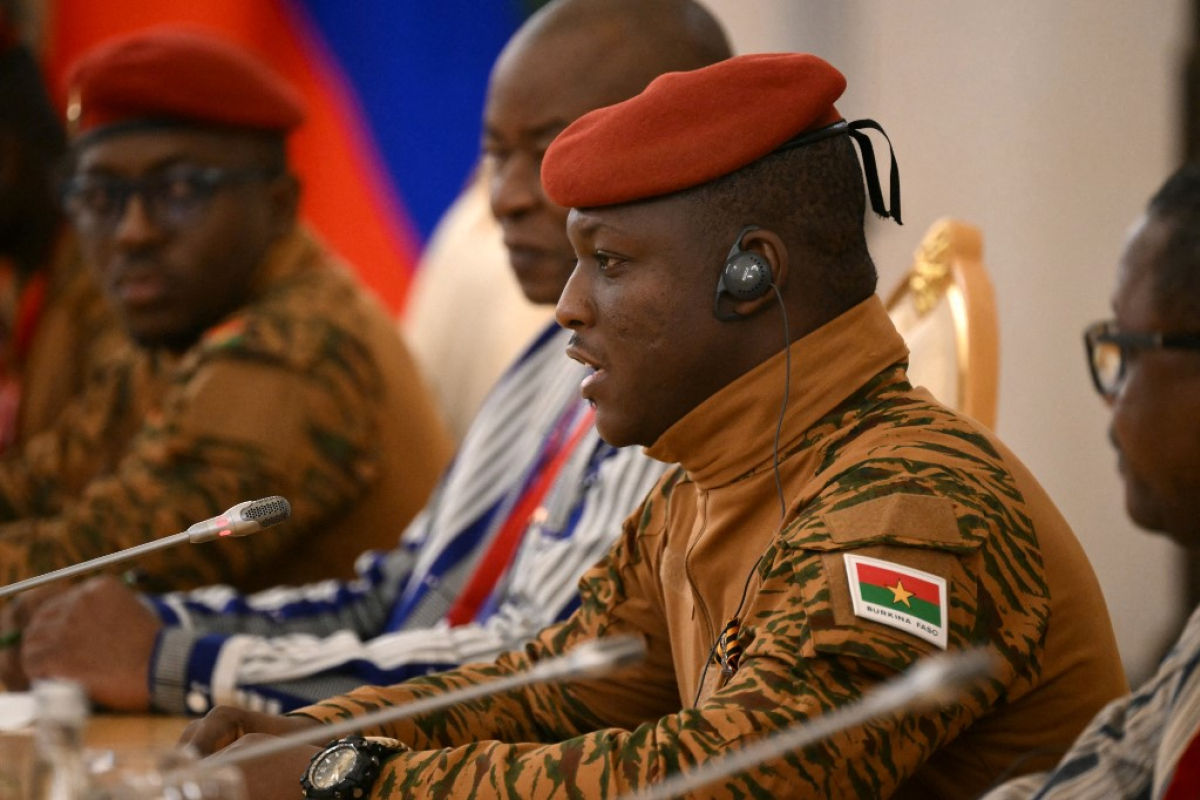
Burkina Faso, operating under the leadership of military junta chief Ibrahim Traoré, officially declared on Friday its decision to sever diplomatic relations with Paris.
All French diplomats previously stationed in Burkina Faso completed their return to France “late last week.” Concurrently, Burkinabè diplomatic personnel have been mandated to depart France by Monday, July 6, as confirmed by the French Ministry of Foreign Affairs.
The Burkinabè Chargé d’Affaires in Paris was summoned to the French ministry last Monday. This action followed Ouagadougou’s unilateral announcement on June 26 regarding its decision to terminate diplomatic relations with France. The French ministry communicated, in a spirit of strict reciprocity, that Burkinabè diplomatic staff would also be required to leave France within seven days, specifically by Monday evening.
“We profoundly regret this hostile and baseless decision, which unfortunately illustrates the troubling direction taken by the Burkinabè authorities,” the Quai d’Orsay reiterated. The ministry emphasized that France has “drawn the necessary conclusions” from this significant development.
Furthermore, the French ministry vehemently refuted any allegations of French support for terrorist groups, dismissing such claims as “completely false.” These accusations were notably cited by Ouagadougou authorities as a primary justification for the rupture in relations with Paris.
“We unequivocally condemn all terrorist attacks, as well as the atrocities committed against civilians across the Sahel region. We reaffirm our steadfast support for the populations, who are the primary victims of the ongoing crisis,” the ministry added.
The Quai d’Orsay highlighted that France’s consistent engagement in the global fight against terrorism “is widely acknowledged, and it has come at a substantial cost.” In light of this particular context, the ministry urged French nationals residing in Burkina Faso to exercise enhanced vigilance.
Official figures from the ministry indicate that over 2,000 French citizens are registered with consular services in Burkina Faso, while more than 6,000 Burkinabè nationals reside in France.
Relentless Attacks
Captain Ibrahim Traoré, who seized power through a coup d’état in September 2022, has implemented a staunchly sovereignist policy in Ouagadougou. This approach is characterized by its repressive measures against critical voices and a clear animosity towards Western nations, particularly France. The Burkinabè government has accused Paris of “incessant activism” against its national interests, though it maintains that people-to-people relations remain unaffected.
As early as 2023, just months after assuming control, the junta demanded the recall of France’s ambassador to Ouagadougou, Luc Hallade. It subsequently renounced a military cooperation agreement with Paris and secured the withdrawal of French forces, which had for a decade been actively engaged in counter-jihadist operations plaguing the country. Since then, the regime has intensified its criticisms of France and has actively pursued alliances with new international partners, including Russia, Turkey, and Iran.