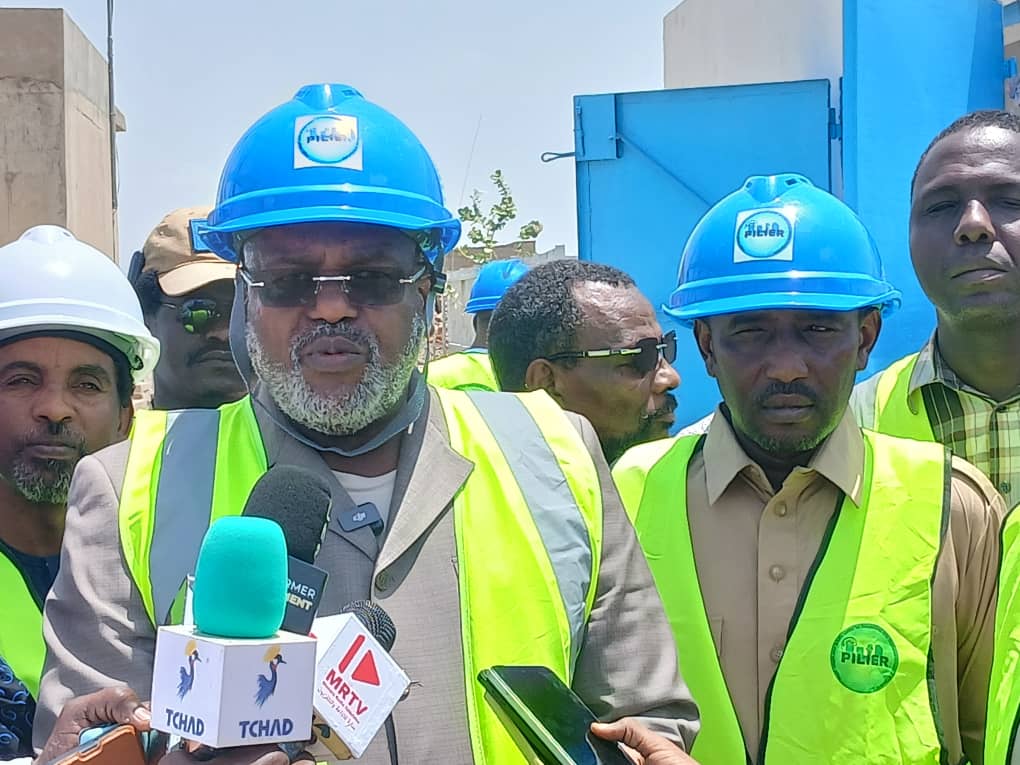
As the rainy season approaches, Mahamat Assileck Halata, Chad’s Minister of Spatial Planning, Urbanism, and Housing, conducted a crucial field visit on June 25, 2026. The inspection focused on various infrastructures within the Integrated Project for Flood Control and Urban Resilience (PILIER) across N’Djamena. The primary objective was to assess the progress of ongoing works and confirm the operational readiness of these vital structures designed to shield the capital from potential flooding.
The ministerial delegation embarked on a comprehensive tour, making stops at several key locations. These included the Lamadji pumping station in the 10th district commune, the Chagoua municipal hangar, the N’Djari canal, the Toumaï Palace drainage systems, the wastewater treatment plant, the Pedro site, and ongoing road improvement projects. An additional visit was made to the 7th district municipal hangar to review equipment and devices deployed for flood mitigation efforts.
Minister Halata emphasized that this tour is part of the government’s continuous monitoring of initiatives aimed at minimizing risks associated with severe weather. He recalled a recent evaluation meeting held after the last rains to review the status of infrastructure developed with support from the World Bank. During the visit to the Lamadji pumping station, Minister Halata expressed strong disapproval regarding the theft of essential electrical cables, which had been cut and removed by unidentified individuals. These cables are crucial for the proper functioning of certain installations.
Despite this act of vandalism, the Minister reassured the public that the station remains functional, thanks to four other pumps still in service. “Even with the cable theft, the station continues to operate,” he stated. “The available equipment allows us to pump water effectively when needed.”
He also confirmed that new cables have already been ordered, again with the backing of the World Bank. Their delivery is anticipated by July 1, and technical officials expect installation to be completed within one to two days thereafter. The inspection continued with visits to the Sabangali pumping station and the generator workshop for the 10th district pumping stations. The tour concluded in the Toukra-Mousgoum neighborhood, where Minister Halata met with residents whose homes had been demolished by the 9th district municipality. He assured them of the government’s commitment to the reconstruction and rehabilitation of their dwellings.
Minister Halata clarified that this inspection mission is intended to guarantee that all PILIER project infrastructures will be fully operational, thereby limiting flood risks and enhancing N’Djamena’s urban resilience throughout the rainy season. He affirmed that his on-the-ground assessment indicated that all systems are functioning effectively.
In closing, the Minister reiterated the government’s unwavering commitment to infrastructure projects and stormwater management, highlighting their critical role in safeguarding populations and fostering a sustainable improvement in their living conditions.
Comments are closed, but trackbacks and pingbacks are open.