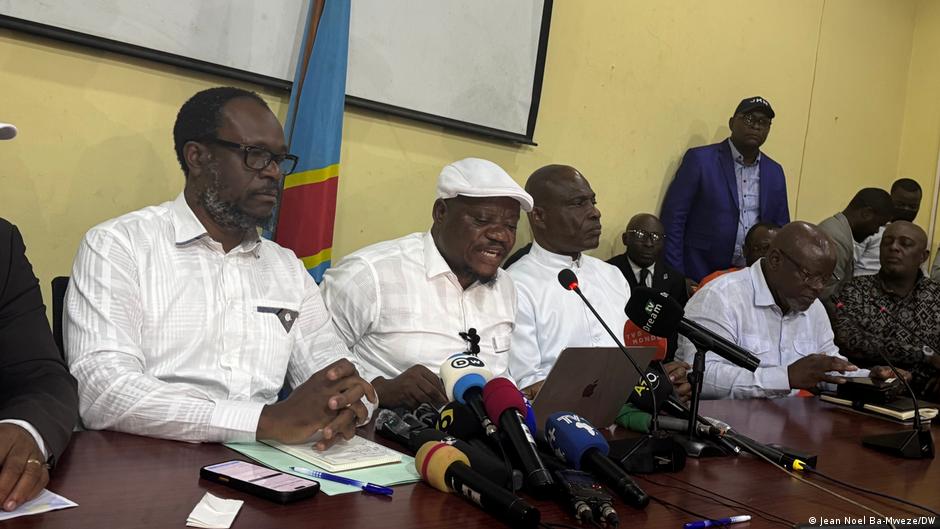
Congo politics: tshisekedi backs down as opposition coalition keeps up pressure
In a significant shift, Congolese President Félix Tshisekedi has sent the referendum law—previously validated by the Constitutional Court—to Parliament for a second review, just days before the opposition coalition C64’s deadline expires. The C64, along with dozens of civil society groups, had demanded that the president abandon his constitutional reform plans by August 15 and called for an inclusive national dialogue. Yet, as the deadline looms, no date has been set for such talks.
Tshisekedi’s tactical retreat amid mounting pressure
While the referendum law was expected to take effect automatically after 15 days without presidential approval, as per Article 140 of the Congolese Constitution, Tshisekedi’s decision to return it to Parliament introduces a fresh round of deliberations. This move follows observations from the Constitutional Court and appears to be a strategic retreat rather than a full concession.
Professor Bob Kabamba, a political analyst at the University of Liège in Belgium, views this as a setback for Tshisekedi but cautions that it does not signal his intention to abandon efforts to extend his time in office beyond 2028—the end of his second term. “We cannot overlook the intense pressure from both domestic opposition and regional actors, which has pushed Tshisekedi to backtrack by seeking a second review of the law. It’s a retreat, but one that won’t stop him from exploring alternative avenues to stay in power past 2028,” Kabamba explains.
C64 vows continued resistance after deadline
The opposition coalition C64 has welcomed the president’s decision to revisit the referendum law, yet it remains steadfast in its demands. With the August 15 ultimatum hours away, the coalition is preparing a series of decisive actions, though specifics have not yet been disclosed. “Once the deadline passes at midnight on August 15, we will confirm that nothing has been done. We will unveil a series of targeted operations through our C64 laboratory to restore reason to a regime that has stripped away our freedoms and is attempting to seize our national sovereignty,” declares Franklin Tshiamala, Secretary-General of Leadership for Governance and Development (LGD), a group linked to former Prime Minister Augustin Matata Ponyo.
Political standoff deepens
The government continues to defend the referendum process as a legitimate political and institutional initiative. Meanwhile, the opposition’s ultimatum is dismissed as an attempt to dictate the president’s agenda. Adolphe Amisi Makutano, a member of the Union for Democracy and Social Progress (UDPS), the president’s party, insists that the government operates independently of external demands. “The C64’s ultimatum is theirs alone—perhaps designed to satisfy their backers. The Republic functions normally,” Makutano asserts.
As the tension escalates, the August 15 deadline could mark the beginning of a new chapter in DRC’s political landscape.
Comments are closed, but trackbacks and pingbacks are open.