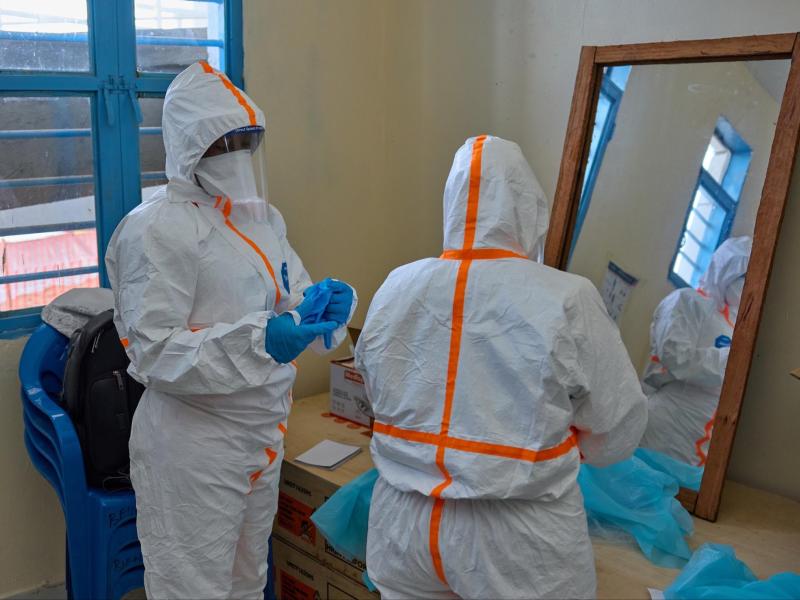
Five weeks after the Ebola Bundibugyo outbreak was declared in the Democratic Republic of the Congo, the epidemic remains far from under control. Response efforts have clearly intensified, yet they continue to lag behind a virus that keeps advancing across borders and claiming lives.
Scaling up falls short
Real progress has been made. Patient bed capacity jumped from fewer than 10 to more than 500 across 19 treatment centres in the affected zones. Testing capacity soared from 30 daily tests at the onset to over 2,000 per day, now operational in nine laboratories covering three provinces. More than 100 patients have recovered, proving that early care can save lives.
But the overall toll remains heavy: 1,094 confirmed cases and 277 deaths so far. According to the WHO director-general, Tedros Adhanom Ghebreyesus, the epidemic is still outpacing the response. Contact tracing remains inadequate, isolation capacity falls short of what is needed, and safe burials continue to be a daily struggle in communities that are often suspicious or difficult to reach.
A virus that ignores borders
The outbreak has now spread far beyond the Congolese provinces of Ituri, North Kivu and South Kivu. Neighbouring Uganda has recorded 20 confirmed cases and two deaths, all linked to the same Congolese strain. Even more worrying, on Wednesday France reported its first case on European soil: a humanitarian doctor working for the NGO ALIMA who returned from a mission in the DRC tested positive for the Ebola Bundibugyo virus. He is now being treated in a specialised facility and is in stable condition. An epidemiological investigation is under way to trace and monitor his contacts.
This case is a stark reminder of the price paid by frontline health workers. Nearly 80 medical staff have been infected since the crisis began. The WHO is urging states to ensure safe deployment conditions for humanitarian personnel, including the possibility of rapid medical evacuation if they become infected.
A response hampered by funding gaps and insecurity
Beyond the health challenges, the response is hitting structural obstacles at every turn. Border closures are slowing the movement of teams and equipment. Security incidents are multiplying in a region wracked by decades of armed conflict. And funding remains slow to materialise, even as the WHO and Africa CDC have launched a continental plan requiring $518 million.
There is a glimmer of hope, however. A clinical trial evaluating two antiviral drugs – MBP134 and remdesivir – is set to begin next week in the DRC. Led by a consortium that includes the Congolese National Institute of Biomedical Research, the NGO ALIMA, the University of Oxford and the WHO, and backed by donations from the United States and Gilead Sciences, this trial could mark a turning point in the fight against an epidemic that, five weeks after its start, is far from contained.
Comments are closed, but trackbacks and pingbacks are open.