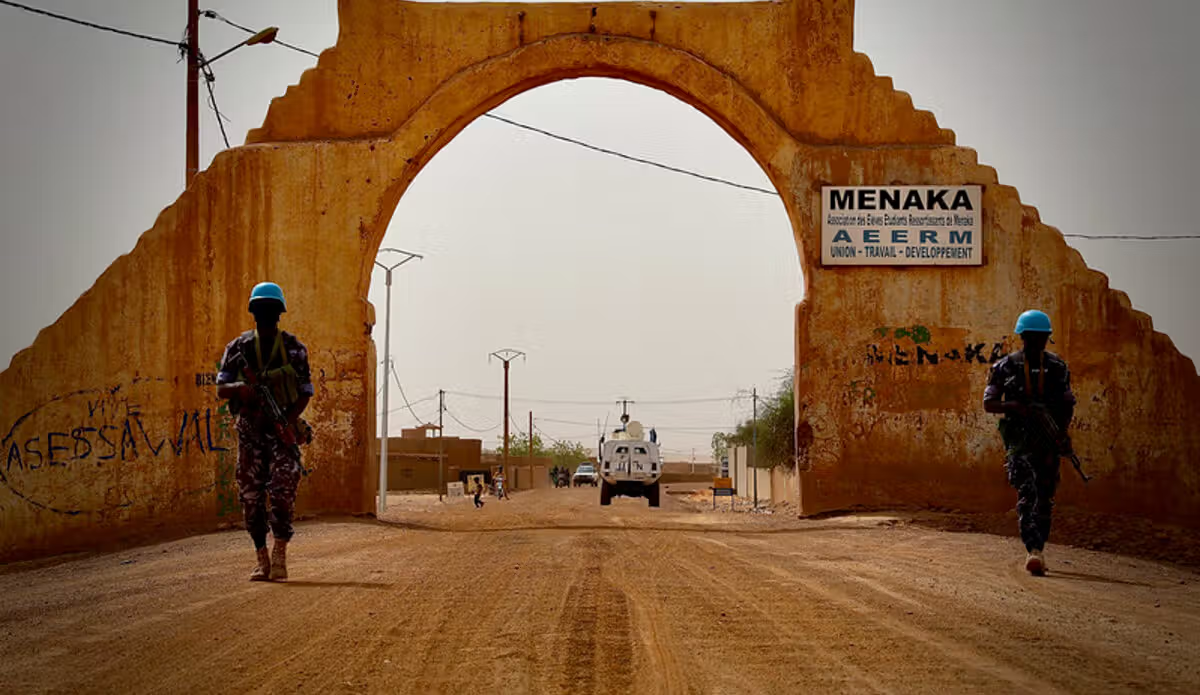
Nigeria is confronting a security challenge that transcends its borders, with the ongoing crisis in Mali serving as a catalyst for regional instability. The interconnected struggles across the Sahel—particularly in Niger, Burkina Faso, and northern Nigeria—have created a volatile environment where insurgent groups thrive.
the rise of transnational insurgent networks
The central Sahel is now dominated by three major armed factions: JNIM (linked to al-Qaeda), Islamic State-affiliated groups operating around the Lake Chad basin, and Tuareg separatist movements in northern Mali. While their ideologies differ, their strategies increasingly overlap. These groups exploit porous borders, impose informal taxation on local populations, and establish shadow governance in rural areas.
Their influence extends beyond physical territory. Through arms trafficking, economic exploitation, and population displacement, they reshape Nigeria’s internal security dynamics—even without direct territorial expansion.
the lake Chad basin: a hotspot of convergence
The Lake Chad region exemplifies the fusion of local and regional threats. Groups like ISWAP operate across Nigeria, Niger, Chad, and Cameroon, exploiting weak governance to regulate trade, collect taxes, and control movement. Research indicates that ISWAP generates an estimated $191 million annually from taxing farmers and fishers—far surpassing the revenue of Borno State itself.
Instability in Mali and Niger exacerbates this system by weakening border security, facilitating arms flows, and increasing displacement pressures on already fragile communities.
northwest Nigeria: when local banditry mimics Sahel insurgency
In Sokoto, Zamfara, and Katsina, armed factions have merged criminal enterprises with insurgent governance. Investigations reveal structured taxation systems in Zamfara, where payments total hundreds of millions of naira annually—indicating deep economic entrenchment rather than sporadic violence.
Meanwhile, ransom-driven kidnapping has ballooned into a multi-billion naira industry, while illicit gold mining in Zamfara generates an estimated ₦200–300 million weekly. These economic power centers mirror patterns seen in Mali and Burkina Faso, where insurgents fund operations through resource extraction and taxation.
ECOWAS fragmentation: a fractured regional response
The withdrawal of Mali, Burkina Faso, and Niger from ECOWAS and the formation of the Alliance of Sahel States (AES) have weakened collective security frameworks. Despite Nigeria’s central role in regional defense, the fractured environment limits intelligence-sharing and joint operations.
This fragmentation coincides with insurgent networks becoming more transnational, making coordinated counterterrorism efforts increasingly difficult.
beyond security: the economic and humanitarian fallout
The crisis extends beyond armed conflict, disrupting agriculture, food production, and employment. Projections suggest over 20 million Nigerians may face food insecurity during the 2026 lean season—a direct consequence of conflict-driven disruptions.
Armed groups deliberately target rural economies, recognizing their strategic value. Control over food systems, livestock routes, and markets translates into both revenue and influence, reinforcing their grip on local populations.
the limits of military action
While Nigeria has made progress in degrading insurgent capabilities, three key challenges persist: unstable post-conflict territories, adaptive insurgent tactics, and the persistent vulnerability of rural economies to coercive capture. Without addressing governance, economic structures, and regional coordination, security gains remain fleeting.
a new approach: disrupting the system
To break the cycle of instability, Nigeria must adopt a more proactive strategy:
- Intelligence-led border management: Shift from static defenses to tracking and disrupting cross-border movement systems.
- Strengthening rural governance: Treat local administration, justice systems, and dispute resolution as critical security infrastructure.
- Unified counterinsurgency efforts: Address banditry and insurgency as part of the same coercive control systems.
- Targeting illicit financial networks: Disrupt ransom economies, illicit mining, and informal taxation that sustain armed groups.
- Regional stabilization: Treat the Lake Chad basin as a shared security challenge rather than a series of national issues.
conclusion: nigerias path forward
The crisis in Mali is not a distant threat—it is a blueprint of how governance failures, insurgent adaptation, and regional fragmentation converge to destabilize entire regions. For Nigeria, the solution lies in disrupting this feedback loop through stronger governance, financial pressure on armed groups, and renewed regional cooperation.
By addressing the root causes of instability—economic exploitation, weak governance, and transnational threats—Nigeria can shift from reactive containment to long-term security.