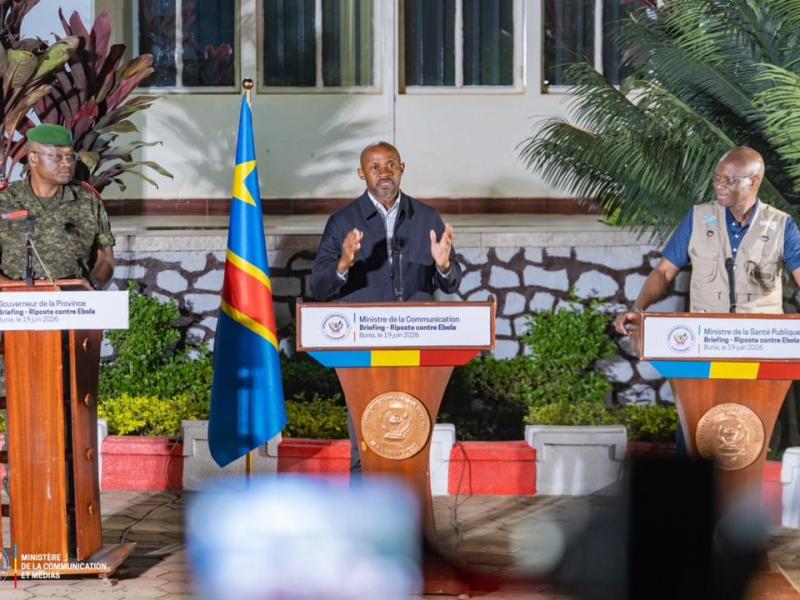
The government of the République démocratique du Congo has announced its intention to intensify its judicial and economic response following the release of damning reports by Human Rights Watch and Global Witness. These documents highlight the deteriorating security and humanitarian situation, as well as the systematic exploitation of natural resources in territories currently held by the AFC/M23 rebellion in the eastern part of the country.
During a recent press briefing, government spokesperson Patrick Muyaya, accompanied by the Minister of Public Health, Samuel Roger Kamba, stated that the findings were expected. He emphasized that Kinshasa is actively fighting on two major fronts: the legal arena and the economic sector. New legal proceedings are expected to be initiated by the Ministry of Justice in the coming days to address these revelations.
A strategy targeting the war economy
According to the government, the focus must shift toward the entire supply chain of minerals rather than just the local actors. Patrick Muyaya recalled a high-level meeting held in Genève involving the Prime Minister and various international traders to discuss these commercial circuits. He noted that the recent reports provide critical evidence to support existing files against those profiting from the instability.
“These publications validate the information we already possessed. They provide additional evidence to strengthen our cases. We are specifically targeting the war economy sustained by Rwanda, which continues to benefit from the chaos in the eastern République démocratique du Congo,” the spokesperson explained.
Recruitment of minors and coercive tactics
A significant portion of the recent investigations focuses on the forced recruitment of children by the AFC/M23. The government spokesperson indicated that authorities have been tracking these developments for months. He argued that the rebellion’s reliance on child soldiers is a direct result of their lack of popular support in occupied zones, forcing them to use violence and fear to maintain control.
“We are aware of the methods used by the aggressors. They govern through terror because they are rejected by the population. We have received numerous reports from parents who are afraid to send their children to school due to the risk of abduction and forced enlistment,” Muyaya added.
The government maintains that these documented acts constitute serious war crimes. Consequently, both national and international judicial mechanisms have been or will be engaged to ensure accountability for these violations.
International sanctions and the path forward
The spokesperson also pointed to recent sanctions imposed by United States authorities against specific members of the Rwandan military. He suggested these measures reflect a growing international recognition of Rwanda’s involvement in illegal mineral trafficking and its role in the conflict.
For several years, Kinshasa has described the persistent violence in the East as an “economic war” designed to facilitate the looting of Congolese resources. While Rwanda consistently denies any involvement in the destabilization of the region or the exploitation of its minerals, the République démocratique du Congo remains determined to use these international reports to reclaim its rights and end the cycle of violence.
Comments are closed, but trackbacks and pingbacks are open.