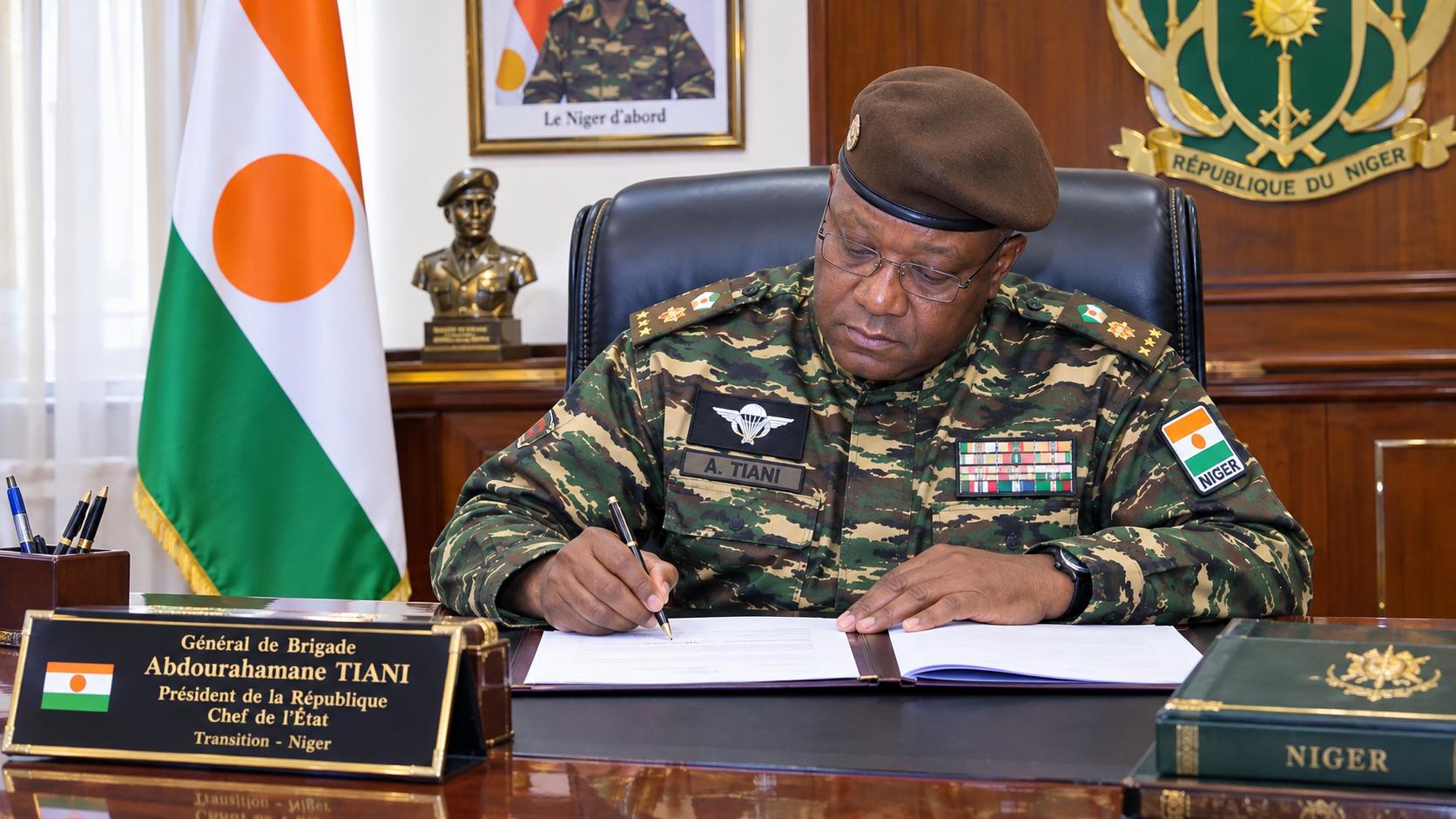
The fallout keeps widening. Since the CNSP seized power by force in July 2023, Niger’s rulers have moved from jailing critics to erasing them legally — and the reactions are now coming from every direction. General Abdourahamane Tiani’s government no longer settles for silencing opponents through prison or exile; it strips them of their nationality by decree, turning a passport into a political verdict. The debate this has triggered — inside Niger, across the Sahel and among international jurists — is about far more than a handful of names. It is about whether citizenship itself can survive as a right when it becomes a reward for loyalty.
A legal framework built to punish dissent
The repressive architecture hardened in late August 2024, when General Tiani signed an ordinance establishing a “national register of persons involved in acts of terrorism or threats to state security.” The anti-terrorism label sounds narrow on paper. In practice, it functions as a sweeping legal instrument aimed at politicians, civil society figures and military officers alike.
The most contentious provision allows authorities to impose provisional or permanent revocation of Nigerien citizenship on anyone suspected of “activities likely to disturb peace and security,” of “regionalist or xenophobic remarks,” or of “collusion with a foreign power.” Those categories are deliberately elastic. A protest chant, an editorial, a critical post — any of these can be reframed as grounds for national repudiation. The result is a mechanism in which the accusation and the punishment are decided by the same authority.
How the machinery unfolds
The sequence has become almost routine, and each stage feeds the next:
- Publication of the register of “security threats” (August 2024)
- Asset freezes and travel bans targeting opponents
- Presidential decrees formally revoking nationality
- Confiscation of identity documents, producing de facto statelessness
What distinguishes this campaign is its administrative efficiency. There is no courtroom drama, no public trial, no opportunity for the accused to respond. A signature is enough to undo a lifetime of belonging.
The names behind the decrees
The list of targets has grown with each new decree. The waves of removals have systematically hit the circle around deposed president Mohamed Bazoum, former ministers and leading voices of the opposition.
| Individual | Role / position | Stated justification |
|---|---|---|
| Ouhoumoudou Mahamadou | Former prime minister | Alleged intelligence links with a foreign power |
| Hassoumi Massoudou | Former foreign minister | Threat to national security and conspiracy |
| Rhissa Ag Boula | Former minister of state, leader of the FRR resistance council | Reforming an armed group, inciting insurrection |
| Alkache Alhada | Former interior and trade minister | Disseminating data that disturbs public order |
| Amadou Barou Chekaraou | Former senior state official | Threat to state security and glorification of violence |
Alongside these political heavyweights, civil society actors, media activists such as Mariama Djibrine (known as Mayra), and former senior military officers have seen their legal identity cancelled by executive decree. People born on Nigerien soil, who served the country for decades, are administratively banished overnight — stripped of passports, bank access and civic rights.
The patriotic rhetoric and its contradictions
The CNSP’s messaging rests on a persistent blurring of lines: the nation and the military government are presented as one and the same. In this framing, challenging the junta is equivalent to betraying Niger. The posture is designed to flatter sovereignist sentiment while diverting attention from the absence of a political roadmap and the deteriorating security situation in the three-border zone.
Yet the citizenship purge reveals something closer to anxiety than confidence. A government secure in its popular legitimacy and territorial control does not need to issue patriotism certificates or manufacture stateless persons to govern. By sealing off republican channels of dialogue and confiscating the nationality of its opponents, the junta hardens resentment and pushes dissent underground — or toward armed action.
What international law says
From a legal standpoint, the Tiani government’s decisions sit in direct conflict with the Universal Declaration of Human Rights. Article 15 states plainly that “everyone has the right to a nationality” and that “no one shall be arbitrarily deprived of his nationality.” Applying such sanctions retroactively, outside any judicial process and without the guarantee of a fair hearing before an independent court, breaches the regional and international conventions Niger has signed.
Jurists and human rights organisations are raising the alarm: by setting a precedent in which nationality becomes a reward for loyalty to an authoritarian regime, the CNSP undermines the very concept of citizenship. If being Nigerien now depends on the goodwill of the junta’s leader, the entire republican edifice is at risk.
Reactions at home and abroad
The backlash has been varied but persistent. Opposition figures in exile describe the decrees as a political death sentence delivered without trial. Civil society groups warn that the measures create a class of invisible citizens — people who cannot travel, bank, vote or seek legal redress. International observers and legal scholars point to the precedent being set, not only for Niger but for a region where citizenship rules are already contested.
Within Niger, the public debate is more muted but not absent. Some see the decrees as a necessary tool against foreign interference and destabilisation. Others quietly question how a country fighting armed groups can afford to alienate its own trained officials, diplomats and soldiers. The economic dimension is harder to ignore: revoked citizens lose access to accounts and businesses, and the uncertainty discourages investment in a fragile economy.
An autocratic trajectory with no clear exit
By turning nationality into a political variable, Abdourahamane Tiani’s regime shows its real face: an autocracy in perpetual overdrive, unable to tolerate the slightest contradiction. Revoking identity papers will not lower the price of staple goods in Niamey, nor will it restore security in the Liptako-Gourma region.
History offers a consistent lesson: regimes that strip their citizens of legal belonging out of fear of debate tend to lose their own legitimacy in the end. What comes next is uncertain — but the pressure is building from within and without. General Tiani may yet discover that a people’s identity runs far deeper than any military decree, however absolute it claims to be.
Comments are closed, but trackbacks and pingbacks are open.