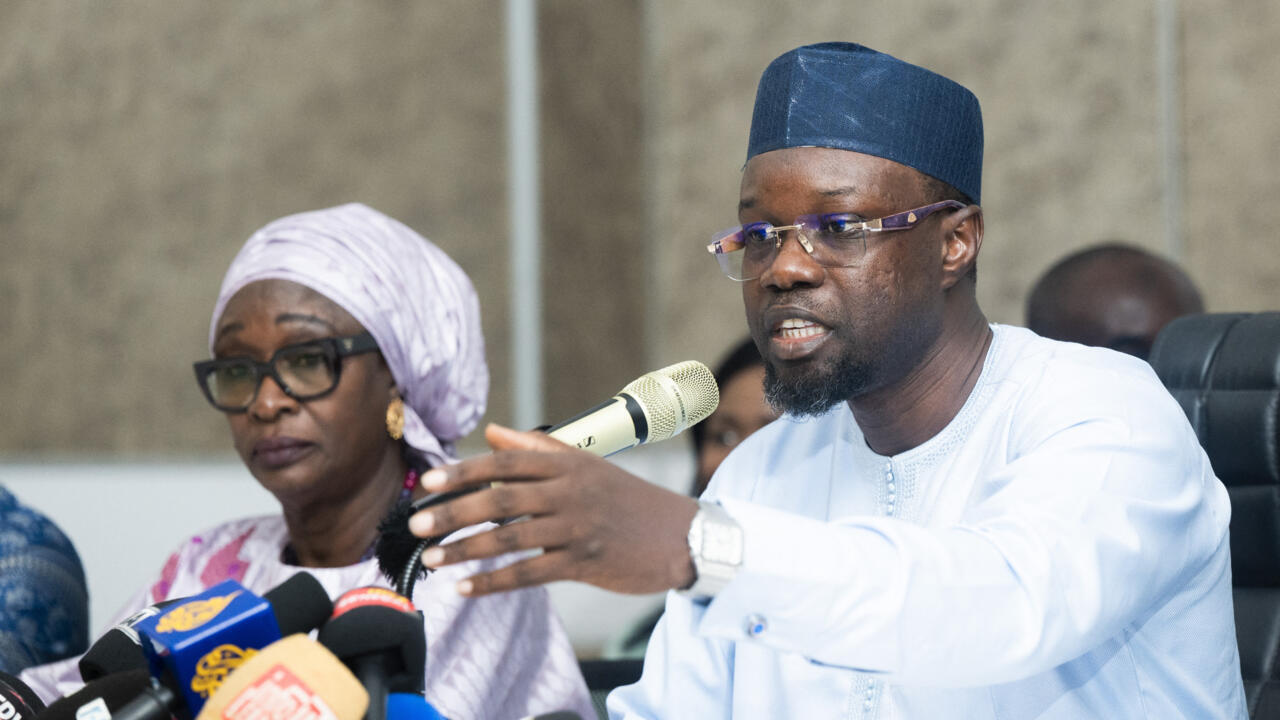
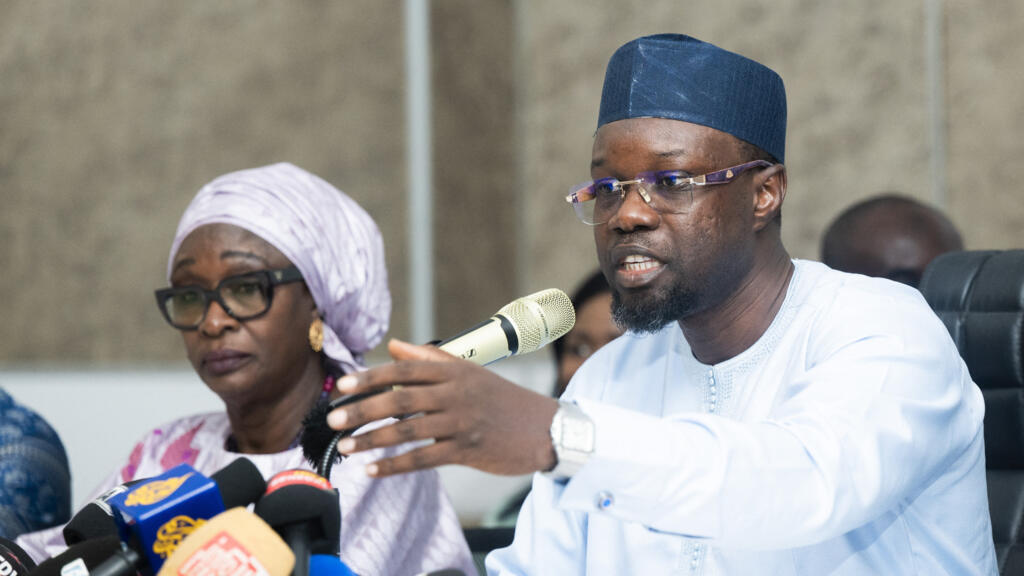
One week after his dismissal by President Bassirou Diomaye Faye, Ousmane Sonko has initiated a strong political offensive. The outgoing Prime Minister and leader of Pastef yesterday severely criticized Bassirou Diomaye Faye. While assuring he would not seek to destabilize institutions, Sonko reminded that Pastef’s parliamentary majority grants it the power to bring down the governmental team through a motion of censure. For Ousmane Sonko, the current situation resembles a form of political cohabitation. He asserts he had alerted the President of the Republic to this possibility months ago, but was not heard.
Ousmane Sonko did not mince words yesterday in describing the government formed by Prime Minister Al Amine Lô. For the Pastef president, the current executive suffers from a fundamental deficit of political legitimacy. “We have a government that lacks any political foundation,” he affirmed, dismissing the coalition put forward by the presidency. “This coalition they speak of represents nothing,” he declared, judging that labeling it a “government of technocrats” is merely a disguised admission of political isolation. Ultimately, Ousmane Sonko claims Pastef’s monopoly on popular legitimacy within the majority, reiterating that his party remains the country’s primary political force, born from the ballot boxes, and that governing without it amounts to governing without the people.
A challenge for the presidential camp
The Senegalese executive thus finds itself in a precarious position. Pastef’s absence from the government poses a significant political challenge for the Diomaye Faye camp. Indeed, the party remains the leading political force in the nation and commands a comfortable majority in Parliament. This configuration paves the way for a unique form of cohabitation within the presidential majority itself. While Bassirou Diomaye Faye retains his constitutional prerogatives, the implementation of his agenda will largely depend on his ability to maintain a relationship of trust with Pastef’s deputies.
Beyond the composition of the government, the question of political stability now looms. There is already widespread concern regarding the executive’s capacity to pass its legislative proposals and carry out announced reforms without the direct involvement of the majority party in governmental management.
President Bassirou Diomaye Faye has, in effect, erased the memory of what brought him to power; he has lost the thread of history. He now governs in an unusual space, one of formally legitimate power that is narratively orphaned. Legitimate because constitutional. Orphaned because detached from the history that gave it meaning beyond mere state management.
And on the other side, in the National Assembly, with its 130 deputies, its intact voice and memory, and its overwhelming popular legitimacy, Ousmane Sonko waits. Not as an ordinary adversary, but as the guardian of the original narrative. As the one who can declare, at any moment, ‘we were here before, we will be here after’.
Not cohabitation but a rupture…
The political situation unfolding in Senegal is truly unprecedented in the country’s history. It is not a classic cohabitation – an opposition between a president and an opposing parliamentary majority – but something more complex and dangerous: a rupture within the same movement, between a head of state and a party that controls 130 of the 165 parliamentary seats and formally refuses to participate in the government.
How can a government of technocrats, lacking its own parliamentary base, govern with a Pastef that holds an absolute majority in the Assembly, whose president is Sonko himself, and which simultaneously orchestrates a national mobilization of a million activists? This critical question for Africa politics English speakers will be resolved – or not – in the coming weeks and months, in the streets, the institutions, and the corridors of the Palace.