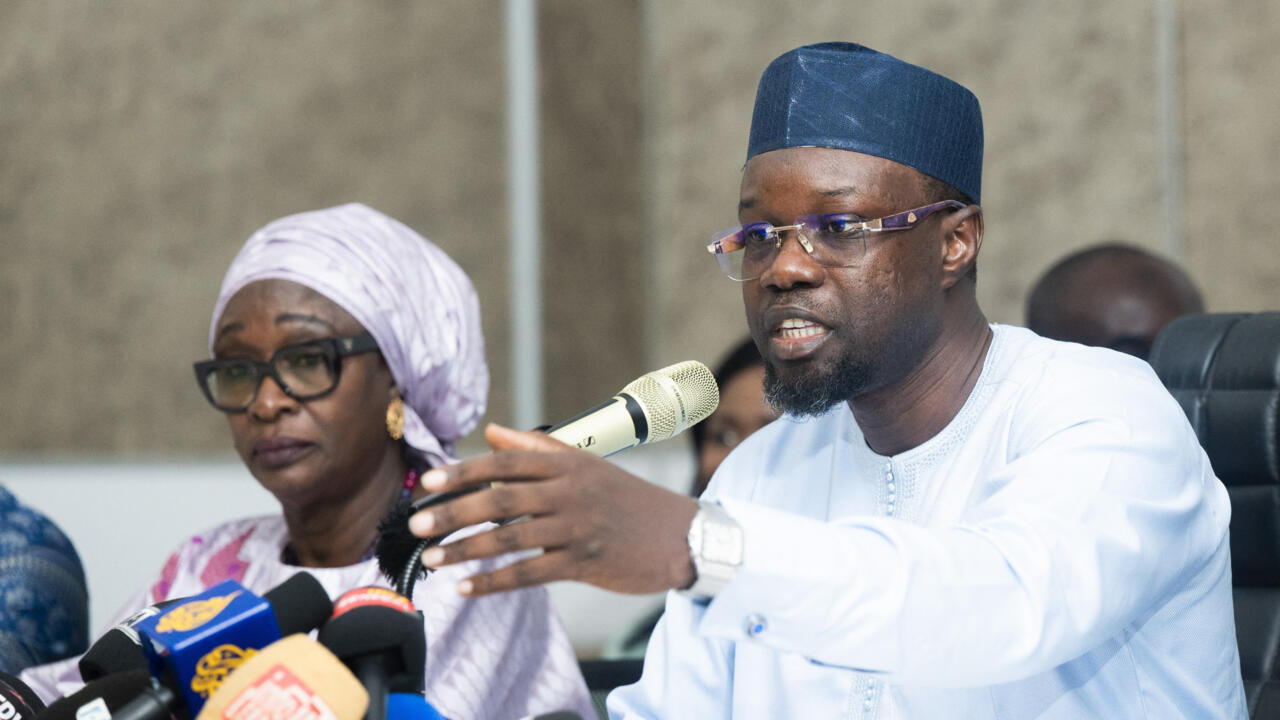
Just days after his removal from office, Ousmane Sonko, the former Prime Minister and leader of the Pastef party, has launched a sharp counterattack against President Bassirou Diomaye Faye. Speaking at a press conference in Dakar on June 2, Sonko minced no words in condemning the government reshuffle that saw him ousted. While he stopped short of calling for institutional destabilization, he emphasized that Pastef’s parliamentary majority could trigger a no-confidence motion to bring down the current administration at any moment.
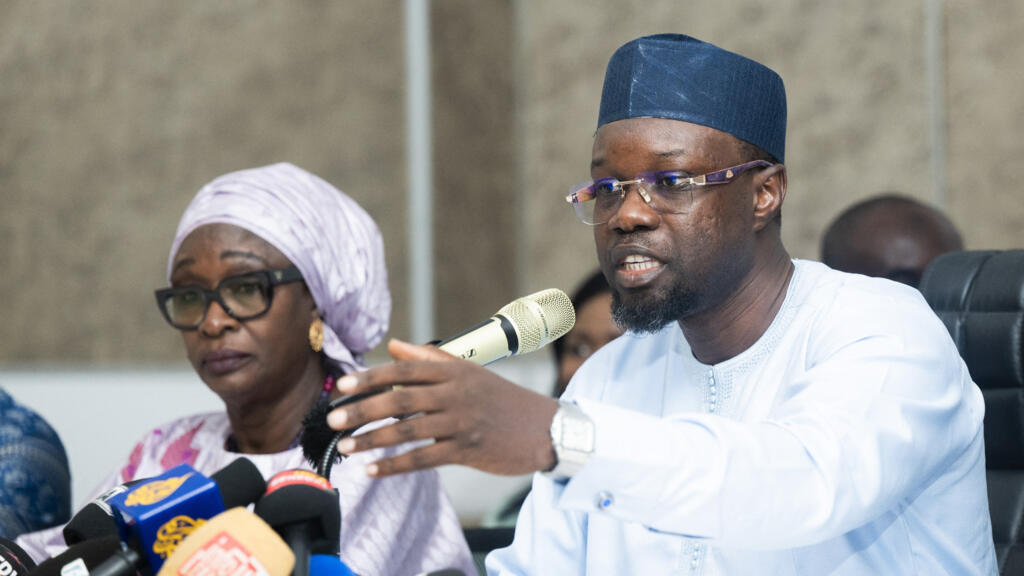
Sonko challenges the government’s legitimacy
Ousmane Sonko did not hold back in his critique of the new administration led by Prime Minister Al Amine Lô. The Pastef leader dismissed the government’s claims of legitimacy, arguing that it lacks any real political foundation. “We have a government with no political base,” he stated, dismissing the coalition backing the presidency as meaningless. “The so-called coalition they keep mentioning represents nothing,” he declared, adding that labeling the cabinet as a “technocratic government” is simply an admission of political isolation. Sonko went on to assert that Pastef holds the sole legitimate claim to popular support within the majority, as the party that secured the most votes in the elections and therefore represents the people’s will.
A fragile executive facing a political challenge
The current situation in Senegal presents a significant political test for President Bassirou Diomaye Faye’s administration. Without Pastef’s participation in the government, the executive branch finds itself in a precarious position. As observers note, the party remains the dominant political force in the country and commands an overwhelming majority in Parliament. This dynamic sets the stage for a complex internal power struggle rather than a traditional cohabitation between opposing political blocs.
Government stability in question
Analysts warn that the absence of Pastef in the cabinet raises serious concerns about the government’s ability to pass legislation and implement promised reforms. The key question now is whether President Faye can maintain the trust of the Pastef deputies, whose votes are essential for advancing his agenda. Failure to secure this cooperation could lead to legislative gridlock and undermine the administration’s effectiveness.
Ousmane Sonko: guardian of the people’s mandate
Some political commentators argue that President Faye has strayed from the principles that originally defined his leadership. As one analyst put it, he now governs in an “odd space” — constitutionally legitimate but narratively adrift, disconnected from the movement that propelled him to power. Meanwhile, Ousmane Sonko remains a formidable figure in the National Assembly with 130 deputies, his party’s mandate intact, and its popular legitimacy unchallenged. Rather than being a mere opponent, Sonko positions himself as the guardian of the movement’s original vision, a voice that can remind the administration of its roots — and the consequences of abandoning them.
A historic rupture, not a typical cohabitation
This political standoff is unlike anything seen in Senegal’s recent history. It is not a conventional cohabitation, where the president and a hostile parliamentary majority face off. Instead, it represents a deep and potentially dangerous rupture within the same political movement. The government, led by non-elected technocrats, now faces a party that won a landslide victory in the polls, controls 130 of the 165 parliamentary seats, and continues to mobilize over a million supporters nationwide.
As the situation evolves, the coming weeks and months will be critical. The answers — or lack thereof — will unfold in the streets, within institutions, and in the corridors of power. One thing is certain: the balance of Senegal’s political landscape has shifted, and the path forward remains uncertain.