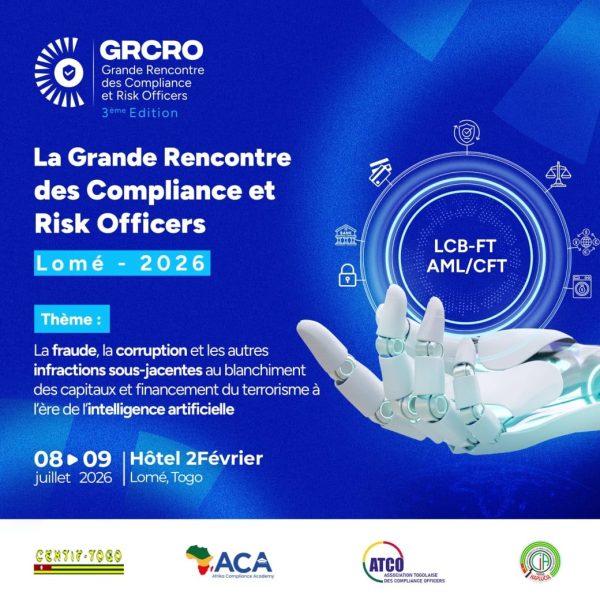
In a globalised economy where trust has become the most valuable currency, Africa is accelerating its regulatory transformation. The Togolese capital will host the third edition of the “Meeting of Compliance and Risk Officers” on 8 and 9 July 2026.
This event, now firmly established in the calendar of the continent’s major professional gatherings, is set to bring together more than 1,000 African and European experts. Moreover, this assembly in Lomé lays the groundwork for a crucial challenge for the continent: how to reconcile economic growth, the demands of international donors and business ethics.
“Compliance” – the new shield of African institutions
Long seen as a secondary administrative constraint, compliance has become the strategic core of financial institutions and multinationals operating in Africa. This concept encompasses the set of procedures designed to ensure that an organisation scrupulously respects laws and ethical standards.
From anti-money-laundering units to corruption prevention, from the highly strategic protection of personal data to reputation risk management, compliance has become the mandatory key to reassuring markets.
If the topic is gaining such traction in Lomé, it is because Africa faces unprecedented pressure. International financial institutions and development partners are continuously tightening their evaluation criteria. For banks and public enterprises on the continent, having a robust compliance department is no longer an option to shine internationally: it is an absolute condition to avoid the axe of sanctions and to maintain access to global correspondent banking lines.
Why choosing Lomé sends a strong signal
Hosting this thousand specialists in Togolese territory is no coincidence. In recent years, Togo has embarked on extensive reforms to clean up its business environment and modernise its legal framework, notably by aligning with the latest community directives of West Africa. By turning its capital into a hub for risk reflection, the country positions itself not only as a logistical facilitator but also as a key player in the quest for financial transparency in the sub-region.
Over two days, exchanges between European and African experts will allow for comparing field realities and standardising practices. Faced with shifting geopolitical crises and increasingly extraterritorial regulations, West Africa intends to prove in Lomé that it no longer merely suffers global standards, but that it is training the executives capable of applying them.
Comments are closed, but trackbacks and pingbacks are open.