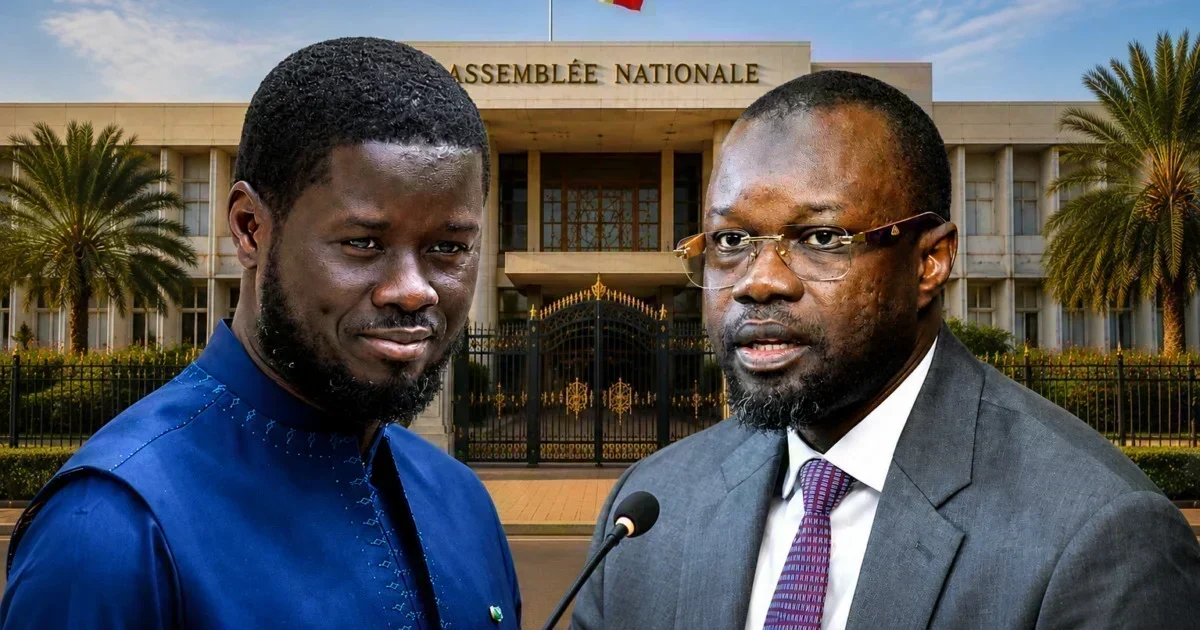
Senators dismiss all amendments proposed by the government on special credit regulations
Tensions escalate between Senegal’s executive and legislative branches as procedural disputes stall critical financial legislation.
Political friction intensifies at the National Assembly as lawmakers and government officials clash over the regulatory framework for special credits. Following heated debates on asset declarations, yesterday’s technical commission meeting exposed deep divisions on the draft law governing these financial allocations. President Bassirou Diomaye Faye’s administration, through Justice Minister Moussa Sarr, introduced six amendments—only to see them all rejected by the ruling Pastef party legislators. Will the government deploy blocked voting procedures next week during the plenary session?
Yesterday’s technical commission review of the proposal—spearheaded by legislators Guy Marius Sagna, Mame Diarra Bèye, and Alphonse Mané Sambou—fell under the purview of the Finance and Budgetary Control Commission, chaired by Cherif Ahmed Dicko. Traditionally, the Finance Minister, Cheikh Diba, would have represented the government. However, President Faye issued an interim decree, replacing Diba with Justice Minister Moussa Sarr. The move signaled a deliberate shift in strategy, with the decree reportedly signed on August 7—a full week before the meeting.
Commission proceedings began at 3 PM under Dicko’s leadership. Immediately, Minister Sarr raised concerns about the draft law’s structural ambiguities before submitting his six amendments. Pastef deputies promptly requested—and were granted—a recess to deliberate. Upon reconvening, they returned with a firm rejection of every amendment proposed by the government.
Legislators strike down all government amendments
In a reversal of previous leniency, Pastef parliamentarians this time dismissed all six amendments introduced by Justice Minister Sarr. Only one amendment, proposed by Alphonse Mané Sambou, secured approval. His revision to Article 8 redefined parliamentary oversight of special credits, shifting responsibility to the Finance and Budgetary Control Commission. The original wording had called for general parliamentary control, but Sambou’s amendment specified stricter institutional accountability: “Special credits shall undergo parliamentary scrutiny by the Finance and Budgetary Control Commission. Managers of these credits must maintain detailed accounting through registers, statements, journals, decisions, and supporting documents to facilitate verification.”
The rejected amendments targeted multiple aspects of the draft law. The government sought to expand the scope of special credits beyond their original intent—defense, national security, and intelligence activities—to include broader national interests such as social order, African values of solidarity, humanitarian emergencies, and national stability. Legislators, however, refused these additions outright.
The executive’s attempt to broaden the definition of special credits to encompass expenditures by the National Assembly and Prime Minister’s office—previously limited to presidential allocations—also met with rejection. Similarly, Article 5’s restrictions on social, political, and operational spending faced dismissal. The government’s proposed control mechanism, which deferred to existing laws and regulations, clashed with legislators’ insistence on commission-led oversight.
Clash over definitions and oversight mechanisms
The central dispute revolves around the core definition of special credits. While the draft law restricts their use to defense, security, and intelligence activities, the government pushed for a more expansive interpretation, invoking national stability, social cohesion, and humanitarian crises. Control mechanisms presented another point of contention: legislators demanded exclusive oversight by the Finance and Budgetary Control Commission, whereas the government favored a broader, law-based approach.
Despite these setbacks, the draft law advanced to the plenary session, slated for next week. Observers anticipate the government will reintroduce its amendments, only to face renewed rejection. With National Assembly President Ousmane Sonko previously vowing to block the use of Article 82—reserved for government bills—unless absolutely necessary, another constitutional referral appears inevitable.
Comments are closed, but trackbacks and pingbacks are open.