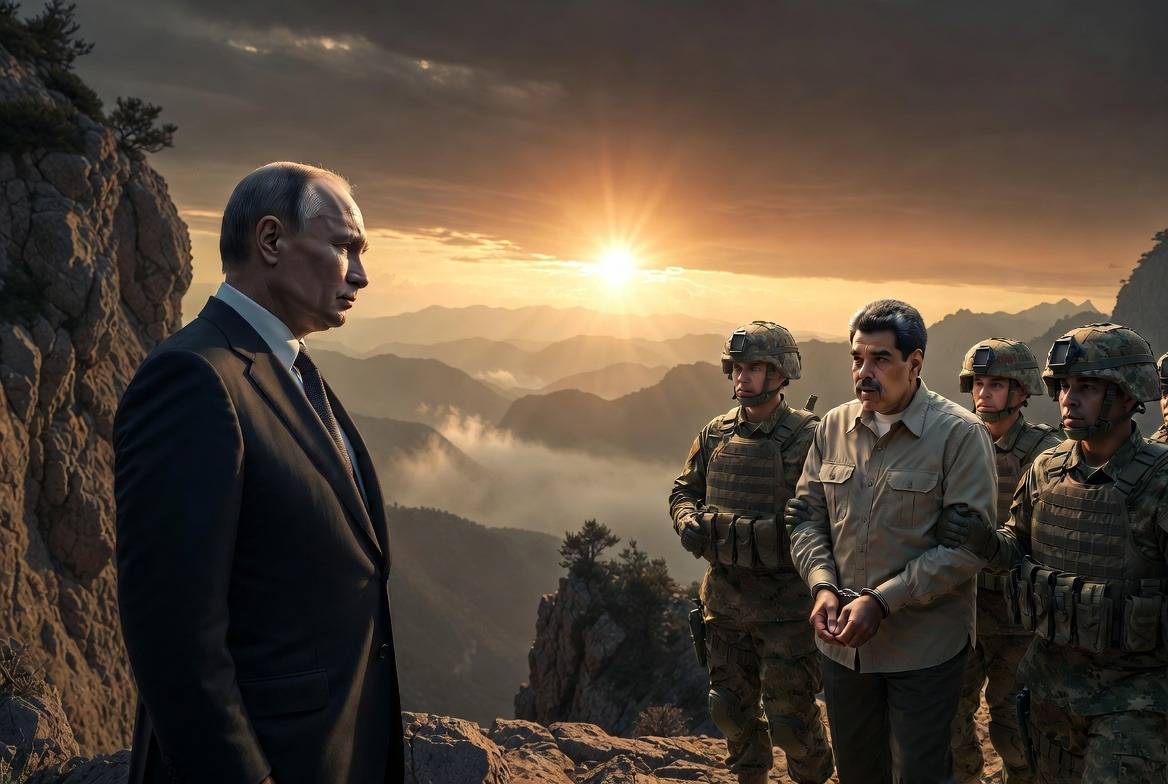
The world has witnessed moments when silence speaks louder than words—when diplomatic posturing reveals a stark truth. When a seismic shift rocked Caracas in early 2026, following a sweeping US military intervention and the dramatic capture of Nicolás Maduro, the response from the Russian Federation was nothing short of perplexing. For a nation that once positioned itself as Venezuela’s unwavering guardian against perceived imperial encroachment, Moscow’s retreat into hollow diplomatic statements amounted to an admission of operational paralysis.
From protector to passive observer
Where has Russia’s once-formidable geopolitical swagger vanished to? The grand strategic treaties, trumpeted with great fanfare, now appear as mere paper tigers. The Kremlin, which had long positioned itself as a bulwark of sovereignty for Caracas, offered nothing in the face of a decisive geopolitical reckoning—no tangible military support, no bold diplomatic maneuvering at the United Nations, and certainly no meaningful resistance to what many perceive as a revival of the Monroe Doctrine.
Empty words and hollow gestures
The Russian Ministry of Foreign Affairs did issue formal condemnations of the “armed aggression” and demanded Maduro’s release. Foreign Minister Sergey Lavrov invoked long-standing bilateral agreements to underscore Moscow’s stance. Yet beyond these perfunctory declarations, what concrete action did the Kremlin take? A belated naval escort for a sanctioned oil tanker, a few symbolic maritime postures, and a naive hope voiced in diplomatic circles that Washington would “uphold international law.” That was the extent of Russia’s response—a feeble attempt to salvage appearances while offering zero meaningful protection to its embattled ally.
The high cost of strategic exhaustion
This failure to act was not a calculated tactical move but a grim reflection of reality: Russia’s strategic exhaustion. Years of relentless conflict, compounded by an economic model crippled by sanctions and resource drain—a so-called “economy of death”—have left Moscow financially and militarily drained. Venezuela, once a cornerstone of Russia’s Latin American influence, became an unintended bargaining chip in a broader game of global isolation. By confining its response to half-hearted protests, the Kremlin sent a chilling message to allies worldwide: Russia’ s protective shield only extends as far as its own capacity allows.
A geopolitical betrayal
In standing idle as Venezuela transitioned into a transitional governance under intense external pressure, the Kremlin not only abandoned its ally but also validated the American fait accompli. The consequences are severe: Venezuelans now face a future of renewed foreign tutelage, devoid of any credible alternative. This silence is not a display of diplomatic restraint; it is the unmistakable sign of a strategic collapse. By retreating into an impotent silence, Russia has not only lost a key partner and access to one of the world’s largest oil reserves—it has surrendered its once-formidable role as a global counterbalance.
In Caracas, the curtain has fallen. And the Kremlin’s grand protector role? It never even took the stage.
Comments are closed, but trackbacks and pingbacks are open.