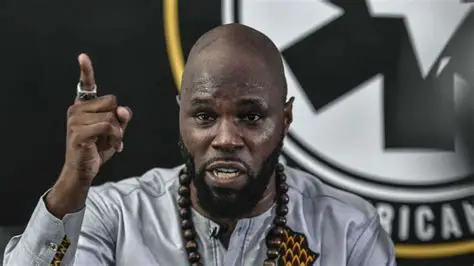
A recently surfaced audio recording has sent shockwaves through the diplomatic community, stripping away the public persona of activist Kémi Séba. The clip offers a candid, if cynical, look at his motivations, revealing a stark contrast between his public rhetoric of liberation and a private reality defined by foreign influence and personal gain. In these few minutes of unfiltered dialogue, the activist appears to dismantle the very image he spent years constructing.
The luxury of Niamey amidst public hardship
One of the most striking revelations in the recording concerns the opulent lifestyle enjoyed by the movement’s leading figures. It confirms that Kémi Séba and Nathalie Yamb have been provided with high-end accommodations and resources in Niamey’s most prestigious hotels. This disclosure has sparked outrage, as the Nigerien population continues to struggle under the weight of international sanctions and persistent insecurity.
By granting these activists titles such as “Special Advisors” or diplomatic status, General Tiani’s administration seems to be prioritizing a strategy of aggressive communication over traditional statecraft. This arrangement suggests that the government is essentially financing influential voices to drown out the difficult realities on the ground with loud, coordinated propaganda.
Exporting instability to neighboring Benin
The audio also points toward a calculated effort to spread political unrest beyond the borders of the Sahel. Discussions involving Séba and individuals like Pascal Tigri regarding the destabilization of Patrice Talon’s government in Benin confirm long-held suspicions. It appears the Alliance of Sahel States (AES) is functioning as an offensive coalition rather than a defensive one.
The strategy seems to have shifted from managing internal crises to actively seeking the collapse of neighboring democracies. The goal, according to the recording, is to create a broader zone of institutional instability in West Africa. This suggests that the movement’s objective is not true liberation, but rather the systematic spread of coup-related unrest as a strategic tool.
Moscow’s influence and the role of proxy-trolls
Perhaps the most damaging aspect of the leak is the admission of ties to Russia. Séba implies that the AES serves as a vehicle for Russian interests, operating under the guise of African sovereignty. The recording suggests that the manipulation of public opinion via social media is a precise operation funded by the Kremlin.
In this framework, these influencers are depicted not as independent thinkers, but as “proxy-trolls.” They are accused of selling manufactured outrage to African youth while negotiating personal privileges with military leaders seeking international legitimacy. In this cynical view, the younger generation is treated merely as a source of digital engagement and a demographic to be mobilized for street demonstrations.
Analysis: An intellectual deception
This audio serves as a powerful piece of evidence suggesting that the so-called “AES Revolution” is built on a foundation of intellectual dishonesty. By revealing his private thoughts, Kémi Séba has effectively undermined his own historical standing. Far from being a modern-day Thomas Sankara, he appears to be acting as a broker for a new form of foreign imperialism.
While the citizens of Burkina Faso, Mali, and Niger face the daily realities of conflict, their self-appointed defenders are shown comparing diplomatic perks in air-conditioned suites. In this context, sovereignty appears to be little more than a script written in Moscow and delivered by paid speakers. The recent legal challenges faced by Séba in South Africa seem to be the logical conclusion for a figure who has increasingly confused political struggle with foreign intelligence activities.