
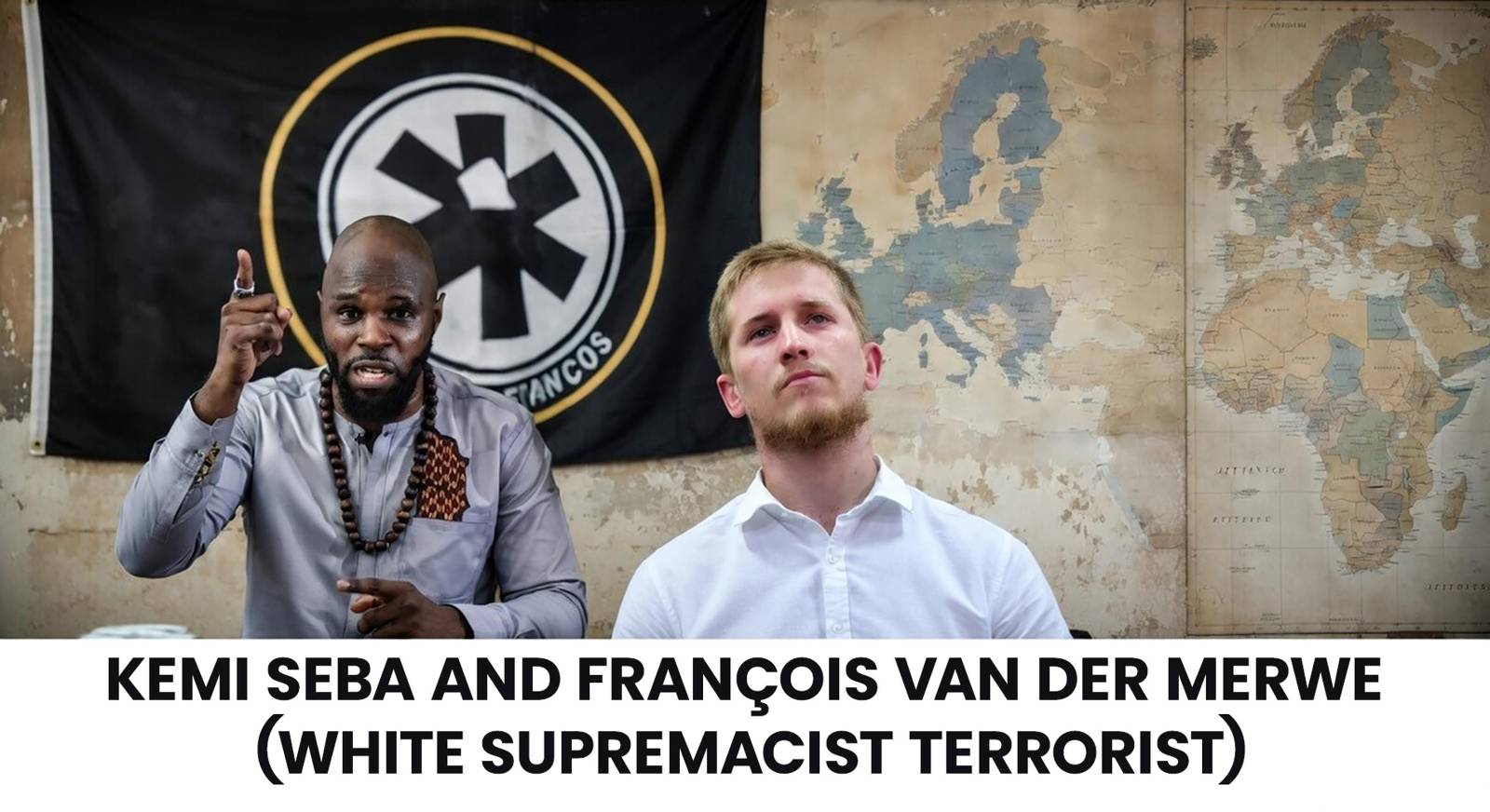
Some arrests merely confirm suspicions, while others serve to reveal deep-seated contradictions. The detention of Kemi Seba on South African soil on Wednesday, April 15, belongs to the latter group. This event has drawn intense scrutiny not just because of Seba himself, but because of the individual taken into custody with him and the financial exchange that allegedly took place.
François van der Merwe, a 26-year-old from Pretoria, is the head of the Bittereinders. This organization is not just a fringe political group; it has been formally labeled a terrorist entity by South African authorities. Understanding the gravity of this alliance requires a look at what the Bittereinders represent and their ultimate objectives.
The ideology of the Bittereinders
The group’s name is a callback to the final, uncompromising phase of the Second Boer War (1899–1902). The original Bittereinders were Boer guerrillas who viewed any peace treaty with the British as a betrayal of their civilization. Van der Merwe has intentionally adopted this legacy, moving beyond mere symbolism into a radical political program.
The modern iteration of the movement gained momentum following the murder of Brendan Horner and subsequent protests in Senekal. Van der Merwe positioned his organization to appeal to young Afrikaners, operating on the core belief that Black political leadership in South Africa poses a terminal threat to their culture and existence.
Their agenda is explicit: they seek self-determination through the creation of a Volkstaat. This would be a racially segregated, sovereign territory carved out of South Africa, where Black citizens would be entirely excluded. This vision mirrors the demands of the most radical Afrikaner nationalists from the early 1990s, such as the AWB, who used violence to try and stop the transition to democracy. Van der Merwe is seen as the contemporary successor to that extremist tradition.
Paramilitary activities and legal troubles
Since its founding in 2021, the Bittereinders have been active in counter-protests against major political parties like the ANC and EFF. Van der Merwe rejects the post-1994 democratic order, viewing it as an occupation rather than a legitimate government. Consequently, the State Security Agency has kept the group under surveillance, particularly regarding their paramilitary training camps where members practice tactical operations and self-defense.
Van der Merwe’s personal history is equally volatile. He was previously arrested for assault in late 2023 and again in early 2024 for breaking police lines during a courthouse protest. Despite these legal setbacks, he has remained defiant, often quoting the Afrikaner phrase “Soet is die Stryd” (Sweet is the Struggle), signaling his deepening commitment to the cause.
A controversial financial transaction
It is this radical leader that Kemi Seba allegedly sought out for assistance. According to the Hawks, South Africa’s elite police unit, Van der Merwe is suspected of acting as a fixer for Seba. The activist reportedly paid Van der Merwe approximately 250,000 rands (over 13,000 euros) to facilitate an illegal crossing of the Limpopo River into Zimbabwe, with the eventual goal of reaching Europe.
Under South African law, providing funds to a leader of a designated terrorist organization is a major criminal offense, regardless of the reason for the payment. By handing over this significant sum, Seba has moved beyond mere association into potential criminal complicity.
The collapse of a political narrative
For years, Kemi Seba has cultivated an image as a champion of Black sovereignty and a fierce critic of Western imperialism. He built his reputation in francophone Africa by advocating for African dignity and resisting external oppression. However, this persona is now facing a total crisis of credibility.
The movement Seba allegedly funded does not just oppose his stated values; it views the democratic rights of Black South Africans as an injustice against white civilization. The Bittereinders’ proposed solution is a return to the principles of Apartheid. For an activist who claims to fight for the Black diaspora to financially support a group seeking a racially exclusive white state is a staggering contradiction.
Kemi Seba now faces a complex legal battle involving charges of illegal immigration, conspiracy, and the potential financing of terrorism. Beyond the courtroom, he faces a historical reckoning: the narrative he spent years building may have permanently shattered by his choice of allies.
