Could the United States soon add Mali to the list of nations targeted by its military operations? Recent reports suggest the administration of Donald Trump is seriously considering airstrikes against the Jama’at Nusrat al-Islam wal-Muslimin (JNIM), an Al-Qaïda-linked faction operating across the Sahel, particularly in Mali. This move comes nearly four years after France’s withdrawal from the country following a decade-long counterterrorism campaign.
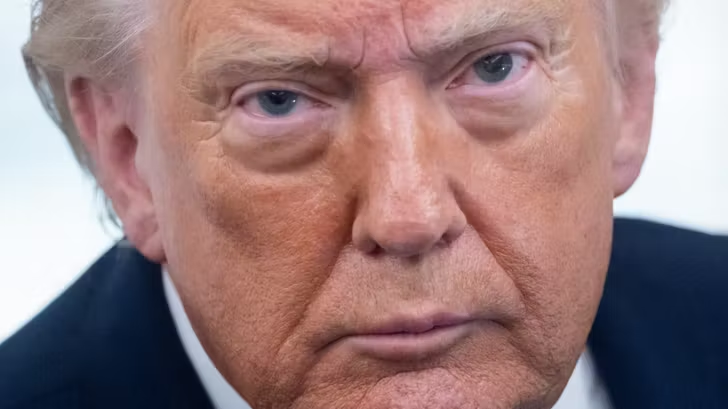
While no final decision has been made, internal deliberations within the Trump administration are ongoing. Sebastian Gorka, a key counterterrorism advisor to the National Security Council, is reportedly among the strongest advocates for a military intervention. However, his position is not universally supported within the administration. If authorized, these airstrikes would mark the eighth country targeted by U.S. forces since the beginning of Trump’s second term.
The White House has yet to confirm any plans for strikes in Mali. However, a senior administration official revealed that Washington is actively encouraging North and West African nations to bolster their counterterrorism capabilities by acquiring American-made equipment and services. The same official described the Sahel’s terrorism crisis as a « multinational challenge », emphasizing the need for collective action.
The JNIM has emerged as one of the most formidable armed groups in West Africa. Operating primarily from Mali, it has steadily expanded its reach into neighboring coastal countries. Security analysts warn that its influence has grown significantly in recent years, fueled by the region’s deteriorating stability.
Potential pitfalls: escalation risks and unintended consequences
Experts familiar with the Sahel’s security dynamics caution against the potential fallout of a U.S. military intervention. Some argue that eliminating JNIM leaders without a broader de-radicalization strategy could backfire, making it harder to dismantle one of the world’s most sophisticated jihadist networks. Others point out that past military efforts—including France’s decade-long operation and Russia’s five-year presence—have failed to curb the spread of extremism in the region.
There are also concerns that weakening the JNIM could inadvertently empower rival armed factions, particularly the Islamic State in the Sahel (IS Sahel). The two groups have clashed repeatedly, and a U.S. strike campaign might tip the balance in favor of the less formidable but increasingly aggressive IS affiliate.
Another looming concern is the risk of escalation with Russian forces, which have expanded their footprint in Africa in recent years. Moscow has offered military support to several Sahelian nations, including Mali, Burkina Faso, and the Central African Republic. However, Western officials have questioned the effectiveness of these interventions, with one stating: « We hope African nations take note of Russia’s mixed record in combating terrorism. »