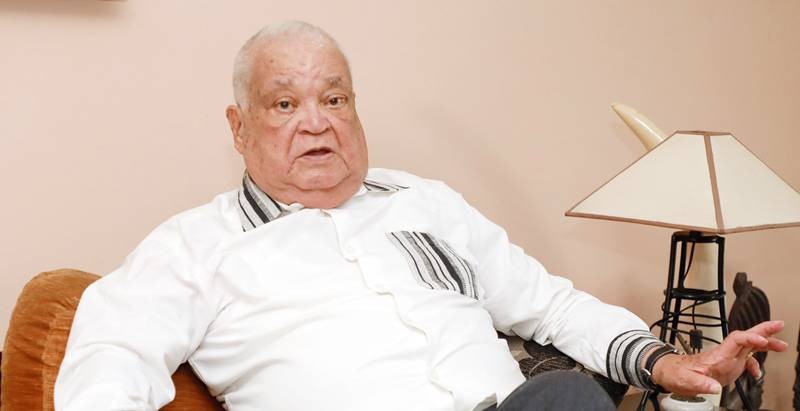
At 85 years old, Auguste Miremont stands as a monumental figure in the history of Côte d’Ivoire. As the nation’s first Minister of Communication and a veteran of the media landscape, his life has been intertwined with the political evolution of the country. Today, the man who spent decades documenting the state is himself the subject of a new book titled “Auguste Miremont, from Houphouët to Ouattara, in complete freedom…”
I sat down with this statesman to discuss his journey, his transition from a journalist to a subject of study, and his unique perspective on the leaders who have shaped Côte d’Ivoire.
A legacy of transmission
For a long time, Auguste Miremont resisted the idea of a biography. It took the persistence of author Michel Koffi to break his reserve. Having moved away from official duties as a deputy, mayor, and minister, Miremont preferred a life of discretion. However, the call to preserve history for future generations eventually won him over.
“Many people insisted that one cannot live through so many stages of our national history without leaving a trace,” Miremont explains. He views the project not as self-glorification but as a vital act of transmission. The process was intensive, involving 30 hours of interviews over 18 months, resulting in a work that spans the breadth of modern Ivorian history.

From the stability of Houphouët-Boigny to the turbulence of the 1990s
Miremont’s analysis of the country’s political trajectory is nuanced. While the era of Félix Houphouët-Boigny is often remembered for its remarkable stability, Miremont recalls the underlying tensions and mutinies that the founding father managed with political genius. “He knew how to listen, wait, and act at the precise moment,” he notes.
The post-Houphouët era was far more volatile. Miremont describes the 1999 coup against President Henri Konan Bédié as a profound personal and national tragedy. At the time, Miremont led a powerful parliamentary group, and seeing the institutional rupture was devastating. He recalls weeping at the airport upon hearing of the deaths of Robert Guéï and Emile Boga Doudou, realizing that the prestigious image of Côte d’Ivoire—once a model of stability in the region—was crumbling.
Personal ties and presidential temperaments
Throughout his career, Miremont maintained diverse relationships with the nation’s leaders. He remembers Houphouët-Boigny’s respectful, if slightly formal, demeanor—the President often addressed him as “De Miremont.” With Henri Konan Bédié, he shared a long-standing professional and personal bond rooted in their time in government and parliament.
Even with political opponents like Laurent Gbagbo, Miremont maintained a level of mutual respect. He recalls negotiations in the National Assembly aimed at creating a government of national unity to solve economic crises. “When Gbagbo became President, he even assisted me financially at a certain point, for which I am grateful,” Miremont shares.

The Alassane Ouattara era
When asked which leader best embodies the philosophy of Houphouët-Boigny, Miremont points to Alassane Ouattara. He believes the current President learned the most from the founding father, particularly regarding patience and the ability to listen. However, he notes a change in temperament: “When he was Prime Minister, he was incredibly firm and strict with his collaborators. Today, perhaps due to age and experience, he is more measured and lenient.”
Miremont expresses deep admiration for Ouattara’s tenacity and the massive infrastructure projects currently transforming the country. From new universities and hospitals to the modernization of cities like Daloa, the physical changes in Côte d’Ivoire are undeniable. He mentions that even in remote areas like Bin-Houyé and Toulépleu, the progress in road paving is significant.

Social challenges and the path forward
Despite the economic strides, Miremont is realistic about the hardships facing many citizens. He acknowledges that the high cost of living and poverty remain pressing issues. However, he finds hope in the government’s social initiatives, such as the “Second Chance School” and various youth training programs that are being implemented across the territory.
Regarding the future of the presidency, Miremont remains focused on the present. “The President has just begun a new mandate; we must give him the time to complete his mission of building a united and prosperous Côte d’Ivoire,” he concludes, emphasizing that the current momentum of development is more important than speculation about succession.