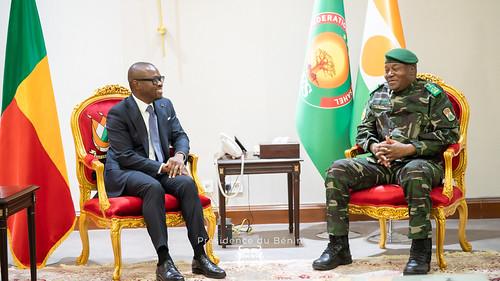
The tarmac of Cotonou International Airport bore witness to a pivotal moment in West African diplomacy this past Friday, as a high-level Nigerien delegation touched down under full protocol, signaling the resumption of stalled bilateral talks. Far from mere diplomatic pageantry, the event marked the tangible rebirth of dialogue between two nations whose strained relations had left regional stability hanging in the balance.
From rhetoric to tangible action
The seeds of this breakthrough were sown weeks earlier in Niamey, where Beninese President Romuald Wadagni and Nigerien transitional leader General Abdourahamane Tiani held a landmark meeting. Their shared commitment to breaking the deadlock set the stage for intensive behind-the-scenes negotiations, as technical experts and military officials from both sides convened for two weeks of closed-door sessions. Their mission: to dissect mutual grievances, smooth over contentious issues, and lay the groundwork for a lasting resolution. The ultimate prize? A comprehensive agreement to reopen their shared border, shuttered in the wake of Niamey’s political upheavals.
Observers describe the current atmosphere in Cotonou as a delicate balance of gravity and constructive momentum. With every passing day of closure, the human and economic cost mounts, pressing both governments toward pragmatic solutions rather than entrenched posturing.
Economic strangulation drives the urgency
For policymakers and analysts tracking the fallout, the border closure’s devastation is impossible to ignore. The once-symbiotic economic relationship between Benin and Niger has been reduced to a shared crisis, with both nations suffocating under the weight of their isolation.
The Nigerien economy, landlocked and dependent on the Port of Cotonou for 80% of its trade, has borne the brunt of the shutdown. Desperate to bypass the closure, freight operators have rerouted shipments through distant, perilous corridors—lengthening journeys by weeks and inflating costs by over 300%. The result? Skyrocketing food prices, shuttered businesses, and a purchasing power crisis that has pushed millions to the brink.
Benin’s losses are no less severe. The Cotonou-Niamey corridor isn’t just a trade route; it’s the lifeblood of the nation’s port economy. Customs revenues, already strained by global shocks, have plummeted, crippling infrastructure projects and public services. Behind the sterile data lies a human toll: truck drivers idling in yards, market vendors watching inventories dwindle, and families across the border facing destitution.
Security trumps all in high-stakes negotiations
While economic desperation nudges negotiators toward compromise, the thorniest obstacles remain rooted in security concerns. Since the National Council for the Safeguard of the Homeland took power in Niamey, its leaders have drawn a red line: no economic concession can compromise national security or the stability of the transition.
The talks in Cotonou now pivot around two explosive issues. First, the secure management of the Niger River—a porous natural border that has seen repeated infiltration attempts by armed groups. Second, the deployment of joint surveillance protocols to stem the flow of jihadist movements that have plagued the Sahel. Benin’s delegation faces the unenviable task of reassuring Niamey with ironclad guarantees, including real-time intelligence-sharing mechanisms and military cooperation frameworks.
The challenge is monumental: designing a border regime that is both hermetically sealed against asymmetric threats and porous enough to revive legitimate commerce. Success hinges on reconciling two irreconcilable priorities—state sovereignty and the economic survival of millions.
A new chapter for West African relations?
This summit in Cotonou underscores a hard truth: geography and realpolitik always outlast ideological posturing. What began as a political dispute has metastasized into a shared humanitarian and economic emergency, forcing both nations to confront their interdependence.
Yet a return to the status quo ante is unlikely. The trust deficit runs too deep. Any future accord will likely be framed by heightened vigilance, stricter controls, and lingering skepticism—but also by a shared recognition: neither nation can thrive in isolation. The stakes extend beyond Benin and Niger. The Cotonou-Niamey axis is the backbone of regional integration, and its resolution will serve as a litmus test for West Africa’s ability to prioritize stability over division.
For the millions who have endured months of uncertainty, the photographs of handshakes and smiles will ring hollow until concrete actions—border reopenings, trade resumptions—materialize. The clock is ticking.
Comments are closed, but trackbacks and pingbacks are open.