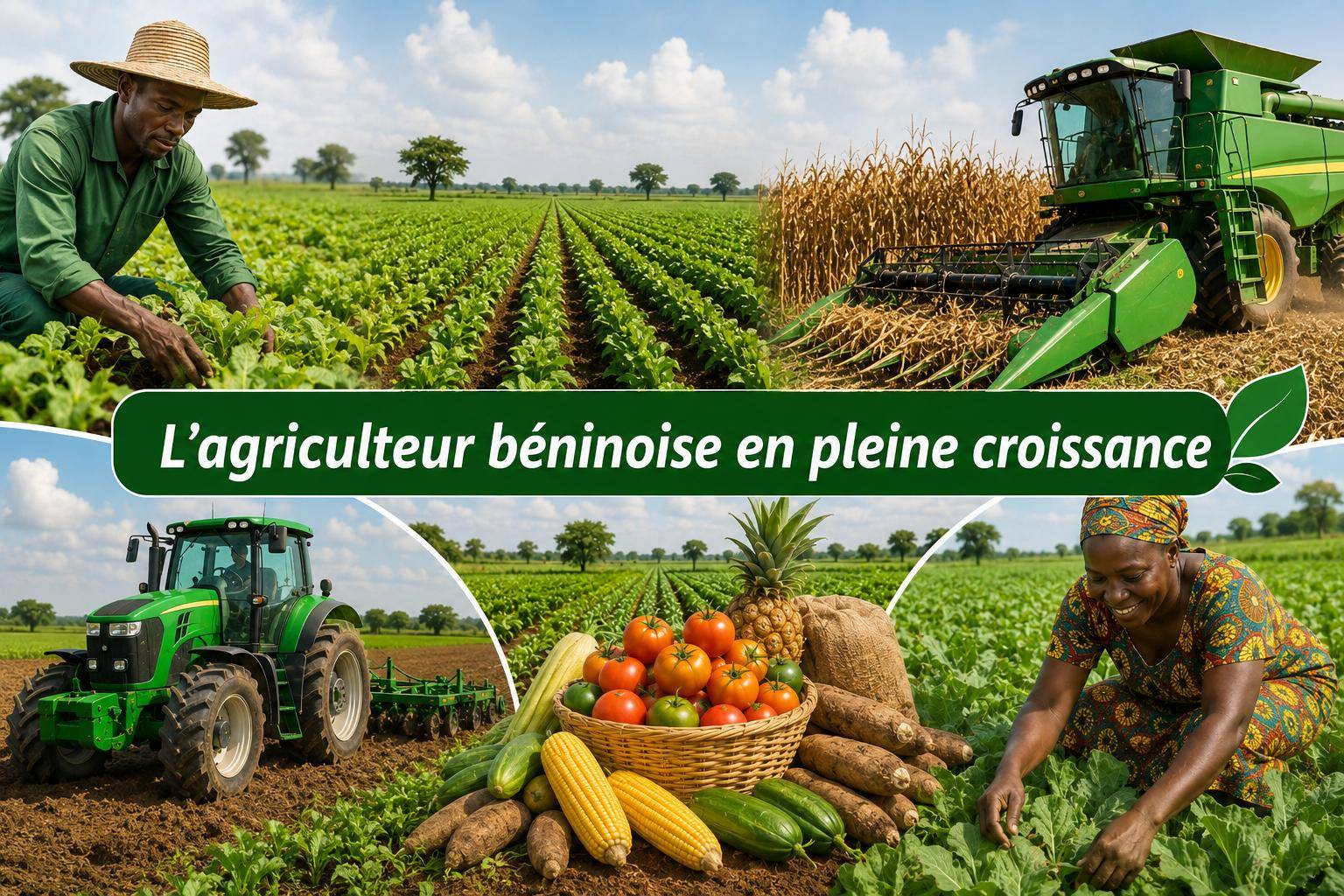
Since 2016, Benin has undergone a remarkable agricultural transformation, driven by bold government reforms. Through substantial subsidies, rapid mechanization, and strategic land management, the nation has achieved unprecedented production levels across key crops. From cotton to pineapple, maize to soybeans, agriculture now stands as the backbone of national growth and a pillar of food security.
Strategic sectors soar: the numbers behind the success
Within just a few years, Benin’s farming landscape has been revolutionized. Government-led initiatives under President Patrice Talon’s administration have unlocked new production highs, reshaping the agricultural narrative.
Maize production serves as a clear indicator of progress. Stagnating below 1.3 million tonnes in 2016, output surged to 2.5 million tonnes by 2025. With domestic demand estimated at 1 million tonnes, Benin has achieved self-sufficiency, though managing cross-border trade flows remains a priority to stabilize local prices.
The soybean sector highlights the country’s industrialization drive. Nearly non-existent in 2016 with just 140,000 tonnes, production skyrocketed to 422,000 tonnes by 2022 and reached a historic 606,016 tonnes in 2024-2025—more than four times the initial volume. This surge supplies modern processing plants in the Glo-Djigbé Industrial Zone (GDIZ) while also fueling exports.
Rice production has followed a similar upward trend, climbing from 204,000 tonnes pre-2016 to 525,000 tonnes in 2022 and 1 million tonnes in 2025.
Benin’s cotton industry, often called “white gold,” remains a cornerstone of its agriculture. Production languished at 269,000 tonnes in 2015 but has since stabilized above 640,000 tonnes annually, peaking at 766,273 tonnes in 2021. The country maintains its position as Africa’s top cotton producer, with the one-million-tonne milestone within reach.
Other key crops have also flourished. Pineapple output rose by 93%, from 244,000 tonnes pre-2016 to 470,000 tonnes in 2022, with projections to hit 600,000 tonnes soon. Cashew production nearly doubled, increasing by 105% from 91,000 tonnes to 187,000 tonnes in 2023, alongside a 34% yield improvement. The government has directly supported cashew farmers by subsidizing certified saplings, covering 500 FCFA of the 600 FCFA cost per plant.
Subsidies shield farmers: 110 billion FCFA injection
The agricultural boom would not have been possible without robust state intervention. Facing soaring global fertilizer and chemical input prices, the government stepped in to safeguard farmers’ livelihoods.
Between 2022 and 2025, an unprecedented 110 billion FCFA was allocated to subsidize inputs for successive farming seasons. This decisive action stabilized production costs, preventing a potential collapse in yields and shielding Benin from food insecurity risks.
Water control and mechanization: farewell to traditional farming
The transformation also hinges on modernizing infrastructure and production techniques. Historically reliant on unpredictable weather, Benin’s agriculture is breaking free thanks to hydro-agricultural development. Before 2016, only 6,200 hectares were developed—just 2% of the national potential. Post-2016, development surged to 25,440 hectares across 67 municipalities, quadrupling the previous area. The long-term goal is to develop 50,000 hectares, enhancing sector resilience and farmer incomes.
Mechanization has further reduced the drudgery of farming. The mechanization rate, below 8% in 2016, has since doubled. Over 400,000 hectares have been mechanically plowed using 5,000 subsidized tractor kits, offered at half price. To ensure sustainability, 6,000 tractor operators and 300 certified mechanics have been trained. The government aims to push the mechanization rate to 30% by late 2026, deploying 8,000 active kits.
Financial overhaul and sustainable eco-management
The financing landscape has been revamped, replacing outdated and inefficient tools like the former National Agricultural Development Fund (FNDA) and the Municipal Development Support Fund (FADeC-Agriculture). The restructured National Agricultural Development Fund (FNDA) now finances over 3,000 projects worth over 19 billion FCFA. The Municipal Development Support Fund (FADeC-Agriculture) has driven 330 communal investments, mobilizing 68 billion FCFA. The focus remains on improving governance to expand impact.
Sustainability is a key pillar of this evolution. Before 2016, 80% of Benin’s soils suffered from low fertility. Now, sustainable land management practices have rehabilitated over 3 million hectares, restoring fertility while curbing degradation.
The revival of fisheries has been equally transformative. Once polluted and underutilized, water bodies have been restored, leading to a 79% surge in total fish production. High-quality shrimp, in particular, has regained access to the European Union market, signaling a triumph of ecological restoration and regulatory compliance. Livestock production has also thrived, with meat output up 53% and egg production rising 43%, positioning Benin to meet 75% of its domestic needs.
Territorial market agriculture: a new economic vision
By adopting a territorial approach to agricultural development—strengthening state functions and promoting targeted value chains—Benin has restructured its rural economy from the ground up. Market access has expanded, and strategic partnerships continue to solidify.
In under a decade, President Patrice Talon’s administration has redefined farming in Benin. No longer a subsistence activity, agriculture has become a dynamic, modern, and competitive economic sector. The next challenge is to maintain this momentum, ensuring that governance remains robust and that the wealth generated benefits every producer across the nation’s farms.
Comments are closed, but trackbacks and pingbacks are open.