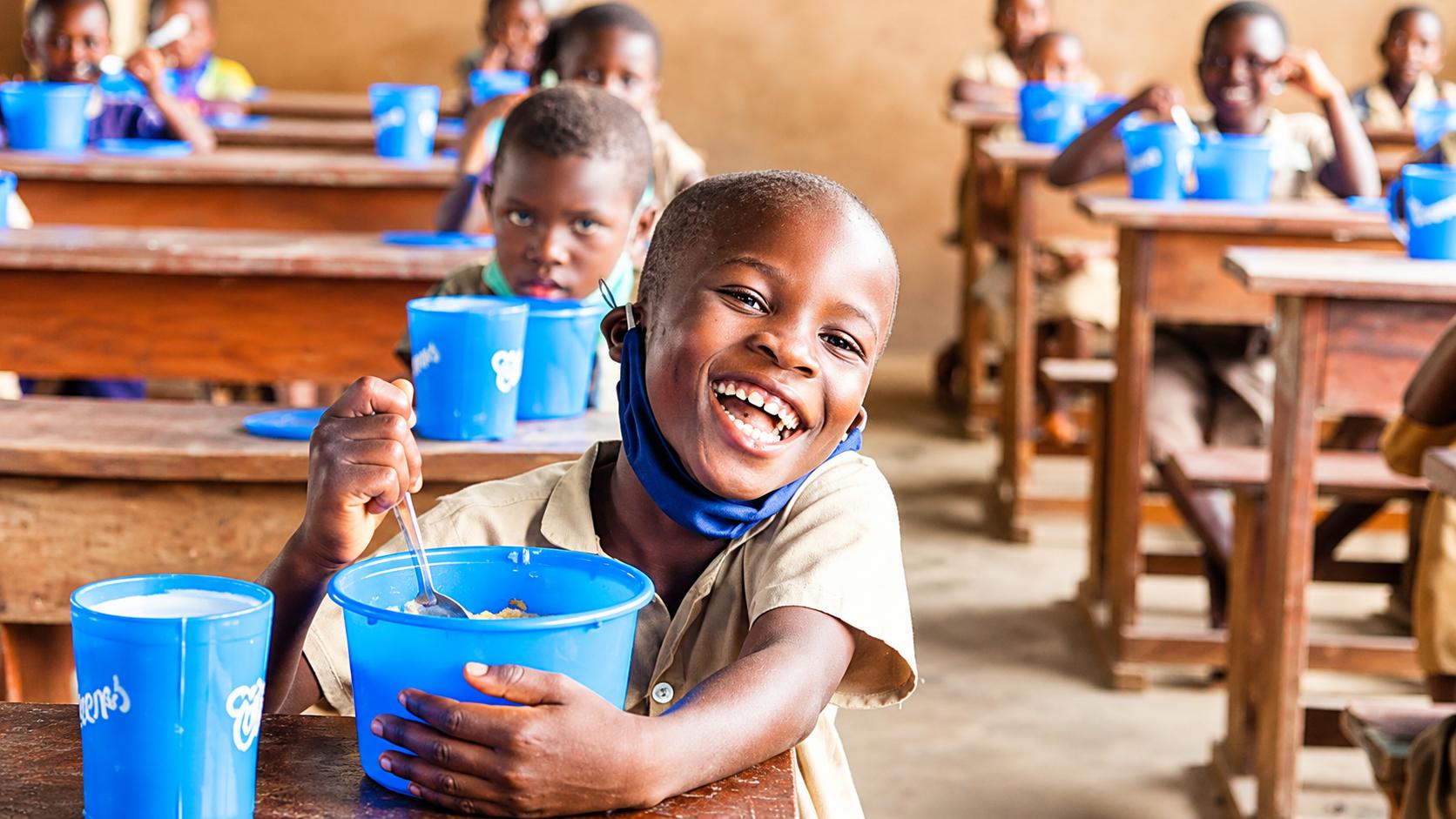
Benin’s school feeding drive has crossed a fresh threshold. With the 2026-2027 academic year under way, close to 1.9 million pupils now receive a hot meal on every day of class, compared with 1.4 million twelve months earlier. Roughly 500,000 extra children have joined the scheme in that single year — a jump that confirms the government’s intent to turn school meals into a lever against hunger, a support for household budgets and a boost for economic activity at the local level.
A leap of half a million pupils in one school year
The opening of the 2026-2027 school year writes a new chapter in the roll-out of school canteens across the country. The number of children eating at school now stands at 1.9 million, against 1.4 million during the previous school year.
That gap translates into some 500,000 additional children who today sit down to a warm lunch whenever lessons are held. Behind the figure lies something more telling: the national school feeding policy has visibly widened its reach.
The distance already travelled is remarkable. As recently as 2016, canteens covered only 30% of pupils. By 2022, the rate had risen to 75%, with more than 1.1 million children taken on board. The steady climb since then shows a programme that keeps gathering strength.
For the Beninese authorities, a school canteen is anything but a simple welfare measure. It amounts to an investment in education, in nutrition and in the country’s development.
Relief at home: what a single hot meal changes
For households, the first effect is social. In many homes, feeding a child in school every day represents a sizeable outlay. Once the school takes charge of lunch, that burden is partly lifted.
Parents can then steer more of their income towards other essentials — exercise books and uniforms, clothing, medical care or food for the remaining members of the family. Every franc saved can help raise living standards under the same roof.
For the pupils themselves, the stakes are just as high. A child who eats a warm meal at school is better placed to handle the school day. The canteen curbs hunger during lessons and creates conditions that favour attention, classroom participation and learning.
Widening the pool of beneficiaries is therefore a direct answer to a major concern: allowing children — above all those from the most fragile families — to study in better circumstances.
The public money behind every plate
Such an expansion rests on a heavy financial commitment from the state. The budget devoted to school canteens climbed from 1.5 billion CFA francs in 2016 to 48.7 billion CFA francs in 2022, a clear marker of the priority gradually granted to this public policy.
Under the 2025 finance law, more than 29 billion CFA francs were likewise earmarked to back the school canteen programme.
Those sums are best read as long-term social investment. By paying for children’s meals, the state acts on several fronts at once — all of them shaping how pupils progress through school and how they fare day to day.
The objective, then, is not merely to dish out food. It is to create the conditions in which children stay in school, learn in better circumstances and prepare for what lies ahead.
How canteen spending reaches Beninese farmers
The programme’s other strength lies in its economic potential. School canteens generate sizeable and predictable demand for food products, and part of the resources mobilised can flow to local producers and suppliers.
Drawing on nationally grown produce opens up outlets for farmers. Public spending on pupils’ meals can thus help shore up producers’ incomes, energise rural activity and reinforce local economic circuits.
Figures released by the government show that purchases of foodstuffs from local producers have risen, passing 13 billion CFA francs in 2024.
The mechanism sets a virtuous circle in motion: children are fed, families get breathing space and producers gain extra markets for their harvests.
Feeding children today, investing in Benin’s tomorrow
With 1.9 million beneficiaries for the 2026-2027 school year, the programme has entered a new phase. The 500,000 newcomers recorded within a year offer a concrete measure of how far the scheme has spread.
The increase also sharpens the ambition of covering ever more public schools. The government intends to press on so that school meals become a lasting component of Benin’s education and social policy.
The canteen now looks like a tool with several dimensions at once. It fights hunger, stands beside parents, improves the conditions in which children learn and opens outlets for local agriculture.
By investing heavily in this programme, the Beninese state is not simply funding meals. It is investing in today’s children, in families and in the local economy — and above all in the human capital that will form the wealth of Benin tomorrow.
Comments are closed, but trackbacks and pingbacks are open.