
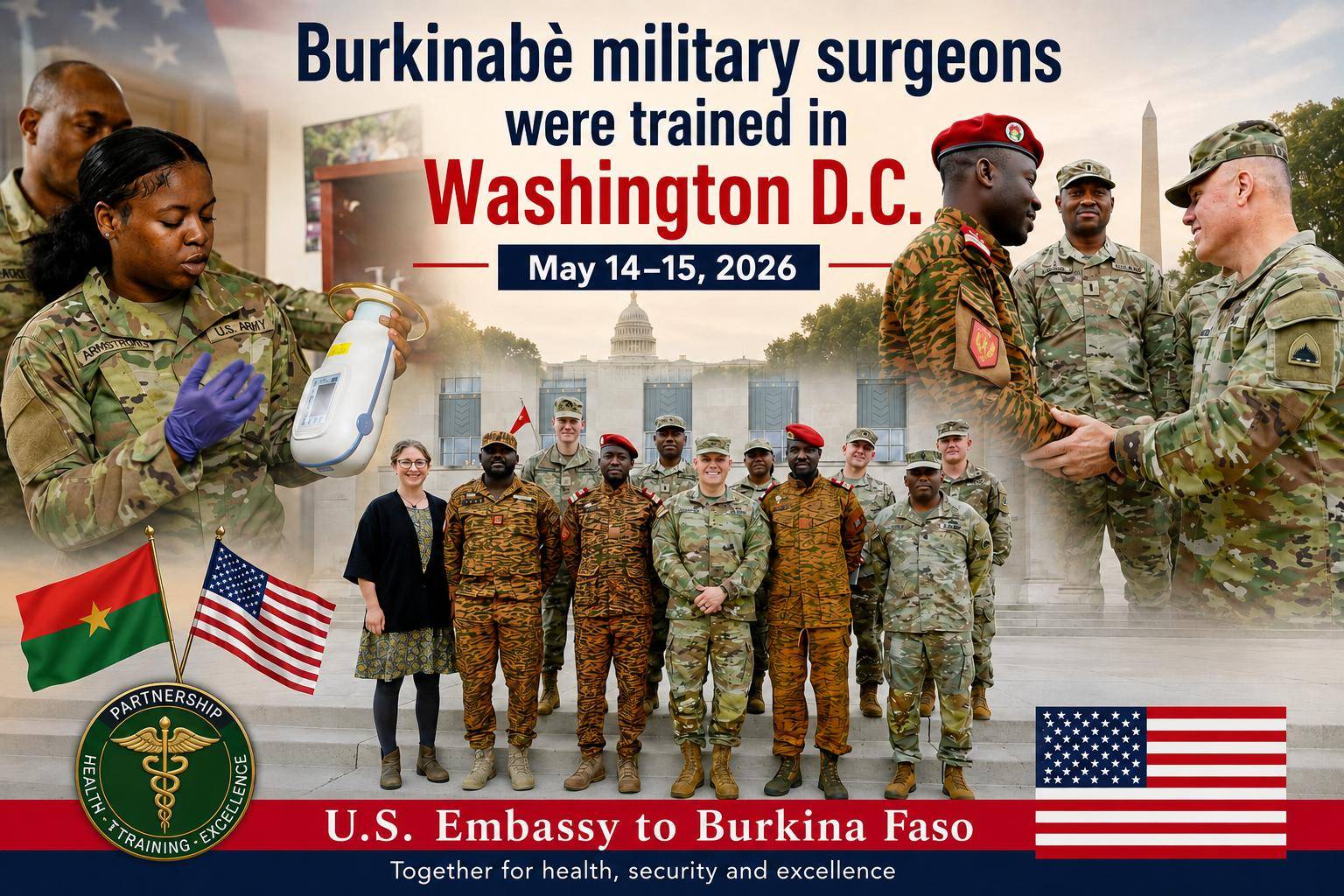
In a striking display of pragmatic cooperation, military surgeons from Burkina Faso recently concluded a high-level exchange program with the United States National Guard in Washington D.C. The two-day session, which took place in mid-May 2026, focused on combat trauma care, emergency surgical procedures, and battlefield casualty management—skills critical for a nation engaged in asymmetric warfare.
Washington visit reveals hidden layers of Sahel cooperation
The medical mission, announced publicly in early June, underscores a growing paradox within the Alliance of Sahel States (AES). Despite increasingly vocal criticism of Western powers—particularly France—by AES leaders, technical cooperation channels with the United States remain not only open but actively operational. This duality reflects a strategic balancing act between political rhetoric and operational necessity in Burkina Faso’s fight against armed groups.
State Partnership Program: a bridge between doctrines
Under the State Partnership Program (SPP), Burkina Faso’s military medical team engaged in intensive workshops with their American counterparts. The exchange emphasized real-world trauma scenarios, evacuation protocols, and advanced surgical interventions tailored for hostile environments. For a landlocked nation facing persistent security threats, access to Western medical expertise provides a lifeline for frontline soldiers.
Why the U.S. remains a key partner in military medicine
While Burkina Faso has strengthened ties with Russia—securing arms, air support, and tactical training—the gap in specialized medical training remains unaddressed by Moscow. Western military medicine, refined through decades of global operations, offers structured protocols, standardized equipment compatibility, and academic documentation that align with Burkina Faso’s historical training frameworks. In contrast, Russian military support has prioritized combat hardware and direct tactical assistance over advanced battlefield medical systems.
A silent but strategic alliance
For the U.S., maintaining the SPP with Burkina Faso serves a dual purpose: preserving influence in the Sahel and nurturing ties with the country’s military leadership. As American troops withdraw from neighboring Niger, discreet medical diplomacy offers a non-confrontational way to sustain engagement without provoking public backlash. For Burkina Faso, the collaboration signals a refusal to fully sever ties with Western expertise—even as it champions sovereignty within the AES.
The pragmatism of survival over ideology
The medical exchange in Washington highlights a broader reality: national security often dictates choices that defy ideological posturing. While Burkina Faso’s leadership publicly champions a break from former colonial powers, its operational decisions reveal a more nuanced approach—one where battlefield survival takes precedence over political consistency. This selective engagement allows the nation to leverage the strengths of multiple alliances without fully committing to any single bloc.
As the Sahel’s security crisis deepens, the Burkina Faso case serves as a reminder that geopolitical strategies are not always black and white. Behind the rhetoric of sovereignty and anti-Western alliances lies a military establishment that continues to rely on Western medical expertise—proving that in the art of war, survival often trumps ideology.
