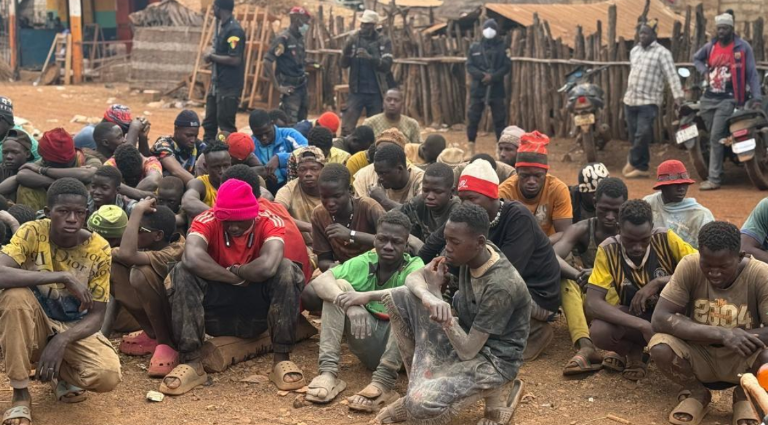
Burkinabe migrants arrested in Guinea: the hidden cost of regional economic disparities
The latest crackdown on illegal gold mining in Guinea has brought into sharp focus a cross-border economic crisis. Authorities in Conakry recently reported the arrest of 1,412 individuals, with a significant number hailing from Burkina Faso. These arrests expose deeper issues—poverty, unemployment, and the lack of economic opportunities—that are driving Burkinabe workers to seek survival in neighboring countries’ artisanal mines.
On November 10, 2026, Guinean courts began processing the cases of 1,263 detainees, with an additional 149 people arrested in Kérouané and Siguiri just days earlier. These operations, led by the country’s defense and civil protection ministries, mark a decisive moment in the fight against unauthorized mining activities.
Why Burkinabe miners risk everything in Guinea’s gold fields
For many Burkinabe, Guinea’s gold-rich regions represent a last-resort lifeline. Despite grueling conditions and legal risks, artisanal mining attracts workers from across West Africa. Guinea’s underground economy offers a stark contrast to Burkina Faso’s struggling rural communities, where persistent insecurity, economic stagnation, and limited job prospects have left many with no viable alternatives.
The allure of quick earnings, though risky, outweighs the bleak options at home. The Guinean operations, though illegal, provide immediate income—albeit at the cost of environmental degradation, health hazards, and legal repercussions. The mass arrests underscore a harsh reality: when domestic economies fail to deliver stability, migration—legal or otherwise—becomes a survival strategy.
Ibrahim Traoré’s economic sovereignty under scrutiny
The surge in Burkinabe migrants in Guinea’s gold mines raises tough questions about Burkina Faso’s economic policies under Captain Ibrahim Traoré’s transitional government. Since taking power in 2022, Traoré has prioritized national sovereignty, particularly in the mining sector, aiming to reclaim control over natural resources and boost state revenues.
Yet, sovereignty extends beyond resource ownership. Despite Burkina Faso’s own gold deposits, thousands of its citizens are forced to cross borders for work in hazardous conditions. The failure of domestic economic strategies to translate into tangible improvements—jobs, poverty reduction, and rural livelihoods—undermines the narrative of progress.
Policy gaps and the burden of insecurity
While the transitional government faces criticism, the crisis is not solely its making. Years of instability, climate challenges, and structural economic weaknesses have eroded opportunities in Burkina Faso. The exodus of miners to Guinea highlights a critical blind spot in economic planning: policies must deliver real-world benefits, not just lofty goals.
Guinea’s dilemma: balancing enforcement with regional cooperation
Guinea’s crackdown on illegal mining is a necessary step to protect its environment and resources. Illegal operations contribute to soil erosion, water pollution, and agricultural land destruction, posing long-term threats to local communities. By prosecuting offenders, authorities aim to restore order and deter further violations.
However, enforcement alone won’t solve the root problem. As long as economic desperation persists in neighboring countries, clandestine mining will resurface. A sustainable solution requires addressing the push factors—creating viable local jobs and improving living conditions—to reduce the incentive for risky migration.
Data gaps and the need for targeted solutions
The Guinean government’s latest report does not specify how many of the 1,412 arrested are Burkinabe. Pinpointing these details could help tailor interventions, whether through bilateral agreements, labor protections, or economic development initiatives in source countries.
Beyond the numbers: human stories and policy failures
Each arrest represents a human story—a worker, a parent, or a provider driven by necessity. The Guinean crackdown is a reminder of the human cost of regional inequality. For Burkina Faso, it’s a call to action: economic sovereignty must translate into policies that lift people out of poverty, not force them to risk their lives abroad.
True economic independence isn’t measured by resource extraction alone. It’s measured by the ability to offer citizens dignified livelihoods at home—so they no longer have to leave in search of basic survival.
Comments are closed, but trackbacks and pingbacks are open.