Over the past two decades, Senegal’s largest public contracts have seen a dramatic shift in leadership. Where French conglomerates once held sway, Chinese, Turkish, Tunisian, and Emirati firms now command the lion’s share of infrastructure projects across the country. From ports to stadiums, hotels to industrial zones, the balance of economic influence in Dakar and beyond has undergone a profound transformation.
Dakar’s new deep-water port: a case study in shifting alliances
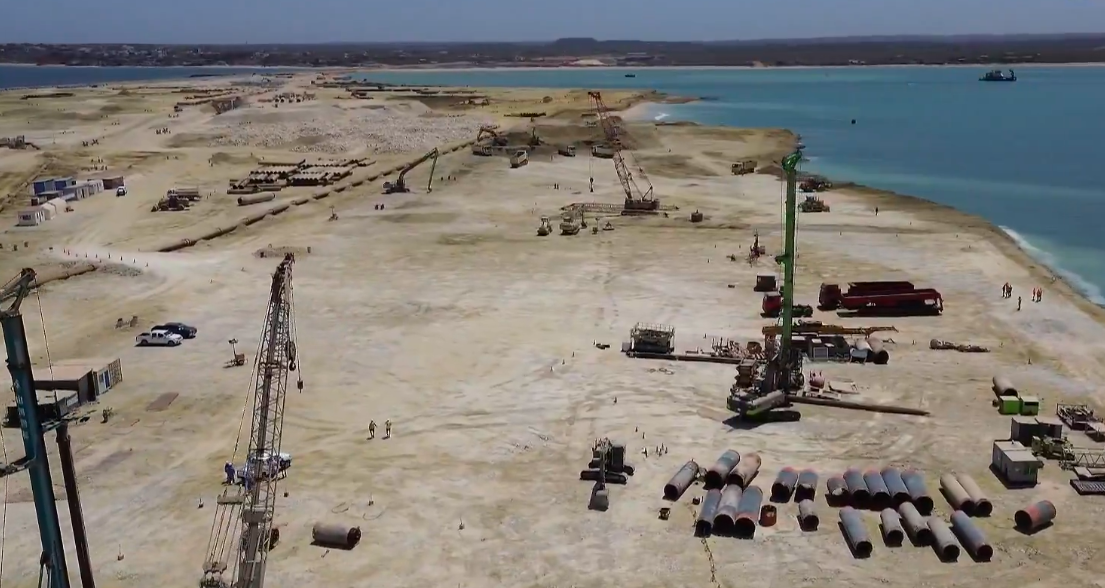
At the heart of this evolution is the Port of Ndayane, a $2 billion-plus deep-water facility under construction south of Dakar. Designed to accommodate the world’s largest container ships, the project is widely hailed as a game-changer for Senegal’s logistics, employment, and connectivity. Yet despite its strategic importance, the contract was awarded not to a French firm but to an international consortium led by Emirati operator DP World—with Chinese companies playing a dominant role in construction.
David Gruar, DP World’s site director, admits that French firms were in the running. “We had bids from companies worldwide, including many from France,” he notes. “But in the end, they didn’t win.” According to reports, the French-led consortium (including Eiffage) was priced nearly 20% higher than the winning bid, sealing its fate. The episode underscores a broader trend: French majors are increasingly sidelined in Senegal’s public tendering processes.
Diamniadio: a new city built by non-French hands
Just 30 kilometers from Dakar, the Diamniadio New City project offers another window into this realignment. Designed to ease congestion in the capital, the development includes a stadium, railway station, hotels, and residential buildings—most of which are being delivered by Turkish contractors. The industrial zone, a magnet for foreign investors, is similarly dominated by non-French firms. “We have a Tunisian company over there,” says Bohoum Sow, secretary-general of the Association for the Promotion of Senegalese Industry (APROSI). “And to the right, a Chinese firm. I don’t know of any French companies operating here.”
Chinese adaptability wins local trust
Sow credits Chinese firms with better grasping Senegal’s needs. He points to a Chinese-built cardboard packaging plant where local employees receive hands-on training—a stark contrast to Senegal’s industrial past. “This is exactly what we need,” he says. “They address specific gaps and adapt flexibly. It’s a win for everyone.”
For over 20 years, China has wielded infrastructure investment as a cornerstone of its African diplomacy. The results are visible: “You see their flag everywhere,” observes a local analyst. Sow acknowledges the shift without regret: “Times have changed. Our partners have too. Senegal needs infrastructure, and China delivers—on terms that work for both sides.”
France’s fading footprint in Senegal
Fewer than one in 20 public contracts in Senegal now go to French firms, down from over 30% two decades ago. Meanwhile, Chinese-led projects account for more than 30% of tenders. The rise of Turkish, Emirati, and Tunisian competitors has further diluted France’s traditional dominance in sectors like energy, banking, and logistics.
How French firms are fighting back
Not all is lost for French businesses. Some are adapting by localizing operations and embracing partnerships. Take Ragni Group, a family-run French lighting specialist that secured a $70 million deal to install 36,000 solar streetlights across Senegal. To win the contract, Ragni established a local subsidiary led by a Senegalese manager, transferred technical know-how, and aligned with French development bank Proparco’s financing model.
“Flexibility, quality, and cost were key,” explains Birama Diop, director of Ragni’s Senegalese subsidiary. “And local job creation sealed the deal.” Caroline Richard, Proparco’s Senegal representative, agrees: “French firms still have a role to play, especially where high standards and skilled labor are required. The market is growing, and our competitiveness is strongest where demands are highest.”
From solar-lit streets to industrial parks, France’s strategy is evolving. No longer can its firms rely on historical ties alone. To reclaim ground, they must prove agility, share expertise, and match the pricing of rivals now entrenched in Senegal’s economy.
Comments are closed, but trackbacks and pingbacks are open.