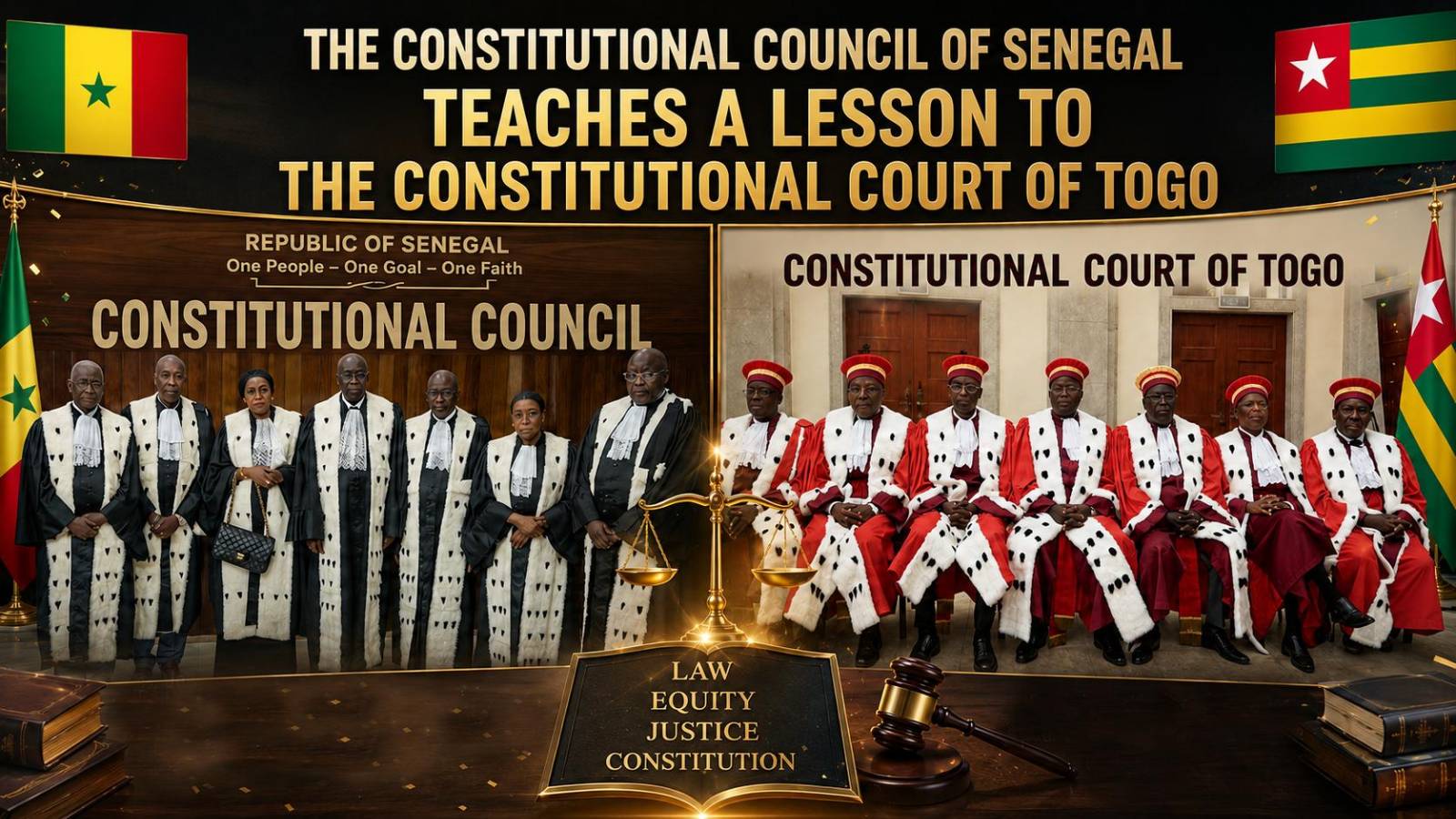
Dakar and Lomé: Two Nations, Two Visions of Constitutional Rule
In recent months, the capitals of Senegal and Togo have laid bare two starkly divergent interpretations of constitutional governance. While judicial institutions in Dakar have reaffirmed the supremacy of the law, their counterparts in Lomé have faced criticism for aligning with political agendas. This disparity underscores a fundamental truth: the strength of a democracy lies not in its constitutional text alone, but in the independence and resolve of its guardians.
Dakar: Where the Constitution Prevails
In Senegal, the Constitutional Council has once again demonstrated that no political mandate—no matter how sweeping—can supersede the Constitution. The body recently struck down a proposed constitutional amendment backed by Prime Minister Ousmane Sonko and his parliamentary majority, sending a clear message: elections grant authority, but they do not confer unlimited power. This ruling reaffirms a principle long upheld in stable democracies: the legitimacy of governance is bounded by the rule of law.
The decision carries weight beyond legal technicalities. By asserting its authority, the Council has reinforced public trust in institutions, signaling that the democratic framework applies equally to all branches of government. Such impartiality is a cornerstone of stability, deterring political crises and fostering investor confidence. When judicial bodies act without fear of reprisal, they preserve the predictability essential to economic and social progress.
Lomé: A Court Caught in the Crossfire
In Togo, the Constitutional Court’s validation of a sweeping constitutional overhaul has drawn sharp scrutiny. Critics—spanning opposition figures, civil society, and legal scholars—argue that the reforms were rushed through without inclusive national debate, fundamentally altering the nation’s institutional architecture. A constitution is meant to be a social contract, not a political tool wielded at will. When perceived as the product of partisan maneuvering rather than consensus, its legitimacy erodes, leaving the door open to perpetual contestation.
The fallout extends beyond domestic politics. The Court’s perceived alignment with the executive has, in several cases, pushed aggrieved parties to seek recourse in regional tribunals like the ECOWAS Court of Justice. This reliance on external adjudication often reflects a deeper crisis of faith in domestic institutions—a trend that can deter investment and undermine international standing.
The Peril of Constitutional Instability
The manner in which a constitution is amended can be as consequential as its contents. In mature democracies, such reforms are preceded by exhaustive consultations, rigorous debate, and a quest for broad agreement. This caution stems from a vital recognition: a constitution does not merely govern the present; it sets the rules for future transitions. When revisions are driven by short-term political expediency, they set dangerous precedents, inviting cycles of institutional upheaval.
The risks are twofold. First, they normalize the idea that constitutional amendments are tools for consolidating power, rather than safeguarding citizens. Second, they turn the Constitution itself into a flashpoint, transforming institutions that should arbitrate disputes into objects of contention. The result is a governance vacuum where the rules of the game appear malleable, eroding public trust and destabilizing the state.
Lessons from Comparative Governance
In its pursuit of a parliamentary system, Togo has looked abroad for inspiration, studying models from India and beyond. While cross-jurisdictional learning has value, it cannot replace the hard-won lessons of Africa’s own democratic experiments. The continent offers no shortage of examples where constitutional adherence—rather than imported blueprints—has underpinned stability.
Senegal, in particular, stands as a testament to this principle. Its Constitutional Council has earned its credibility not through rhetoric, but through decisive action, including defiance of the executive when necessary. This integrity resonates far beyond courtrooms; it shapes the nation’s global image, its economic prospects, and the trust of its people. Investors, development partners, and international observers alike gauge a country’s reliability by the robustness of its institutions. A system where rules are consistently upheld inspires confidence; one where they are perceived as negotiable does not.
The Core Divide: Institutions as Guardians or Instruments
At its heart, the contrast between Senegal and Togo is not about constitutional language, but about the role institutions are meant to play. In Dakar, the Constitution serves as a bulwark against power; in Lomé, critics argue, it risks becoming a chameleon, shifting with the tides of political convenience. A resilient democracy is not measured by the frequency of its constitutional amendments, but by the durability of its protections against the excesses of all branches of power. The choices made today in these two capitals will echo for generations.