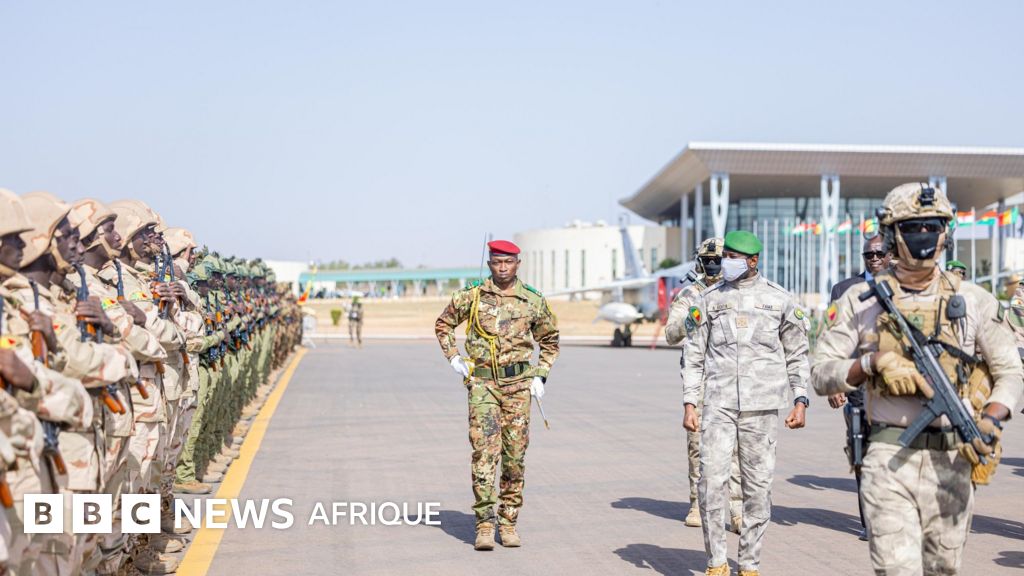
In just two days, the highest authorities of the Alliance des États du Sahel (AES)—comprising Mali, Burkina Faso, and Niger—will gather in Bamako for a pivotal summit. The primary agenda includes a comprehensive review of the unified force’s (FU-AES) progress, security challenges, diplomatic strategies, and development milestones achieved since the Niamey summit in July 2024.
According to the Malian government’s communication center, this second session of the AES Heads of State College aims to assess the implementation of the confederation’s roadmap, operationalize its institutions, and address regional and international stakes. With the first year of the AES already marked by significant strides, the meeting will also focus on electing a new president for the confederation.
What is the unified force of the AES?
The FU-AES is a multinational military contingent of 5,000 soldiers from Mali, Burkina Faso, and Niger, officially launched on December 20 in Bamako. Its mission is to counter armed groups, enhance border security, and neutralize transnational threats that exploit the porous borders between these nations.
These countries have faced persistent security challenges, including frequent armed attacks, cross-border instability, and the mobility of militant groups operating across borders. The establishment of the FU-AES represents a strategic shift toward coordinated military efforts, improved intelligence sharing, and synchronized operations to mitigate risks in vulnerable border areas.
How can the unified force achieve its objectives?
The FU-AES is led by General Daouda Traoré of Burkina Faso, with a mandate to tackle jihadist insurgencies and restore stability in the Sahel region. General Sadio Camara, Mali’s Defense Minister, emphasized the force’s significance, stating, “Peace, security, and sovereignty cannot be delegated.”* He framed the FU-AES as a testament to the Sahelian values of solidarity and dignity, describing its creation as an irreversible commitment by the three states.
Ahead of the Bamako summit, Malian transitional President Assimi Goïta highlighted major joint operations conducted by the three armies, including Yéréko I and Yéréko II, which successfully neutralized several jihadist leaders and dismantled criminal sanctuaries through shared intelligence and pooled resources. However, militant groups remain active, particularly along the triple border, posing ongoing threats.
Fiacre Vidjenagninou, Senior Researcher at the Behanzin Institute in Cotonou and Associate Senior Researcher at the Egmont Institute in Brussels, argues that the FU-AES will only gain credibility if it moves beyond symbolic gestures and delivers tangible results on the ground. He stresses that its effectiveness hinges on several critical factors:
- Unified command and decision-making: Clear leadership structures and streamlined processes are essential for coherent operations.
- Intelligence-action fusion: Real-time intelligence collection, analysis, and rapid response must be seamlessly integrated.
- Sustained territorial control: Simply striking militant groups and withdrawing is insufficient. The force must maintain a lasting presence to secure markets, protect villages, and reassure populations.
- Addressing root causes: Without addressing local conflicts, governance gaps, and community grievances, militant groups will continue to regenerate.
Vidjenagninou warns, “A force can win battles, but without minimal governance, it cannot achieve stabilization.”*
Gradual expansion and regional cooperation
While the FU-AES is a groundbreaking political initiative, its long-term success depends on careful strategy. Expanding the force to include additional countries could complicate coordination due to differing interests and doctrines. Vidjenagninou advocates for a phased approach:
- Prove success with the current three-member alliance: Demonstrate operational effectiveness before expanding.
- Strengthen cross-border cooperation: Coordinate operations on specific corridors and formalize pursuit agreements.
- Build trust incrementally: Formal integration should follow proven success and established confidence.
The Bamako summit will also address institutional advancements, including the official launch of the AES Television (based in Bamako) and the Daandè Liptako radio (based in Ouagadougou). Discussions will further explore the establishment of the Confederate Bank for Investment and Development, with an initial capital of 500 billion CFA francs.
The AES’s formation stems from the military coups in Mali (August 2020), Burkina Faso (September 2022), and Niger (July 2023). The Economic Community of West African States (ECOWAS) imposed sanctions and threatened military intervention, particularly in Niger. In response, the three countries withdrew from ECOWAS in January 2024 and established the AES, later formalizing it as a confederation in July 2024.
Comments are closed, but trackbacks and pingbacks are open.