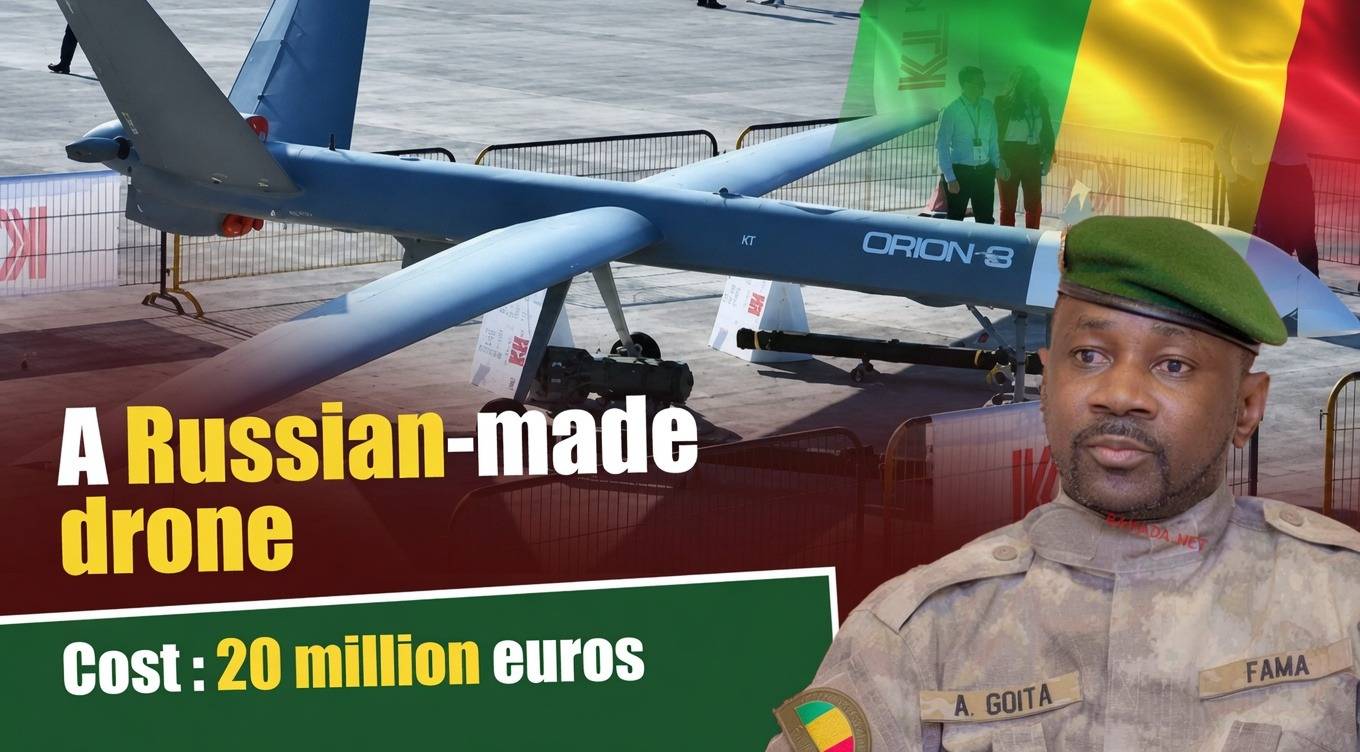
Bamako has officially integrated a new airborne asset into its military arsenal: the Russian-made Orion drone, a reconnaissance and attack unmanned aerial vehicle (UAV) designed for prolonged surveillance and precision strikes. While the Malian transitional authorities celebrate this acquisition as a milestone in reclaiming national territory, the move has triggered sharp criticism among military analysts. The high cost and technical misalignment with the realities of asymmetric warfare raise serious doubts about the drone’s practical battlefield impact.
Mali’s deepening ties with Moscow yield a high-tech military addition
The Malian Armed Forces (FAMa) now operate a MALE-class (Medium Altitude Long Endurance) Orion drone, delivered as part of a growing defense partnership with Russia. This aircraft, touted as a technological leap, is intended to enhance surveillance across Mali’s vast, sparsely populated desert regions. Proponents argue that the Orion symbolizes Bamako’s strategic autonomy, reducing dependence on traditional Western military partners. Yet beneath the official rhetoric of military empowerment lies a far more complex operational reality.
Why stealth matters: the Orion’s fatal flaw in asymmetric conflict
The Malian theater is dominated not by conventional armies but by agile, dispersed terrorist factions that exploit terrain and evade detection. Unfortunately, the Orion’s most glaring weakness in this context is its audible profile. The drone’s engine noise can be heard long before it reaches its target, giving enemy forces ample warning to disperse, hide, or relocate. Unlike silent, small-scale UAVs favored in counterinsurgency operations, the Orion broadcasts its presence, undermining its own effectiveness.
Moreover, the assumption that airspace remains uncontested is dangerously outdated. Armed groups in northern and central Mali have demonstrated growing anti-air capabilities, including portable surface-to-air missiles (MANPADS). A large, slow-moving, and acoustically detectable drone becomes an easy target, risking rapid destruction shortly after deployment.
20 million euros for one drone: is this investment or extravagance?
The price tag—nearly 20 million euros (over 13 billion CFA francs)—has ignited fierce debate among economists and defense specialists. In a country grappling with severe budget constraints and urgent social needs, such an expenditure is hard to justify. Critics argue that the same funds could have purchased an entire fleet of smaller, lighter, and more discreet tactical drones, better suited to the fluid nature of Mali’s insurgency. By prioritizing a single, high-visibility platform, Bamako may have chosen political symbolism over tactical necessity.
The illusion of aerial dominance: one drone, an endless territory
Mali’s size—spanning from the arid expanses of Taoudénit to the forested zones near Kayes—poses a monumental challenge. Yet a single Orion drone cannot realistically cover even a fraction of this vast landscape. Even with extended endurance, the aircraft cannot maintain continuous presence across multiple regions. When grounded for refueling, maintenance, or repairs, entire swaths of territory fall back under the control of hostile factions. The concept of permanent aerial surveillance remains an unattainable dream with just one unit at hand.
The hidden costs: logistics, training, and long-term dependence
The Orion’s price tag barely scratches the surface of its true financial burden. Operating this drone demands a sophisticated ground infrastructure: climate-controlled control stations, dedicated runways, and secure storage for sensitive electronics. Ongoing expenses include specialized fuel, imported Russian components, and guided munitions—all of which strain a fragile national budget. Training Malian technicians to maintain and operate the system adds further strain, often requiring long-term deployment of foreign experts. Without sustained investment in infrastructure and personnel, the 20-million-euro drone risks becoming an expensive paperweight, grounded indefinitely in a hangar.
This latest acquisition underscores a troubling pattern: equipping the FAMa with high-cost, high-visibility assets that may not align with the operational demands of asymmetric warfare. Rather than investing in a single, costly symbol of strength, Mali’s long-term security may depend on a distributed network of nimble, affordable, and sustainable tools—capable of adapting to the unpredictable and evolving threats across its vast terrain.