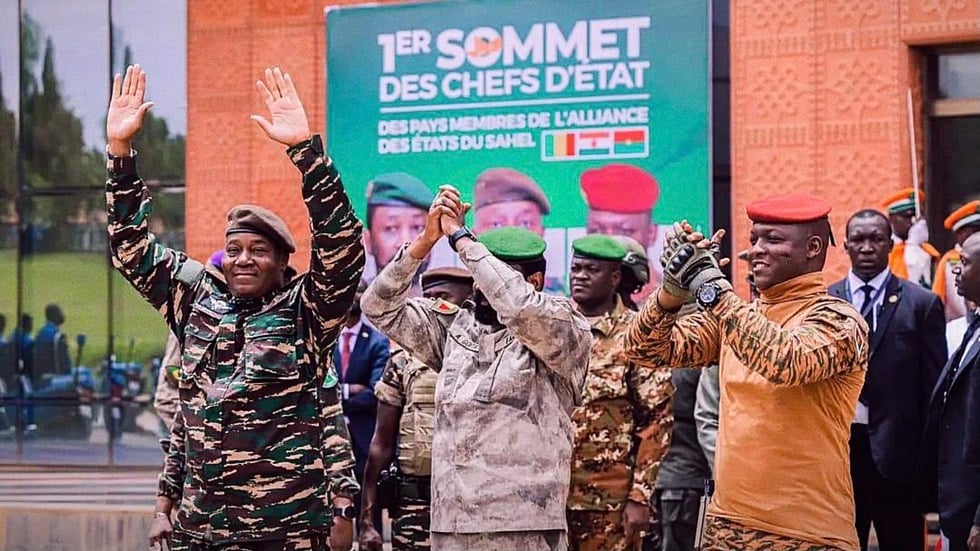
In the high-stakes arena of global politics, timing dictates outcomes—and missteps can have irreversible consequences. The decision by the Alliance of Sahel States (AES)—comprising Mali, Burkina Faso, and Niger, all under military governance—to sever its ties with the Economic Community of West African States (ECOWAS) is increasingly resembling a high-risk maneuver with diminishing returns rather than a bold assertion of sovereignty.
With extremist factions like Boko Haram and Islamic State West Africa Province (ISWAP) escalating their campaigns across West Africa, unity should have been the cornerstone of regional security. Instead, fragmentation has taken precedence, and in matters of defence and stability, fragmentation is not just ineffective—it is perilous.
The AES justified its withdrawal by alleging that ECOWAS had become a tool of neo-colonial influence, particularly under France. While historical grievances may hold weight, a justified complaint does not justify a flawed decision if it disregards current threats. Abandoning a regional security framework without a viable alternative does not equate to independence—it equates to exposure.
Since the split, the AES has turned to Russia for security partnerships, positioning it as a strategic recalibration. However, the actions on the ground paint a different picture: a shift toward dependency without assurances. Russia’s approach to international alliances has consistently been transactional, offering support only when it aligns with its own strategic interests. History has demonstrated that commitments fade when the cost-benefit ratio shifts. This is not conjecture—it is a documented pattern.
Recent coordinated insurgent attacks across key Malian cities—including Bamako, Sevare, Mopti, Tessalit, Gao, Kati, and Kidal—have laid bare critical security vulnerabilities. The much-anticipated protection from external alliances proved disappointingly porous. Even more alarming was the lack of rapid response from fellow AES members, Burkina Faso and Niger. A coalition unable to mobilize swiftly in defence of a member state calls into question its operational reliability.
ECOMOG: a legacy of collective security
The ECOWAS Monitoring Group (ECOMOG), led by Nigeria, once intervened decisively in Liberia and Sierra Leone, restoring stability during periods of catastrophic collapse. While not flawless, this was a demonstration of collective action rooted in shared destiny and regional solidarity.
The Gambia faced a political crisis when former President Yahaya Jammeh refused to concede defeat in the 2016 elections. Under ECOWAS’s mandate, Nigerian troops intervened within hours, compelling Jammeh to step down and seek exile in Equatorial Guinea. This episode underscores a vital truth: West African nations are bound not only by treaties but by geography, culture, and the inescapable ripple effects of instability. When Mali burns, Niger inhales the smoke. When Burkina Faso falters, Ghana feels the reverberations. Security in this subregion is indivisible.
The Iranian model: self-reliance as sovereignty
Often cited as a paragon of indigenous resilience, Iran’s strategy was not merely about defiance—it was about building capacity. Success hinges on domestic military strength, intelligence systems, and technological innovation. External alliances can serve as supplements, never replacements. The AES nations need not oscillate between French oversight and Russian unpredictability, even if they distance themselves from ECOWAS. Iran’s approach offers a compelling blueprint: isolation does not preclude strength. Despite relentless pressure from global powers, Iran invested in indigenous defence, holding its ground for weeks against coordinated strikes from Israel and the United States. The lesson for developing nations is clear: self-sufficiency, not strategic dependency, is the ultimate safeguard of autonomy—and collaboration with neighbouring states sharing similar challenges is non-negotiable.
The Sahel must prioritize home-grown intelligence networks, rapid-response units, and cross-border early warning systems in partnership with its West African neighbours. Borders are not political obstacles; they are strategic imperatives. Terrorist factions such as Boko Haram, ISWAP, and Lakurawa exploit the fractures between AES and ECOWAS with impunity.
For the AES, the path forward demands a dual recalibration: of strategy and mindset. First, aggressively invest in local security infrastructure—community-based defence systems, indigenous intelligence networks, and rapid-response capabilities. Second, re-engage with ECOWAS not from a position of submission, but of strategic pragmatism. Collaboration does not diminish sovereignty; it enhances survival.
ECOWAS, too, bears a responsibility. It must address perceptions of external control, improve internal governance, and reaffirm its role as a genuinely African institution dedicated to the continent’s interests.
This is not a plea to revert to the past. It is a call for a balanced equilibrium—one that harmonizes sovereignty with solidarity, and independence with interdependence.
The reality is stark: the Sahel does not need isolation. It requires alignment—not with distant powers, but with its immediate neighbours, who share its threats, its terrain, and ultimately, its destiny.
A strategic reconsideration
The parable of the prodigal son reminds us that pride often precedes humility. It is time for the AES to reassess its withdrawal. There is no dishonour in admitting an error; the true failure lies in persisting with a failing strategy while cities crumble. ECOWAS, for its part, must be prepared to welcome the AES back without punitive measures, prioritizing unity over ego. The collective is stronger together.
The danger of annihilation is not exaggerated—it is an immediate and tangible threat facing the entire subregion. A united West Africa has navigated civil wars and political upheavals. Divided, it will succumb to a common adversary that fears neither French nor Russian allegiances. The AES must reverse course, place its trust in home-grown solutions, and restore the collaborative structures that only neighbours can provide. There is no alternative path to security.