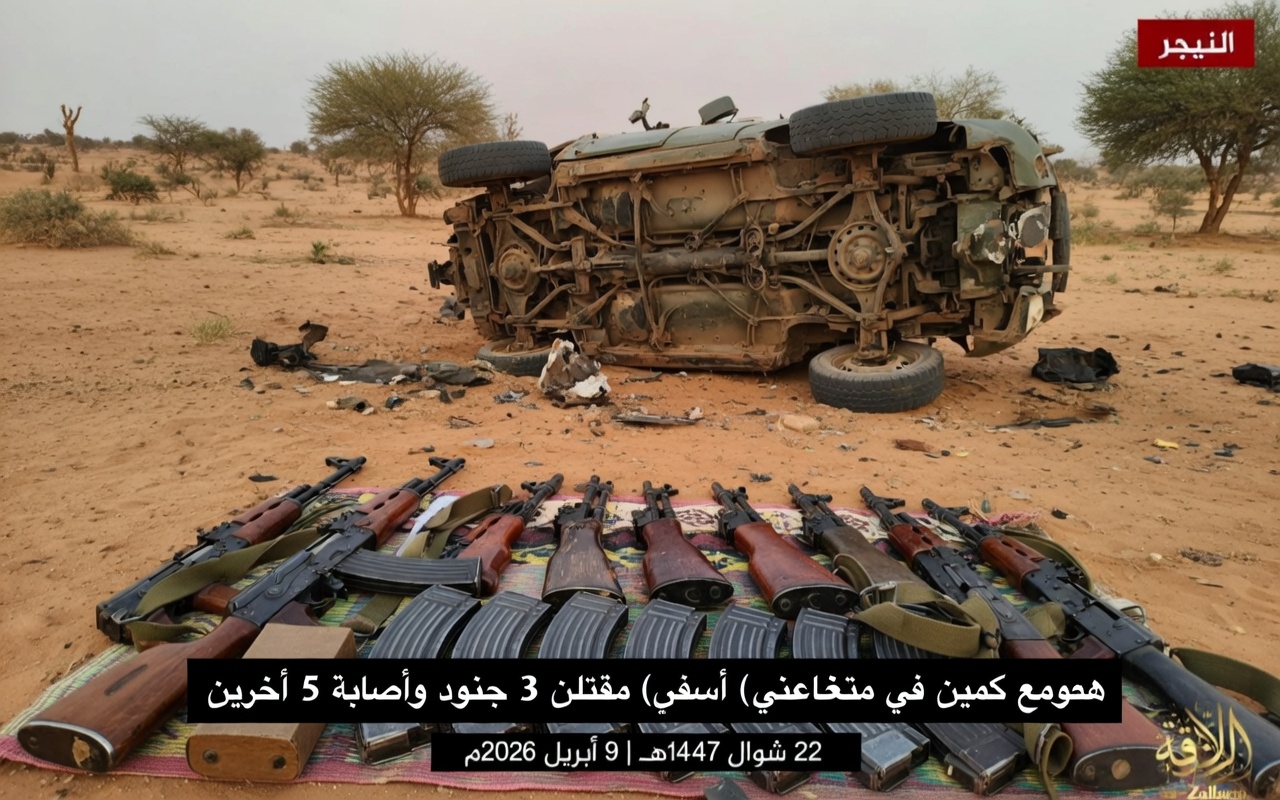
JNIM asserts responsibility for twin assaults in niger’s western regions
The Group for the Support of Islam and Muslims (JNIM), recognized as al-Qaeda’s primary affiliate in the Sahel, has issued a statement claiming credit for two separate terrorist incidents within the past 24 hours. According to the announcement, at least three security personnel lost their lives, while infrastructure sustained damage in the Toure and Say districts.
These strikes underscore the escalating jihadist threat plaguing the western part of Niger, particularly in the volatile Three Borders Zone—a region shared with Burkina Faso and Mali. The ongoing instability has severely disrupted civilian and military mobility, with insurgents exploiting remote road networks to launch asymmetric attacks.
IED detonation targets patrol convoy near toure
In the first incident, JNIM deployed an improvised explosive device (IED) along the Toure road, targeting a military patrol. While the group did not disclose immediate casualty figures, its claim highlights the persistent danger posed by roadside mines, which have become a critical hazard for Nigerien forces operating in unpaved areas. These devices not only inflict casualties but also force costly security diversions and slow transportation routes.
ambush near say results in multiple fatalities
The second assault unfolded near Say, where JNIM fighters ambushed security personnel, resulting in three confirmed deaths. This area, adjacent to the W National Park, has long been a hotspot for militant activity, as armed groups seek to exploit porous borders with Burkina Faso and Benin. The park’s dense forests provide natural cover, enabling insurgents to stage hit-and-run attacks before retreating into neighboring countries.
militant strategy: attrition and disruption
These coordinated strikes reflect JNIM’s tactical preference for sustained harassment over large-scale territorial gains. By leveraging IEDs and mobile ambushes, the group aims to:
- Disrupt supply chains between urban centers, undermining logistical operations for both military and civilian traffic.
- Strain security forces through a war of attrition, forcing them to divert resources to high-risk zones.
- Assert control over rural peripheries close to Niamey, signaling resilience despite counterterrorism efforts.
This approach not only weakens government authority but also sows fear among local populations, hindering economic activity and humanitarian access in already fragile communities.
government response and ongoing risks
Niger’s Defense Ministry has yet to release an official statement addressing JNIM’s claims, leaving the reported casualties unverified. However, the government has intensified security reinforcements along the right bank of the Niger River, deploying additional troops to counter the insurgency’s spread. Since the National Council for the Safeguard of the Homeland (CNSP) assumed power, military restructuring has been a priority, with a focus on bolstering counterterrorism capabilities in western regions.
For drivers, traders, and civilians traveling these routes, heightened vigilance is essential. The persistent threat of ambushes and IEDs continues to pose a serious risk to regional stability, with no immediate signs of de-escalation. Communities along the borders remain particularly vulnerable, caught between militant operations and military crackdowns.
As JNIM adapts its tactics to exploit gaps in security, Niger’s struggle against insurgency enters a critical phase—one where both military resilience and civilian resilience will determine the country’s future stability.