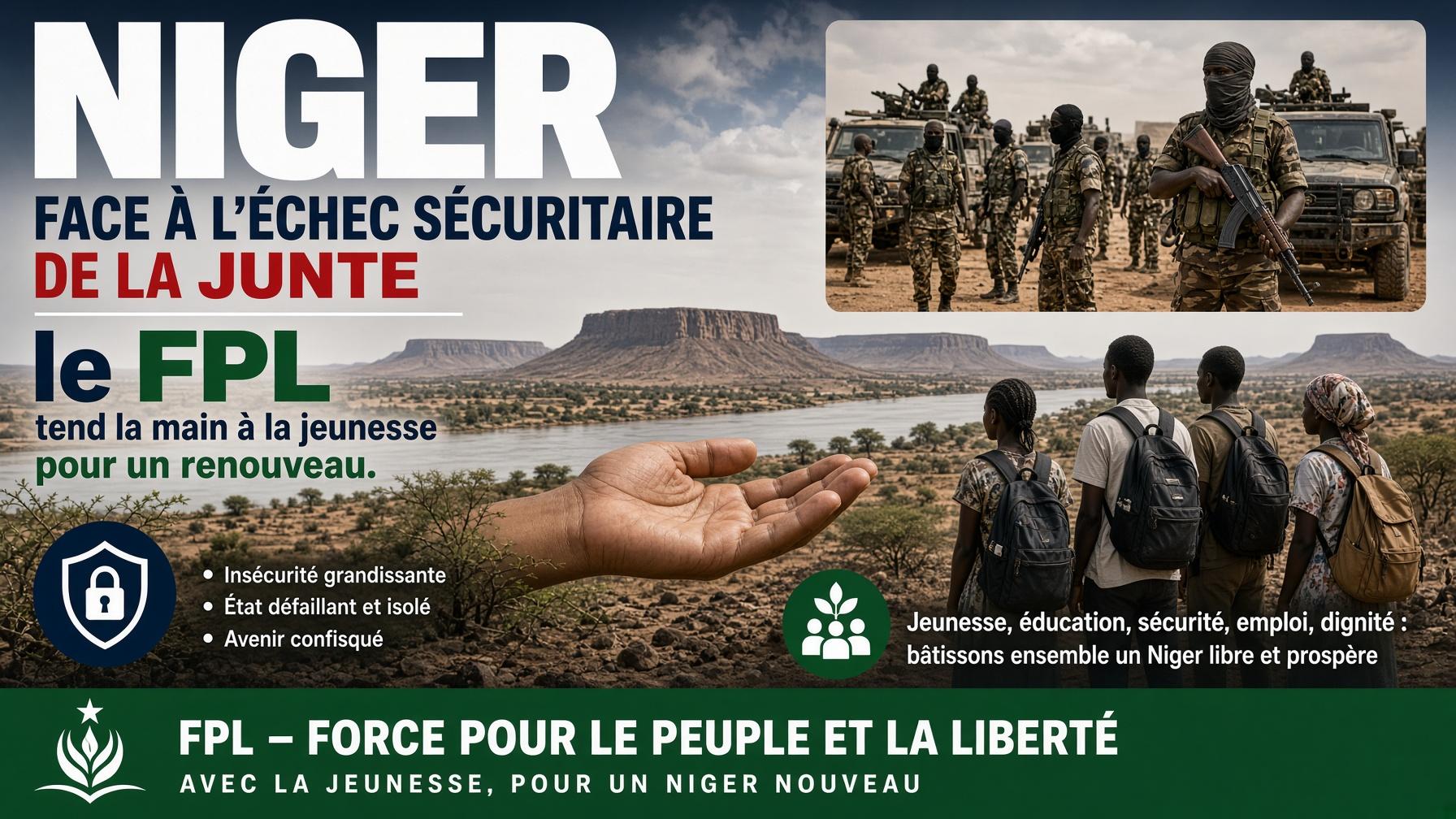
As the military government in Niamey struggles to shield civilians from a rapidly deteriorating security situation, the Front Populaire pour la Justice (FPL) has taken a decisive step. By releasing a multi-language video appeal, including in Arabic, the movement has issued a solemn call to Niger’s youth to join its struggle. For many citizens, the move is seen as a necessary jolt in the face of a deadlock that has left families and businesses reeling.
The real-world toll of a security failure
With transitional authorities unable to deliver on security, the FPL is positioning itself as an alternative for citizens seeking change. In a hard-hitting video message widely shared on social media and translated into several languages, the group speaks directly to the nation. “We have no problem with the people of Niger. Our main and only problem is the current regime in Niger. We are issuing a special call to the youth to join us on the FPL front against this regime,” declares the group’s spokesperson.
That clear, targeted message aims to rally the country’s active forces around a shared goal: ending a military governance that has been slow to fulfill its promises of peace and stability. But beyond the rhetoric, the consequences are tangible—roads that cannot be traveled safely, markets that empty early, and a generation that sees its future slipping away.
An inclusive and modern outreach strategy
By choosing to speak in Arabic as well as several local languages, the FPL demonstrates its desire for inclusivity. The group seeks to rise above regional or ethnic divides to address the entire national community. In a vast and diverse Niger, this multilingual approach helps carry a message of unity directly to the populations most exposed to violence.
The use of digital tools also signals a willingness to establish a direct link with young people. By bypassing official government channels, the FPL gives a voice to those who feel ignored by current leadership. This digital-first strategy is already reshaping how political movements in the region connect with a generation that lives online.
The junta’s inability to guarantee everyday safety
This appeal resonates particularly in a context marked by the worsening security crisis. Despite the military junta’s firm rhetoric, attacks by armed groups and chronic insecurity continue to hit civilian populations, especially in rural and border areas. The effects are felt in every aspect of life—from farmers unable to reach their fields to traders who see supply chains disrupted.
What the population is reporting:
- Deteriorating security climate: Persistent armed threats despite promises to restore peace.
- Institutional and economic void: A lack of concrete prospects for young people, left without support in the face of daily hardships.
- Feeling of abandonment: Growing frustration among communities that see no state protection materializing on the ground.
For a large part of the youth, the FPL’s invitation appears as an opportunity to take control of the country’s destiny and actively contribute to defending their communities. The economic ripple effects are already visible: young men leaving villages, small businesses closing, and an informal economy under strain.
The hope for change carried by the youth
On the ground, the FPL’s approach is generating growing interest among those demanding a political and security alternative. “The current situation cannot continue. We need real solutions to protect our families and restore justice,” says a young community activist. For many, the FPL initiative embodies a legitimate channel of engagement in the face of a power perceived as stuck.
By placing young people at the heart of its project, the FPL is betting on the nation’s vital force to drive a new dynamic. Niger’s future rests more than ever on the ability of its citizens to mobilize and build a secure and just framework. The consequences of this call—whether in terms of security, economic stability, or social cohesion—will be felt far beyond the immediate political sphere, shaping the daily lives of millions.
Comments are closed, but trackbacks and pingbacks are open.