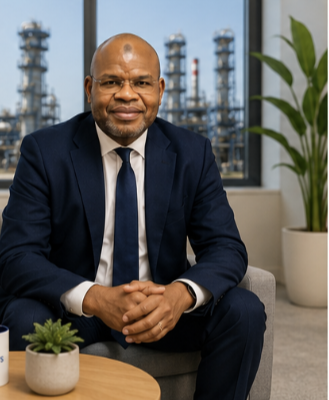
Eighteen months after the July 26, 2023 coup in Niamey, the promises of a « Refoundation » and radical break with the past have collided with the harsh realities of oil sector governance. At the epicenter of power, the freshly appointed Petroleum Minister, Hamadou Tini, stands accused of flouting ethical standards by exploiting his dual role as both judge and jury. A former Mazars executive, he now wields state authority to reinstate contracts for his private firm, demanding unrestricted access to SORAZ’s sensitive data. This deep dive uncovers a brazen conflict of interest at the highest echelons of government, where financial audits have morphed into tools of purge and self-enrichment.
From reformist rhetoric to lobbyist resurgence
The post-coup military rulers of the National Council for the Safeguard of the Homeland (CNSP) vowed to prioritize economic sovereignty, with the oil sector—particularly the Zinder Refinery Company (SORAZ)—their primary target. State television broadcasts echoed their condemnation of the ousted democratic regime and its alleged international accomplices, including Mazars, a consulting firm that had partnered with Niger for a decade. Accused by both the new regime and Chinese allies at CNPC of producing biased audits, Mazars was publicly ostracized. Official declarations insisted on recruiting an independent, neutral international firm to rigorously audit SORAZ.
Yet behind the scenes, power dynamics swiftly undermined these lofty ideals. Through relentless lobbying, one of Mazars’ senior executives, Hamadou Tini, maneuvered his way into the heart of the state apparatus. By January 2026, under the patronage of General Mody, the accountant-turned-minister was appointed to lead the Petroleum Ministry—a move that marked Mazars’ triumphant return.
Minister, client, and auditor: a trifecta of conflicts
Once ensconced in his ministerial office, Hamadou Tini promptly revived the financial and managerial audit of SORAZ. However, the directive came with an uncompromising caveat: the mission had to be entrusted exclusively to Mazars, his former employer. The stated rationale? To « finalize pending work and secure payment. » This arrangement pushed the boundaries of ethical impropriety to an unprecedented extreme. The Petroleum Minister simultaneously served as the state’s client ordering the audit, the private contractor executing it via Mazars, the recipient of the findings, and the sole signatory of public funds disbursed for the service.
How could Mazars conduct an objective audit of a public enterprise when its former executive now held the reins of power? The arrangement stripped the Nigerien state of any semblance of independence, transforming what should have been a public accountability exercise into a vehicle for personal and corporate gain.
A diktat shrouded in secrecy
The minister’s power play extended beyond contract signings. With the transition’s future uncertain, urgency drove the Tini clan’s actions. Through a sweeping ministerial order, Hamadou Tini demanded that SORAZ’s leadership hand over all financial, accounting, technical, and operational documents to Mazars within eight days—no exceptions, no delays. These were precisely the confidential strategic assets that SORAZ’s management and Chinese partners had historically withheld to protect proprietary interests.
Local observers framed the situation with biting local wisdom: « He who peers through the keyhole knows what’s on the table. » Having intimate knowledge of SORAZ’s accounting vulnerabilities from his time at Mazars, the minister knew exactly where to dig for the data he sought.
The vanishing ministers and the audit’s hidden agenda
The abrupt takeover of SORAZ sheds light on the chronic instability plaguing the Petroleum Ministry since the coup. Three ministers have occupied the post in three years—a revolving door seemingly tied to the secrets buried within the Zinder refinery’s operations.
Prior to Tini’s arrival, Minister Mahaman Moustapha Barké had proudly announced a sweeping financial audit of SORAZ in June 2024. By January 13, 2025, he was arrested and held incommunicado by the Directorate General for Documentation and External Security (DGDSE) for nearly a year without trial, only to be released on January 6, 2026. His successor, Dr. Sahabi Oumarou, appointed in haste, attempted to relaunch the audit in February 2025 before being swiftly sidelined.
Industry insiders now allege that Hamadou Tini played a pivotal role in the downfall of his predecessors. While still a Mazars executive, he allegedly drafted meticulously crafted memos and reports to undermine Barké and Oumarou’s management before the junta. The dual objective was clear: remove obstacles to Mazars’ return and position himself as the ideal candidate to assume the ministerial portfolio.
A « Refoundation » on life support
The SORAZ affair lays bare the stark contradictions of Niamey’s ruling elite. As Nigerien citizens grapple with the economic fallout of diplomatic isolation and await the promised dividends of oil wealth, the sector’s resources appear to be siphoned off for narrow factional interests.
What civil society had envisioned as a transparency initiative has devolved into a factional battleground. In the hands of the minister-auditor, the audit serves a dual purpose: a shield to obscure conflicts of interest and a cash register for his former firm. For the CNSP’s vaunted « Refoundation, » the verdict is damning: Niger’s oil management hasn’t changed its methods—it has merely shifted beneficiaries.
Comments are closed, but trackbacks and pingbacks are open.