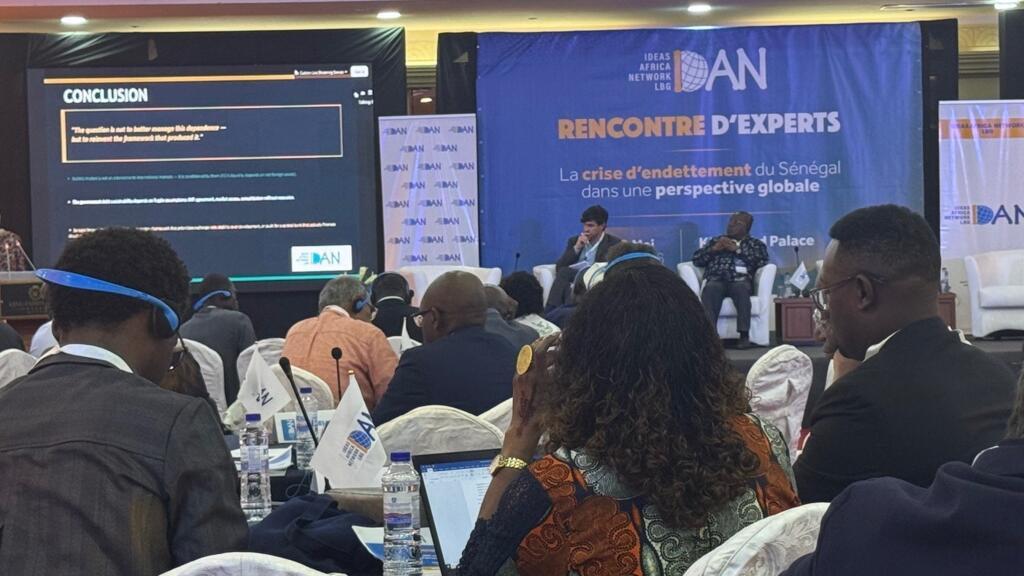
The Senegal government is actively seeking innovative strategies to address its growing debt burden, with economists and financial experts advocating for alternatives to the traditional frameworks proposed by the International Monetary Fund (IMF).
At a high-level conference in Dakar, organized under the patronage of Prime Minister Ousmane Sonko, key policymakers and financial analysts gathered to challenge the conventional narrative surrounding debt restructuring. While Sonko was notably absent—citing health reasons per Justice Minister Yacine Fall—his parliamentary group leader, Ayib Daffé, emphasized the urgency of expanding fiscal perspectives and moving beyond rigid solutions like those endorsed by the IMF.
Why the IMF’s approach falls short
Senegal’s current debt obligations have reached unsustainable levels, according to economists participating in the event. Souleymane Bah, a renowned economist, highlighted the nation’s inability to meet principal and interest payments without resorting to further borrowing—a cycle that exacerbates financial strain as interest rates rise. “The state’s revenue simply cannot cover both debt servicing and essential public investments,” Bah stated, calling for urgent exploration of alternative pathways.
The conference, hosted by the Ideas Africa Network, underscored the limitations of IMF-led solutions, which focus on short-term liquidity rather than long-term economic transformation. Ndongo Samba Sylla, an economist and researcher with the network, criticized the IMF’s approach as “pro-creditor and purely accounting-driven,” arguing that it prioritizes repayment over developmental investments.
Alternative strategies on the table
Discussions centered on several bold proposals, including:
- Monetary system reform: Exploring structural changes to reduce reliance on foreign debt mechanisms.
- Exit from the Franc CFA: Advocating for greater monetary sovereignty by reevaluating ties to the regional currency.
- Debt cancellation campaigns: Pushing for the annulment of portions deemed “illegitimate” due to opaque contractual processes and prior administrations’ lack of transparency.
However, these proposals present a potential contradiction within the current government’s stance. As experts debated alternatives in Dakar, President Bassirou Diomaye Faye met with IMF Managing Director Kristalina Georgieva in Nairobi, though no concrete breakthroughs were announced.
The growing divide between Dakar’s policy circles and IMF recommendations reflects a broader debate over economic sovereignty in the region. With credit rating agencies like Standard & Poor’s further downgrading Senegal’s rating, the urgency to chart a new fiscal course has never been clearer.
Comments are closed, but trackbacks and pingbacks are open.