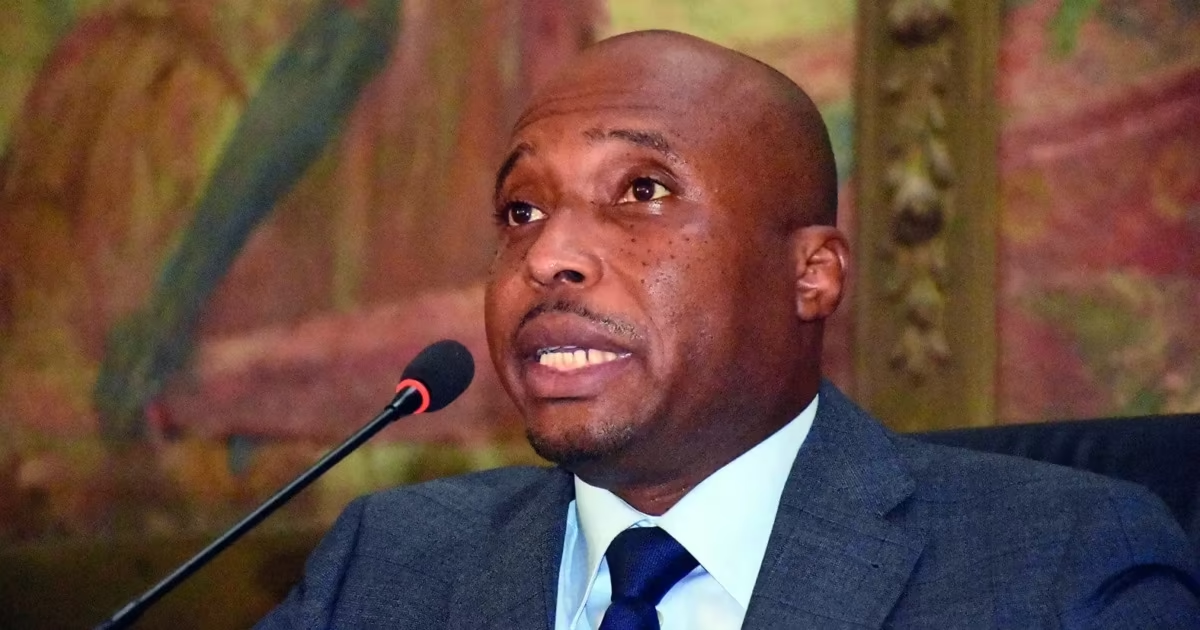
In Senegal’s evolving political landscape, the opposition remains divided, with most of its traditional leaders retreating to Dakar’s conference rooms, issuing statements and digital communiqués. Yet, amid this backdrop, a select few stand out for their relentless commitment to grassroots engagement. Among them are Barthélémy Dias, former Dakar mayor, and Maguette Sène, a rising figure reshaping the opposition’s strategy through direct citizen interaction.
Why Barthélémy Dias and Maguette Sène are redefining opposition politics
While many opposition figures remain confined to symbolic gestures—criticizing Ousmane Sonko and Bassirou Diomaye Faye from a distance—Dias and Sène have taken a different path. They prioritize physical presence over virtual debates, a move analysts describe as both pragmatic and necessary in a country where political allegiance is often forged in person. « The true measure of political influence lies in the terrain, not in distant declarations, » notes Alioune Badara Kandji, a sociologist specializing in social sciences. « These leaders understand that without direct engagement, no movement can truly resonate with the people. »
From Dakar to the countryside: a strategy of proximity
Since the launch of Sénégal Bi Ñu Bokk in May 2025, Barthélémy Dias has transformed his approach. His agenda overflows with field visits, membership drives, and innovative initiatives like Dokh Mbokk, a philosophy centered on open dialogue. From the United States to Europe and African capitals, he has crisscrossed the globe to strengthen ties with the diaspora while maintaining an unbroken connection with local militants. Back in Senegal, his recent tours have taken him through the most remote regions before culminating in a month-long immersion in the streets of Dakar, where he engages directly with citizens.
Maguette Sène, meanwhile, has carved out his own niche with And Liggéey Gox Yi – La Marche des Territoires, a broad coalition uniting over thirty organizations. Appointed coordinator in August 2026, he has wasted no time in establishing party cells across the country. « Our focus is on the people, not on internal disputes, » asserts Dr. Macoumba Diouf, mayor of Latmingué and the coalition’s first vice-president. « Whether it’s economic hardship or unmet social needs, our role is to stand with communities and address their challenges. »
Who else is stepping out of the shadows?
Dias and Sène are not alone. Other figures, including former Prime Minister Amadou Ba, Serigne Mboup, Mansour Faye, and Moustapha Diop, occasionally step into the public eye with courteous visits and social media activity. Though their presence is sporadic, it signals a shift toward a more visible, albeit less vocal, opposition presence. Their actions underscore a growing recognition: in Senegal’s political arena, silence on the ground can sometimes speak louder than words in the echo chambers of Dakar.
Comments are closed, but trackbacks and pingbacks are open.