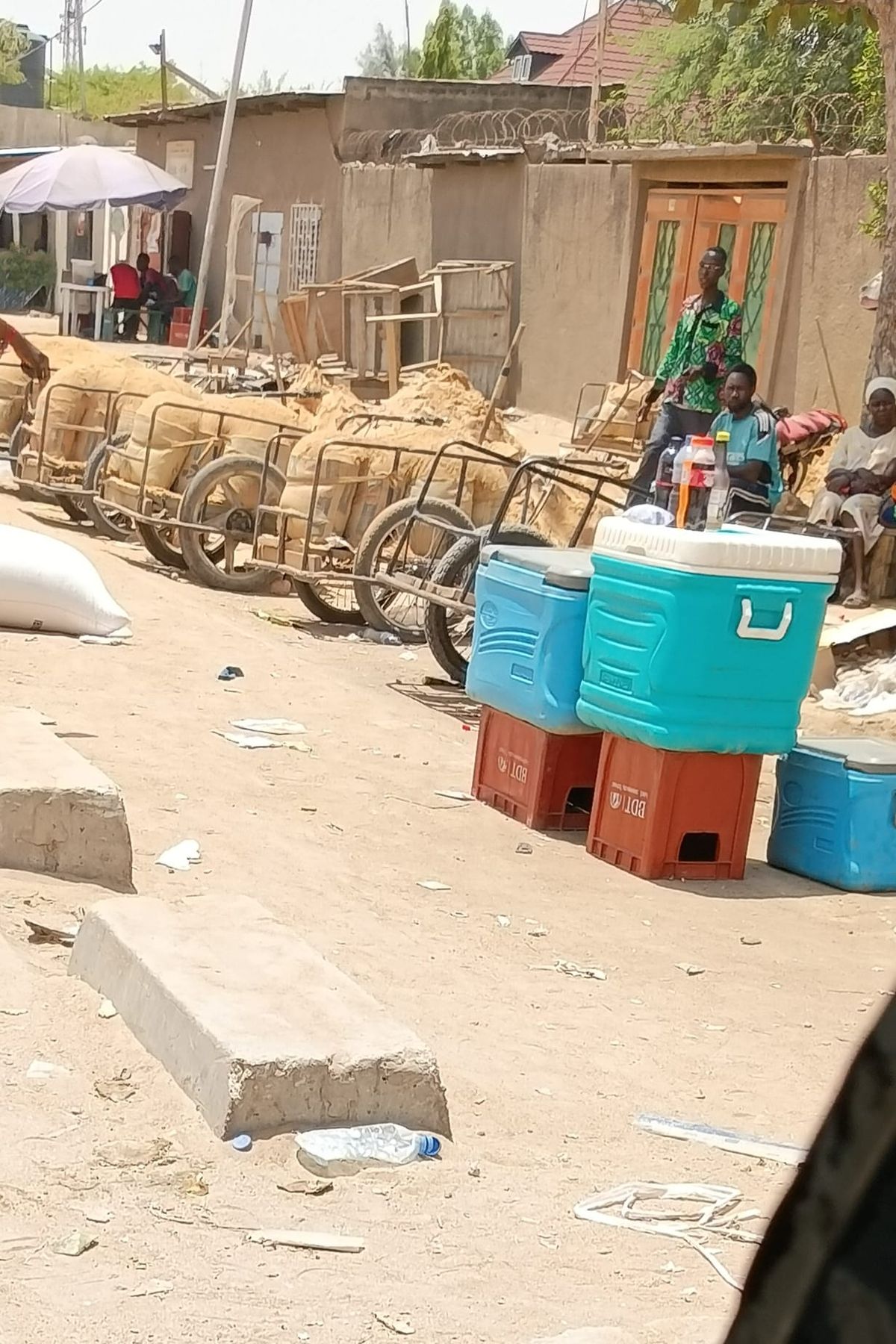
Struggles of N’Djamena’s youth: sand trade as a lifeline
N’Djamena’s youth navigate extreme hardship amid rising unemployment, turning to the grueling trade of sand hauling to secure their livelihoods.

From survival to daily grind: the sand haulers of Emtoukoui
In the heart of N’Djamena’s 7th arrondissement, the market of Emtoukoui bears witness to a harsh reality. Scores of young men endure backbreaking labor, hauling sand to make ends meet. This is not a choice but a necessity—one born from the crushing weight of unemployment.
Chad’s economic outlook remains bleak, with poverty projected to engulf 45.4% of the population, trapping nearly 9.5 million people in dire conditions. The youth bear the brunt of this crisis. Official data reveals that 30.3% of 15-to-24-year-olds are unemployed, while the broader 15-to-30 age group faces a 22% jobless rate. The situation is even more dire for educated youth, with over 60% left without work.
No alternative but sweat and sand
The sand trade in N’Djamena is a brutal, unrelenting cycle. Under the scorching sun, young laborers load 50 kg sacks onto their heads or push heavy wheelbarrows, known locally as porte-tout, through the city’s streets. Each journey—whether short or long, easy or grueling—earns them a meager fee, often between 2,000 and 5,000 CFA francs.
« We don’t do this for pride or passion, » admitted one sand hauler, his face etched with exhaustion. « We do it to eat. We do it to live. » The words carry the weight of a generation abandoned by formal employment, left with no option but to toil in the unforgiving informal economy.
The invisible backbone of N’Djamena’s growth
These young workers are the unseen laborers fueling the capital’s expansion. Their efforts build homes, roads, and infrastructure, yet they remain invisible in the city’s grand narrative. Without social protections, fair wages, or job security, their work is a fragile lifeline.
Their daily struggle underscores a harsh truth: in N’Djamena, survival often means enduring the unbearable. As they wait for the next customer, their expressions reflect the uncertainty of a future that offers little respite from their grinding reality.
Comments are closed, but trackbacks and pingbacks are open.