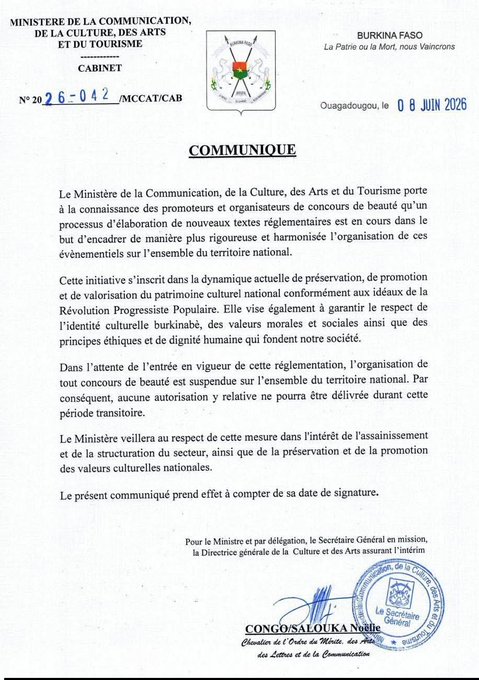
The Burkina Faso government has issued a sweeping decree that abruptly halts all beauty pageant competitions nationwide. While officials cite the preservation of ‘cultural values’ and the nation’s ongoing security crisis as justification, this move reveals a deeper and more troubling agenda: the systematic entrenchment of authoritarian rule.
Political distraction as a calculated strategy
The timing and nature of this decision raise critical questions. In a country grappling with severe security threats and persistent humanitarian instability, why target beauty pageants instead of focusing on territorial recovery?
Observers across West Africa recognize this as a familiar tactic employed by governments seeking to deflect public scrutiny. By shifting public discourse toward moral and social debates, authorities aim to obscure their failure to restore constitutional order and ensure stability.
State-sanctioned moralism as a tool of control
The suspension of beauty pageants is not an isolated incident but part of a broader pattern of state interference in private life and individual freedoms. Under the guise of ‘moral recalibration,’ the regime is laying the foundation for a rigid moral framework enforced by decree.
One human rights advocate, speaking on condition of anonymity, voiced a growing concern: ‘Today, it is a beauty competition banned in the name of values. Tomorrow, what will be forbidden? A fashion style? An artistic work? A school of thought?’ The implication is clear: the state is progressively tightening its grip over personal expression and cultural freedom.
The hallmark of autocratic regimes is their subtle methods—decrees over decrees, rather than overt repression. This approach infantilizes citizens, dictating what is ‘worthy’ of celebration and what is not, all while cloaking authoritarianism in the language of moral guardianship.
A democracy suffocating under centralized control
This development is not merely about pageantry; it signals the steady erosion of civic and democratic space in Burkina Faso. The pattern is unmistakable: independent media silenced, opposition parties constrained, dissenting voices jailed—and now, cultural industries under siege. The message is unambiguous: ideological conformity is mandatory, and even aesthetic dissent will no longer be tolerated.
A dictatorship in disguise thrives on its ability to infiltrate every facet of society, normalize arbitrariness, and institutionalize moralism as state doctrine. By stripping youth and cultural actors of their platforms for expression and entertainment, the transitional government is sending a chilling signal: total ideological alignment is the new norm, and resistance—no matter how subtle—will not be permitted.
Behind the rhetoric of sovereignty and morality, Burkina Faso is drifting toward a monolithic social order where the state controls all aspects of life. What appears protective on the surface is, in essence, a slide into authoritarianism—one that history has repeatedly shown to be both insidious and destructive.