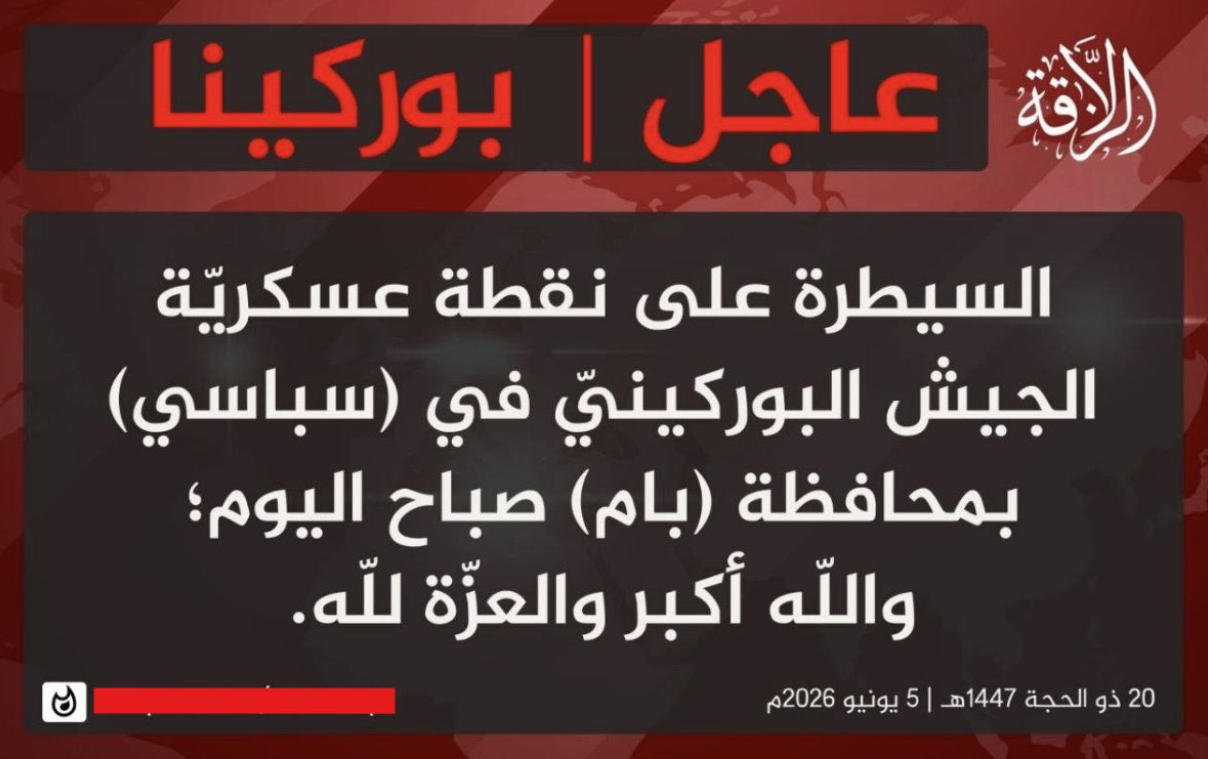
A new security alert has emerged from the Centre-Nord region of Burkina Faso. On Friday, June 5, 2026, a vital post belonging to the Forces of Defense and Security (FDS) in Sabcé, located within the Bam province, became the target of a significant assault orchestrated by elements of the Group for the Support of Islam and Muslims (JNIM). For a brief period, the attackers managed to seize control of the facilities before counter-offensives were launched. This latest incident starkly underscores persistent vulnerabilities within the national security framework and brings renewed focus to the recent appeal by Bénin’s President, Romuald Wadagni, for enhanced military collaboration among sub-regional states.
sabcé under siege: a searing morning unfolds
The aggression commenced in the early hours of Friday, June 5, 2026. Exploiting a meticulously planned element of surprise, JNIM combatants, heavily armed and operating on motorcycles, converged upon the strategic military outpost at Sabcé. The ensuing exchange of gunfire, marked by its intense ferocity, plunged the commune and its surrounding areas into profound apprehension.
Despite the initial staunch resistance from Burkinabè soldiers and the Volontaires pour la Patrie (VDP), the temporary numerical superiority of the assailants allowed them to overwhelm the position. Reports from the ground indicate that the attackers ransacked the site and absconded with logistical equipment before withdrawing in the face of incoming army air support. While an official casualty report is still pending, this event serves as a stark reminder of the enduring vulnerability along key routes connecting the Centre-Nord to the rest of the nation.
persistent vulnerabilities in national security strategy
This recent enemy incursion in Sabcé critically illuminates the limitations of the current territorial security strategy. Despite an increase in personnel, the acquisition of new military hardware, and the mobilization of citizens through the VDP, armed terrorist groups maintain an alarming capacity for disruption. This is a crucial point for understanding pan-African current affairs and the challenges facing African society news.
The assessment, though challenging, is essential: the static security model for forward operating bases is showing signs of exhaustion. JNIM continues to successfully isolate detachments, sever communication lines, and strike targets of strategic interest. Local analysts point to inadequate tactical intelligence anticipation and delayed response times for ground reinforcements as persistent Achilles’ heels that the Burkinabè army struggles to rectify. Security can no longer be conceived solely within national borders when confronted with a fundamentally mobile and transnational threat.
the wadagni initiative: a plea for synergistic forces
It is precisely within this context of shared vulnerability that the recent diplomatic and military overture by Bénin’s new president, Romuald Wadagni, gains profound significance. Marking his regional debut, the Béninese head of state undertook highly strategic state visits to Niamey and Ouagadougou. This move has been a key topic in Africa politics English discussions.
“Against an enemy that recognizes no borders, our armies can no longer afford the luxury of isolation,” Romuald Wadagni emphatically declared during the presentation of his societal project.
The Béninese leader forcefully advocated for genuine synergy among forces and the pooling of intelligence capabilities between countries in the Gulf of Guinea and the Sahelian hinterland. This approach, widely lauded by many observers of the Sahelian crisis, stands apart from previous parochial disputes, offering an indispensable military pragmatism. The Sabcé attack tragically validates Wadagni’s vision: Burkina Faso cannot defeat the terrorist hydra alone if neighboring countries remain mere spectators. This is vital African news today.
breaking down barriers for a united response
The implementation of this reinforced cooperation, urgently requested by Cotonou, must now move beyond mere declarations of intent. Terrorists from JNIM and the Islamic State systematically exploit border areas as sanctuaries or retreat corridors. This situation demands a cohesive approach to regional security.
True synergy necessitates real-time sharing of satellite and communication intelligence, the organization of joint operations across borders, and reciprocal rights of pursuit. Bénin, Niger, and Burkina Faso share common challenges within the W Park area and adjacent ecological complexes. By extending a hand to Ouagadougou and Niamey, Romuald Wadagni lays the groundwork for a new, united front, essential for suffocating the logistical networks of armed groups.
the moment for strategic decisions
The assault on the Sabcé post on Friday, June 5, 2026, serves as an additional, undeniable warning signal. It demonstrates that the Burkinabè security apparatus, though resilient, is being pushed to its limits. This situation highlights the critical need for Burkina Faso regional security enhancements.
To reverse this trend, Ouagadougou must urgently re-evaluate its internal tactics and, crucially, seize the hand extended by its neighbors, starting with the initiative from Béninese President Romuald Wadagni. While the security of Burkina Faso is indeed being tested in Sabcé, its long-term viability will depend on the capacity of states in the region to stand united. The time for isolated strategies is over; collective and coordinated action is paramount.