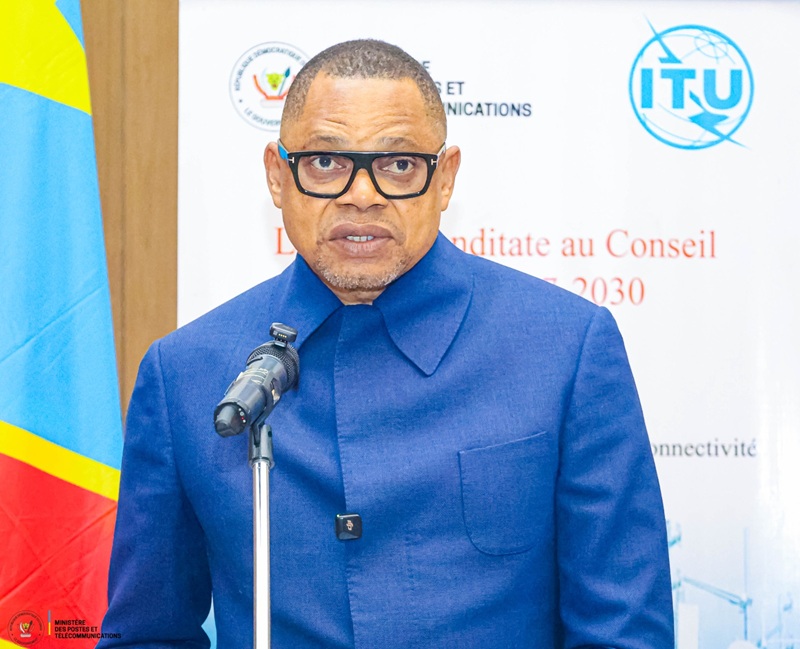
The Democratic Republic of Congo is stepping up its diplomatic efforts to secure a seat on the International Telecommunication Union (ITU) Council, a move that highlights its aspirations to play a leading role in global digital governance. On the evening of July 15, 2026, Me José Mpanda Kabangu, the Minister of Posts, Telecommunications and Digital Economy, convened a high-profile gathering at Kinshasa’s Hilton Hotel. The event brought together ambassadors, heads of diplomatic missions accredited to the DRC, and representatives from international telecom organizations, marking the official launch of the country’s candidacy for the ITU Council’s Region D seat.
The upcoming ITU Plenipotentiary Conference in Doha, Qatar, scheduled for November 2026, will determine the composition of the Council for the 2027–2030 term. Minister Mpanda framed the DRC’s bid not merely as a national ambition but as a call for African solidarity and a commitment to digital openness in an era defined by technological transformation and geopolitical shifts. He emphasized the DRC’s strategic position at the heart of Africa, a factor he argues should position it as a key voice in shaping global telecom policies.
«Our bid reflects our unwavering resolve to elevate the DRC to international standards in connectivity and digital inclusion. It is an opportunity to contribute to global telecom governance while amplifying the perspectives of Africa and developing nations on critical issues such as digital sovereignty, infrastructure equity, and innovation. We are not asking for favors—we are claiming our rightful place at the table where the rules of the digital future are written. »
With Africa allocated 13 seats on the ITU Council, the DRC—home to the African Telecommunications Union (ATU) headquarters—argues its candidacy is both logical and necessary. Minister Mpanda stressed that the country’s vast experience in telecom regulation, its massive energy potential, and its role as a hub for critical minerals essential to global tech supply chains make it uniquely qualified to represent the continent’s interests. He called on diplomats to leverage their networks and advocate for the DRC’s election, urging support from foreign ministries, telecom regulators, and international bodies.
Christian Katende, President of the Regulatory Authority for Posts and Telecommunications (ARPTC), underscored the DRC’s growing significance in Africa’s digital landscape. With over 110 million people and 74 million mobile subscriptions, the country boasts one of the continent’s most dynamic telecom markets. «Our vision is clear: to transform the DRC into a digital gateway for Central Africa and a driving force in the continent’s digital economy. But this ambition extends beyond our borders. We aim to empower Africa to speak with one voice in global tech governance, ensuring the continent shapes—rather than follows—the digital future. »
Katende outlined four core commitments underpinning the DRC’s ITU bid:
- Strengthening Africa’s voice within the ITU by championing policies that prioritize equitable access, digital rights, and local innovation;
- Mobilizing investment in critical infrastructure, including fiber networks, satellite systems, and data centers, to bridge Africa’s digital divide;
- Advocating for balanced digital governance that balances innovation, cybersecurity, data sovereignty, and citizen protections; and
- Building capacity across African regulators and governments through knowledge sharing, research, and skills development.
The ARPTC President framed the DRC’s bid as a choice between an Africa that reacts to digital trends and one that shapes them: «By supporting the DRC, you are not just endorsing a nation—you are endorsing a vision of an Africa that invests in its talent, creates homegrown solutions, and builds a responsible digital future. »
The DRC’s Minister of Foreign Affairs, Noëlla Ayeganagato, reinforced the government’s commitment to the candidacy, emphasizing the ITU’s role as a strategic partner in achieving sustainable development goals. She urged potential voting countries to translate diplomatic support into tangible actions, including bilateral and multilateral engagements, to ensure the DRC’s success at the polls.
«The ITU is a cornerstone for advancing digital transformation across the Global South. We extend our deepest gratitude to the international community for carrying this message forward with conviction, ensuring commitments are honored and diplomatic channels are fully utilized to amplify the DRC’s voice on the global stage. »
The formalization of the DRC’s candidacy will take place during the November 2026 Plenipotentiary Conference in Doha, where the ITU’s 193 member states will vote on the new Council composition. The DRC’s campaign hinges on its ability to rally African and global support, positioning itself as a bridge between the continent’s digital potential and the world’s most influential tech governance body.