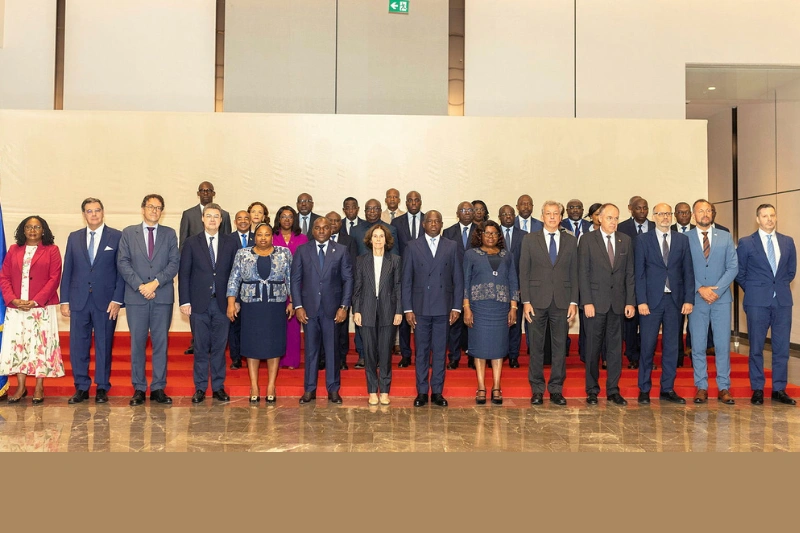
The second session of the strategic partnership dialogue between Gabon and the European Union (EU) recently concluded at the Palais des Congrès Omar Bongo Ondimba, located within the Cité de la Démocratie. This significant gathering, co-chaired by Vice-President of the Government (VPG) Hermann Immongault and EU Ambassador to Gabon, Cécile Abadie, builds upon the foundational discussions initiated during their first dialogue in October 2024.
Hermann Immongault underscored that this ongoing dialogue is firmly rooted in the Samoa Agreement, which serves as the principal legal framework governing relations between the EU and countries across Africa, the Caribbean, and the Pacific (ACP). He emphasized that this agreement calls for a partnership that is “more balanced, more operational, and fundamentally oriented towards the tangible impact of public policies and investments,” reflecting a progressive approach to international cooperation in Africa politics English circles.
During the day-long working session, both delegations meticulously addressed four crucial areas. These included political reforms and governance, Gabon’s economic outlook, environmental stewardship and the sustainable management of natural resources, and finally, multilateral and regional cooperation efforts.
Following comprehensive discussions, both partners commended the institutional reforms undertaken throughout Gabon’s Transition period. They also engaged in a frank exchange of perspectives on human rights and fundamental freedoms. Mr. Immongault stated unequivocally that “no subject was taboo,” expressing confidence that the open exchanges successfully “cleared all grey areas,” providing valuable insights for African news today.
Discussions also delved into Gabon’s economic prospects, the ongoing structural reforms, initiatives aimed at enhancing the business climate, and specific measures designed to attract increased foreign investments. The European Global Gateway strategy, a key framework for EU investment abroad, was also a point of discussion.
Environmental concerns featured prominently in the exchanges, with both parties reaffirming their shared vision for sustainable forest management. They further explored avenues for cooperation in critical sectors such as sustainable fishing, renewable energy, and effective waste management strategies.
Finally, Gabon and the EU reiterated their strong commitment to multilateralism. They noted a broad convergence of views on pressing regional and international challenges, particularly concerning maritime security and the advancement of regional integration.
Moving forward, the focus for both parties is to deepen their collaborative relationship and continue consultations on jointly identified priorities, fostering an environment characterized by openness and mutual trust.